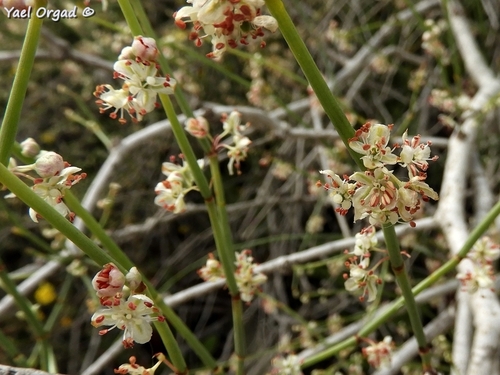
Persicaria hydropiper
(L.) Delarbe
Water pepper, Marshpepper Smartweed

no rights reserved, uploaded by Татьяна Горбушина
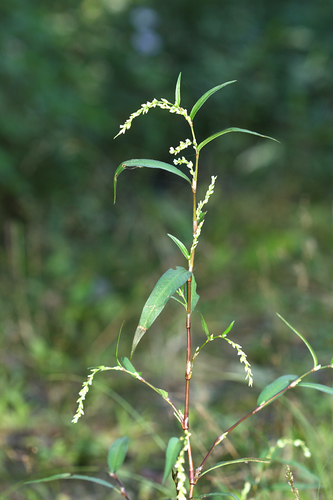
(c) V.S. Volkotrub, some rights reserved (CC BY-NC), uploaded by V.S. Volkotrub
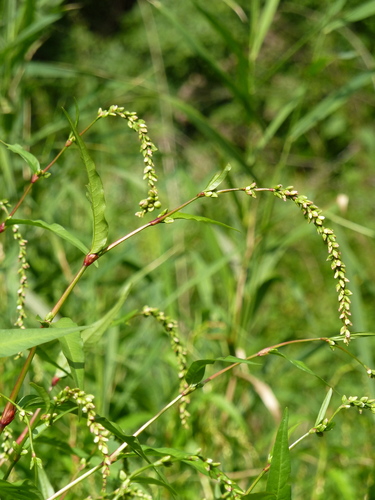
(c) Serge M. Appolonov, some rights reserved (CC BY-NC), uploaded by Serge M. Appolonov
What to Eat
Edible parts: Leaves, Seeds, Leaves - spice, Leaves - tea
Young leaves and stems are eaten, with a strong peppery flavor used as a seasoning; they are finely chopped for flavoring. Stalks are roasted, peeled, and eaten. The acrid juice serves as a spice. Young seedlings are used as a garnish. Leaves can be dried for tea.
Known Hazards
Where to Find It
It is a temperate plant. It grows in shallow water along the edges of creeks and rivers. It grows in wetlands. It grows in open waste places. It suits sunny wet locations. It can grow from the seashore to 1500 m altitude. Tasmania Herbarium. In Yunnan. In Sichuan.
Asia, Australia, Balkans, Bangladesh, Bhutan, Bosnia, Britain, Canada, Central Asia, China, Europe, Himalayas, India, Indochina, Indonesia, Japan, Kazakhstan, Korea, Kyrgyzstan, Luxembourg, Macedonia, Malaysia, Mongolia, Myanmar, Nepal, North America, Northeastern India, Pacific, Pakistan, Philippines, Russia, SE Asia, Sikkim, Slovenia, Sri Lanka, Tajikistan, Tasmania, Thailand, USA, Uzkebistan, Vietnam,
How to Identify
An annual herb. The stems are erect and curve upwards. It can be 80-100 cm tall. The stem has many branches. It forms roots at the nodes. The nodes are enlarged and they have a red ring at the base. The leaves are alternate and narrowly sword shaped. They have glands. The leaves narrow towards their base. The leaves have a peppery taste when chewed. There is a stipule or leaf like structures at the base of the leaf stalk. This has bristles. The leaf stalk is 2-5 mm long. The blade is sword shaped and 2-8 cm long by 0.5-2 cm wide. The flowers are in a slender spike. The spike is spread along the stalk. It tends to bend over. The flowering shoots can be 17 cm long. The individual flowers are small and white. There are 2 subspecies suited to temperate and tropical locations.
How to Grow
Persicaria hydropiper is a very widespread plant, found growing from the cold temperate zone to the tropics. Two subspecies are sometimes distinguished - subsp. hydropiper is found in temperate climates, all parts are larger and the fruits are mostly 2-sided, whilst subsp. microcarpa (Danser) Soják is found in tropical climates, all parts are smaller and the fruits are usually 3-sided. A water plant, growing in shallow water or wet soils. Succeeds in most soils if they are wet and dislikes shade. Plants seem to be immune to the predations of rabbits.
Propagation: Seed - sow in a pot standing in water or in situ. Germination is usually free and easy. When they are large enough to handle, prick the seedlings out into individual pots and plant them out when large enough
Medicinal Uses
Water pepper is eaten in Japan, where it is known as tade (蓼), or more specifically, yanagi tade (柳蓼). The leaves of cultivated plants are used as a vegetable, as the wild type has a far more pungent taste. The herb is usually sold in markets as seedlings. Young red sprouts are known as beni-tade (紅蓼), and are used to garnish sashimi, tempura, and sushi. It is popular for summer cooking. The seeds may also be added to wasabi. Water pepper sauce, known as tade-zu (蓼酢), is a sauce traditionally made from finely chopped water pepper leaves, soaked in vinegar, and a small amount of steamed rice. Occasionally, the juice from a squeezed kabosu is added. In Japanese cuisine it is traditionally used as a complement to grilled freshwater fish, but not saltwater fish. In China, water pepper is known as là liǎo (辣蓼) or shuǐ liǎo (水蓼), and used in traditional Chinese medicine. In Indian traditional medicine, leaves of P. hydropiper are used against intestinal helminth infections. A study has proved that P. hydropiper leaves possess noteworthy anthelmintic efficacy and justify their use in traditional medicine against intestinal worms. DOI: 10.1007/s12639-022-01559-2 In Europe, water pepper was once cultivated and eaten during war time as a substitute for pepper. The plant contains many acids, including formic acid, which makes it unpalatable to livestock. Though mammals do not eat wild water pepper, some insects do, giving rise to the Japanese saying "Tade kuu mushi mo sukizuki" (蓼食う虫も好き好き "Some insects eat water pepper and like it"), which may be translated as "There is no accounting for taste" or "Each to his own."
Other Uses
A yellow-gold dye is obtained from the stalks.
Wikipedia
Source ↗Persicaria hydropiper (syn. Polygonum hydropiper), also known as water pepper, marshpepper knotweed, arse smart or tade, is a plant of the family Polygonaceae. A widespread species, Persicaria hydropiper is found in Australia, New Zealand, temperate Asia, Europe and North America. The plant grows in damp places and shallow water. Cultivated varieties are eaten in East Asia for their pungent flavor.
Other Information
It is used as a hot spicy pepper for seaweeds in Japan. It is sold in local markets in China.
Notes
Chemical composition (Chinese sample): Protein = 7.54%. Fat = 1.86%. Carbohydrate = 7.99%. Ash = 1.99%. There are about 50 Polygonum species.
Names & Synonyms
Agagat, An ji ba qian, Behu, Bislangi, Buding, Cacabean, Chaokhong, Common smartweed, Daun senahun, Ganeri, Ngh(eer) n(uw)(ows)c, Ngh(eer) r(aw)m, Numshim-muk, Packur mul, Pani-maricha, Papreni lisac, Pha chi mi, Phak phai nam, Pungent smartweed, Ram-nuoc, Ratnaulo, Rumput tuboh, Si tuba sawah, Smartweed, Tade, Tuba, Tube seluwang, Water pepper, Yanagi-tade
References (56)
- Altschul, S.V.R., 1973, Drugs and Foods from Little-known Plants. Notes in Harvard University Herbaria. Harvard Univ. Press. Massachusetts. no. 848 (As Polygonum hydropiper)
- Ambasta, S.P. (Ed.), 2000, The Useful Plants of India. CSIR India. p 480 (As Polygonum hydropiper)
- Arora, R. K., 2014, Diversity in Underutilized Plant Species - An Asia-Pacific Perspective. Bioversity International. p 44 (As Polygonum hydropiper)
- Bodkin, F., 1991, Encyclopedia Botanica. Cornstalk publishing, p 819 (As Polygonum hydropiper)
- Burkill, I.H., 1966, A Dictionary of the Economic Products of the Malay Peninsula. Ministry of Agriculture and Cooperatives, Kuala Lumpur, Malaysia. Vol 2 (I-Z) p 1823 (As Polygonum hydropiper)
- Cerne, M., 1992, Wild Plants from Slovenia used as Vegetables. Acta Horticulturae 318. (As Polygonum hydropiper)
- Chen, B. & Qiu, Z., Consumer's Attitudes towards Edible Wild Plants, Ishikawa Prefecture, Japan. p 24 www.hindawi.com/journals/ijfr/aip/872413.pdf (As Polygonum hydropiper)
- Cherikoff V. & Isaacs, J., The Bush Food Handbook. How to gather, grow, process and cook Australian Wild Foods. Ti Tree Press, Australia p 196 (As Polygonum hydropiper)
- Cooper, W. and Cooper, W., 2004, Fruits of the Australian Tropical Rainforest. Nokomis Editions, Victoria, Australia. p 404
- Cribb, A.B. & J.W., 1976, Wild Food in Australia, Fontana. p 126 (As Polygonum hydropiper)
- Curtis, W.M., 1993, The Student's Flora of Tasmania. Part 3 St David's Park Publishing, Tasmania, p 590 (As Polygonum hydropiper)
- Deka, N. & Devi, N., 2015, Wild edible aquatic and marshland angiosperms of Baka district, BTC area, Assam, India. Asian J. Plant Sci. Res. 5(1):32-48
- Duke, J.A., 1992, Handbook of Edible Weeds. CRC Press. p 154 (As Polygonum hydropiper)
- Elliot, W.R., & Jones, D.L., 1997, Encyclopedia of Australian Plants suitable for cultivation. Vol 7. Lothian. p 204
- Facciola, S., 1998, Cornucopia 2: a Source Book of Edible Plants. Kampong Publications, p 185
- Flora of Pakistan. www.eFloras.org
- Foo, J.T.S.(ed), 1996, A Guide to Common Vegetables. Singapore Science Foundation. p 124 (As Polygonum hydropiper)
- Hani Medicine of Xishuangbanna, 1999, p 103 (As Polygonum hydropiper)
- Hist. nat. veg. 10:536. 1841
- Hu, Shiu-ying, 2005, Food Plants of China. The Chinese University Press. p 372 (As Polygonum hydropiper)
- Huq, A. K. M. M., Jamal, J. A. and Stanslas, J., 2014, Ethnobotanical, Phytochemical, Pharmacological, and Toxicological Aspects of Persicaria hydropiper (L.) Delarbre, Evidence-Based Complementary and Alternative Medicine, pp.1-5.
- IRVINE, (As Polygonum hydropiper)
- Irving, M., 2009, The Forager Handbook, A Guide to the Edible Plants of Britain. Ebury Press p 174
- Kiple, K.F. & Ornelas, K.C., (eds), 2000, The Cambridge World History of Food. CUP p 1797 (As Polygonum hydropiper)
- Kumar, Y J. et al, 1987, Further Contribution to the Ethnobotany of Meghalaya: Plants used by "War jaintia" of Jaintia Hill District. Econ. Tax. Bot. Vol 11 No. 1 pp 65- (As Polygonum flaccidum)
- Lamp, C & Collet F., 1989, Field Guide to Weeds in Australia. Inkata Press. p 225 (As Polygonum hydropiper)
- Larkcom, J., 1991, Oriental Vegetables, John Murray, London, p 130 (As Polygonum hydropiper)
- Lazarides, M. & Hince, B., 1993, Handbook of Economic Plants of Australia, CSIRO. p 194 (As Polygonum hydropiper)
- Li, D. et al, 2017, Ethnobotanical survey of herbal tea plants from the traditional markets in Chaoshan, China. Journal of Ethnopharmacology. 205 (2017) 195-206 (As Polygonum hydropiper)
- Low, T., 1992, Bush Tucker. Australia’s Wild Food Harvest. Angus & Robertson. p 185 (As Polygonum hydropiper)
- Luo, B., et al, 2019, Wild edible plants collected by Hani from terraced rice paddy agroecosystem in Honghe Prefecture, Yunnan, China. Journal of Ethnobiology and Ethnomedicine 15:56 (As Polygonum hydropiper)
- MacKinnon, A., et al, 2009, Edible & Medicinal Plants of Canada. Lone Pine. p 322
- Martin, F.W. & Ruberte, R.M., 1979, Edible Leaves of the Tropics. Antillian College Press, Mayaguez, Puerto Rico. p 99, 214 (As Polygonum hydropiper)
- Masoodi, H. U. R. & Sundriyal, R. C., 2020, Richness of non-timber forest products in Himalayan communities—diversity, distribution, use pattern and conservation status. Journal of Ethnobiology and Ethnomedicine 16:56
- Meitei, L. R., et al, 2022, An ethnobotanical study on the wild edible plants used by forest dwellers in Yangoupokpi Lokchao Wildlife Sanctuary, Manipur, India. Ethnobotany Research and Application 23:15
- Moerman, D. F., 2010, Native American Ethnobotany. Timber Press. p 424
- Pham-Hoang Ho, 1999, An Illustrated Flora of Vietnam. Nha Xuat Ban Tre. p 749 (As Polygonum hydropiper)
- Plants for a Future database, The Field, Penpol, Lostwithiel, Cornwall, PL22 0NG, UK. http://www.scs.leeds.ac.uk/pfaf/ (As Polygonum hydropiper)
- PROSEA handbook Volume 13 Spices. p 259
- Rana, D., et al, 2019, Ethnobotanical knowledge among the semi-pastoral Gujjar tribe in the high altitude (Adhwari’s) of Churah subdivision, district Chamba, Western Himalaya. Journal of Ethnobiology and Ethnomedicine (2019) 15:10
- READ, (As Polygonum hydropiper)
- Redzic, S. J., 2006, Wild Edible Plants and their Traditional Use in the Human Nutrition in Bosnia-Herzegovina. Ecology of Food and Nutrition, 45:189-232 (As Polygonum hydropiper)
- Romanowski, N., 2007, Edible Water Gardens. Hyland House. p 77
- Savita, et al, 2006, Studies on wild edible plants of ethnic people in east Sikkim. Asian J. of Bio Sci. (2006) Vol. 1 No. 2 : 117-125 (As Polygonum hydropiper)
- Shikov, A. N. et al, 2017, Traditional and Current Food Use of Wild Plants Listed in the Russian Pharmacopoeia. Frontiers in Pharmacology. Vol. 8 Article 841
- Swapna, M. M. et al, 2011, A review on the medicinal and edible aspects of aquatic and wetland plants of India. J. Med. Plants Res. 5 (33) pp. 7163-7176 (As Polygonum hydropiper)
- Tasmanian Herbarium Vascular Plants list p 45
- Terra, G.J.A., 1973, Tropical Vegetables. Communication 54e Royal Tropical Institute, Amsterdam, p 68 (As Polygonum hydropiper)
- van Wyk, B., 2005, Food Plants of the World. An illustrated guide. Timber press. p 286
- Wang, J. et al, 2013, A Study on the Utilization of Wild Plants for Food in Liangshan Yi Autonomous Prefecture. Plant Diversity and Resources. 35(4): 416-471 (As Polygonum hydropiper)
- Williams A. & Sides, T., 2008, Wiradjuri Plant Use in the Murrumbidgee Catchment. Murrumbidgee Catchment Management Authority. Wagga Wagga, p 90
- World Checklist of Useful Plant Species 2020. Royal Botanic Gardens, Kew
- Wujisguleng, W., & Khasbagen. K., 2010, An integrated assessment of wild vegetable resources in Inner Mongolian Autonomous Region, China. Journal of Ethnobiology and Ethnomedicine 6:34 (As Polygonum hydropiper)
- www.eflora.org Flora of China (As Polygonum hydropiper)
- Xu, You-Kai, et al, 2004, Wild Vegetable Resources and Market Survey in Xishuangbanna, Southwest China. Economic Botany. 58(4): 647-667. (As Polygonum hydropiper)
- Zhang, Y., et al, 2014, Diversity of wetland plants used traditionally in China: a literature review. Journal of Ethnobiology and Ethnomedicine. 10:72 (As Polygonum hydropiper)