Polygonum polystachyum
Wall. ex Meissn.
Himalayan knotweed
(c) Zdeňka Nováková, some rights reserved (CC BY-NC)
(c) Zdeňka Nováková, some rights reserved (CC BY-NC)
(c) Zdeňka Nováková, some rights reserved (CC BY-NC)
What to Eat
Edible parts: Seeds, Flowers, Leaves
Leaves can be cooked for use as a vegetable. The seed can be eaten raw or cooked, though it is quite small and fiddly to work with.
Known Hazards
Where to Find It
In the Himalayas it grows between 2,000-4,000 m altitude. In Sichuan and Yunnan.
Afghanistan, Asia, Bhutan, China, Himalayas, India, Myanmar, Nepal, Northeastern India, Pakistan, SE Asia, Sikkim, Tibet,
How to Identify
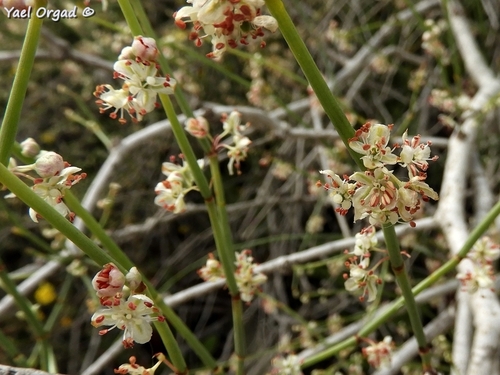
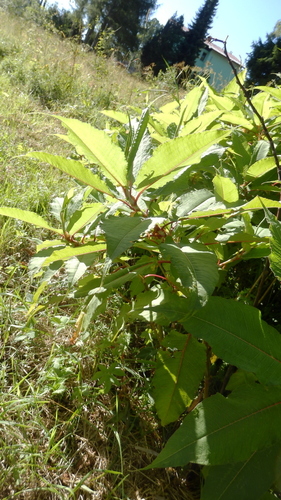
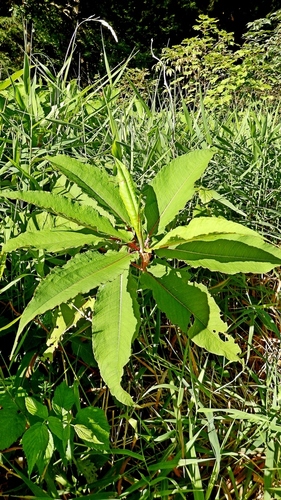
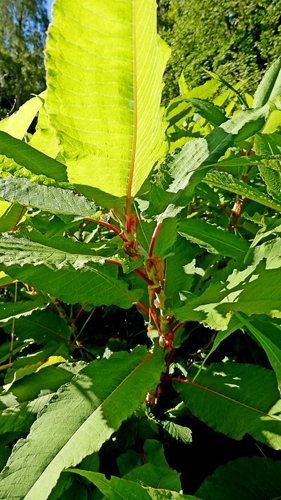
An erect shrubby plant. It grows 2 m tall. It keeps growing from year to year. The leaves are oblong or sword shaped and have a long point. They are 10-25 cm long. They usually have some soft hairs underneath. The flowers are white or pale pink. They have a scent. They are in clusters 15-45 cm long at the ends of branches. The flowers are 6 mm across. Probably now Koenigia polystachya (Meis.) Schuster & Reveal
How to Grow
Succeeds in an ordinary garden soil but prefers a moisture retentive not too fertile soil in sun or part shade. Repays generous treatment. A vigorously spreading plant, it is only really suitable for large areas of ground. Plants are easily mistaken for P. campanulatum. Plants seem to be immune to the predations of rabbits.
Propagation: Sow seed in spring in a cold frame. Germination is usually straightforward. Once seedlings are large enough to handle, prick them out into individual pots and plant out during summer if they have grown sufficiently. If not, keep them in a cold frame over winter and plant out the following spring after the last expected frosts. Division can be done in spring or autumn. Larger divisions can go directly into their permanent positions. Smaller divisions are better potted up and grown on in light shade in a cold frame until well established, then planted out in late spring or early summer.
Medicinal Uses
None known
Other Uses
Plants are very vigorous and can be grown as ground cover, performing well even on stream verges. Space plants approximately 1.2 metres apart in each direction.
Wikipedia
A vigorous perennial reaching 1.8 m (6ft) tall by 1.5 m (5ft) wide at a fast growth rate. Hardy to UK zone 6. Hermaphrodite flowers bloom July to September with seeds ripening September to October. Adapts to light sandy, medium loamy, and heavy clay soils across mildly acidic to basic pH ranges. Grows in semi-shade or full sun, preferring moist soil.
Notes
There are about 50 Polygonum species.
Names & Synonyms
Amldandi, Chuchi, Nia lu, Pang xia mei duo, Sarai, Snya lo, Tror
References (10)
- Ambasta, S.P. (Ed.), 2000, The Useful Plants of India. CSIR India. p 481
- Boesi, A., 2014, Traditional knowledge of wild food plants in a few Tibetan communities. Journal of Ethnobiology and Ethnomedicine 10:75
- Dobriyal, M. J. R. & Dobriyal, R., 2014, Non Wood Forest Produce an Option for Ethnic Food and Nutritional Security in India. Int. J. of Usuf. Mngt. 15(1):17-37
- Flora of China @ efloras.org Volume 5
- Guo, C., et al, 2022, An Ethnobotany Survey of Wild Plants Used by the Tibetan People of the Yadong River Valley, Tibet, China. Journal of Ethnobiology and Ethnomedicine p 27
- Plants for a Future, The Field, Penpol, Lostwithiel, Cornwall, PL22 0NG, UK. http://www.scs.leeds.ac.uk/pfaf/
- Polunin, O., & Stainton, A., 2006, Flowers of the Himalaya, Oxford India Paperbacks. p 346 (As Persicaria polystachyum)
- Rawat, G.S., & Pangtey, Y.P.S., 1987, A Contribution to the Ethnobotany of Alpine Regions of Kumaon. J. Econ. Tax. Bot. Vol. 11 No. 1 pp 139-147
- Singh, H.B., Arora R.K.,1978, Wild edible Plants of India. Indian Council of Agricultural Research, New Delhi. p 33
- N. Wallich, Pl. asiat. rar. 3:61. 1832