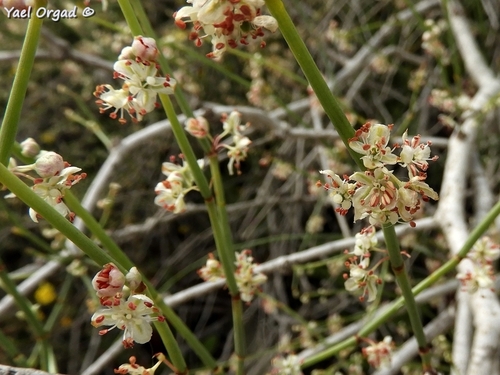
Persicaria pubescens
(Blume) H. Hara
Water smartweed
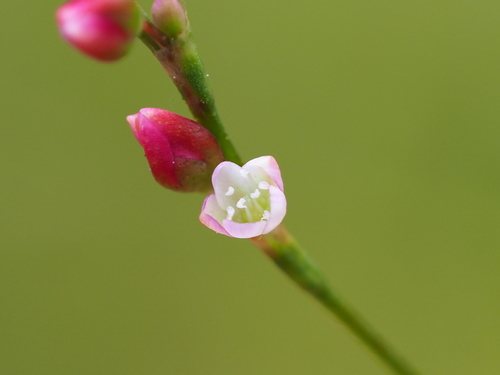
no rights reserved, uploaded by 葉子
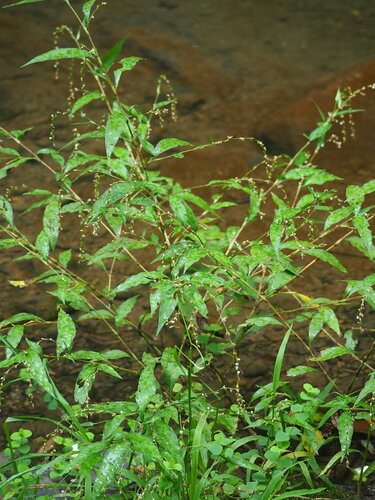
no rights reserved, uploaded by 葉子
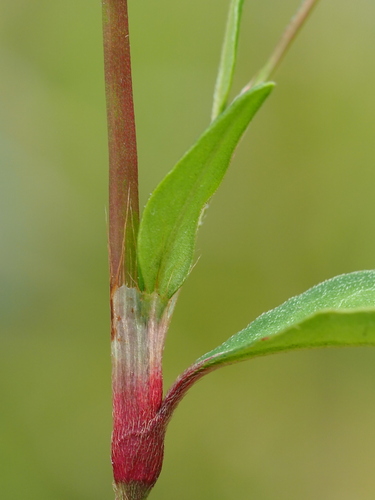
no rights reserved, uploaded by 葉子
What to Eat
Edible parts: Leaves, Seeds, Spice
The leaves are used as a seasoning and leafy vegetable, while the young shoots are used as a spice. The seeds are also edible.
Known Hazards
Where to Find It
A tropical plant. It grows along ditches and near water. In China it grows from sea level to 2,700 m above sea level. In Pakistan it grows up to 1,500 m altitude. In Sichuan and Yunnan.
Africa, Asia, Bangladesh, Bhutan, Cambodia, China, East Africa, Himalayas, India, Indochina, Indonesia, Japan, Korea, Madagascar, Malaysia, Nepal, Northeastern India, Pakistan, SE Asia, Sikkim, Taiwan, Thailand, Vietnam,
How to Identify
An annual herb. It grows 80-100 cm high. The small branches are hairy. The nodes are enlarged. The leaves are sword shaped and 3-8 cm long by 1-2 cm wide. The lower leaves fall off at flowering. The leaves are green with a dark patch below the middle. The flowers are red. There are 3-10 in a loose group at the ends of branches. The flowering groups are 1-10 cm long. The fruit is a dry 3 sided seed 2 mm long.
How to Grow
Persicaria pubescens is found in the warmer parts of the temperate zone and through to tropical areas, where it can be found at elevations up to 2,700 metres. Succeeds in an ordinary garden soil but prefers a moisture retentive not too fertile soil in sun or part shade. Repays generous treatment. Plants seem to be immune to the predations of rabbits.
Propagation: Seed - sow in situ. Germination is usually free and easy.
Medicinal Uses
The plant is abortifacient, emmenagogue. It is used in the treatment of snakebites. A decoction of the plant, combined with onion, is used as a styptic. When used with a young pineapple to procure abortion, it mitigates the violent action of the pineapple. The bruised plant is applied locally to blistered and swollen feet.
Notes
There are about 50 Polygonum species.
Names & Synonyms
Jehe shla, Kelima paya, Kesuma, Lato pire, Nghe long, Nghe long, ng(aws)n, Siok-siok-rangan, Tebuk seludang, Tebok selydang, Tuboh lalap, Tuboh perpancej
References (13)
- Ambasta, S.P. (Ed.), 2000, The Useful Plants of India. CSIR India. p 479 (As Polygonum flaccidum)
- Burkill, I.H., 1966, A Dictionary of the Economic Products of the Malay Peninsula. Ministry of Agriculture and Cooperatives, Kuala Lumpur, Malaysia. Vol 2 (I-Z) p 1824 (As Polygonum pubescens)
- Flora of China @ efloras.org Volume 5 (As Polygonum pubescens)
- Flora of Pakistan. www.eFloras.org (As Persicaria pubescens)
- Hu, Shiu-ying, 2005, Food Plants of China. The Chinese University Press. p 372 (As Polygonum flaccidum)
- Kumar, Y J. et al, 1987, Further Contribution to the Ethnobotany of Meghalaya: Plants used by "War jaintia" of Jaintia Hill District. Econ. Tax. Bot. Vol 11 No. 1 pp 65- (As Polygonum flaccidum)
- Martin, F.W. & Ruberte, R.M., 1979, Edible Leaves of the Tropics. Antillian College Press, Mayaguez, Puerto Rico. p 214 (As Polygonum pubescens)
- Pham-Hoang Ho, 1999, An Illustrated Flora of Vietnam. Nha Xuat Ban Tre. p 750 (As Polygonum pubescens)
- Plants for a Future database, The Field, Penpol, Lostwithiel, Cornwall, PL22 0NG, UK. http://www.scs.leeds.ac.uk/pfaf/ (As Polygonum pubescens)
- PROSEA handbook Volume 13 Spices. p 260 (As Persicaria pubescens)
- Srivastava, R. C., 2009, Traditional knowledge of Adi tribe of Arunachal Pradesh on plants. Indian Journal of Traditional Knowledge. 8(2): 146-153 (As Polygonum pubescens)
- Terra, G.J.A., 1973, Tropical Vegetables. Communication 54e Royal Tropical Institute, Amsterdam, p 68 (As Polygonum pubescens)
- World Checklist of Useful Plant Species 2020. Royal Botanic Gardens, Kew