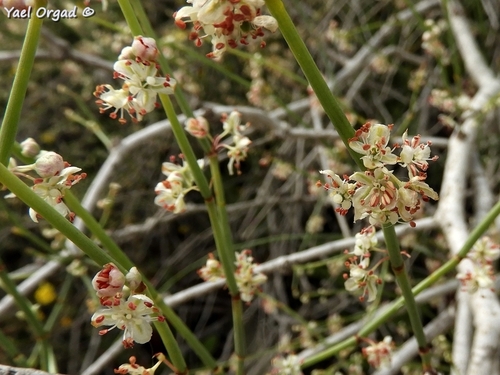
Polygonum runcinatum
(Buch-Ham.) D.Don
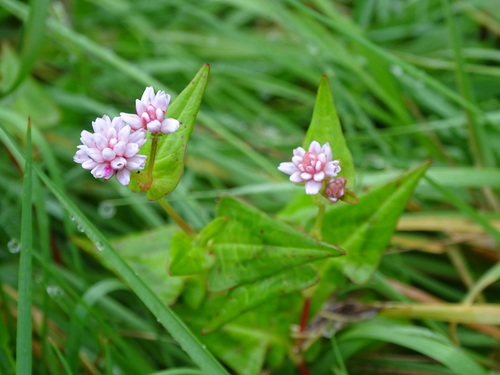
(c) Smile Taiwan, some rights reserved (CC BY-NC)
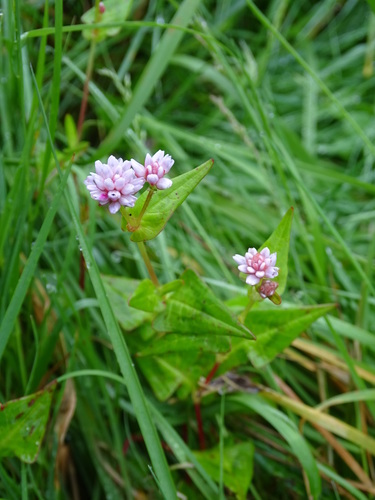
(c) Smile Taiwan, some rights reserved (CC BY-NC)

(c) Yaling Lin, some rights reserved (CC BY-NC)
What to Eat
Edible parts: Leaves, Seeds
Tender young leaves and shoots can be eaten raw or cooked as a vegetable. The seed can also be eaten raw or cooked, though it is quite small and fiddly to work with.
Where to Find It
A tropical and subtropical plant. In Nepal it grows between 1600-3600 m altitude. It grows in moist, shady places. It often grows near water. It grows between 800-3,900 m above sea level. In Yunnan.
Asia, Bhutan, China, Himalayas, India, Indochina, Indonesia, Malaysia, Myanmar, Nepal, Northeastern India, Philippines, SE Asia, Sikkim, Thailand, Tibet, Vietnam,
How to Identify
A small trailing herb. The stems are angled. The leaves have stalks. The leaves are the shape of an arrowhead with 2 unequal lobes. The leaves are 2-18.5 cm long by 1.7-7.5 cm wide. They have coarse teeth. There can be hairs on the mid vein above. The flowers are white or pink and in groups at the ends of the stalks.
How to Grow
Plants are grown from seed.
Propagation: Sow seed in spring in a cold frame. Germination is usually straightforward. Once seedlings are large enough to handle, prick them out into individual pots and plant out during summer if they have grown sufficiently. If not, keep them in a cold frame over winter and plant out the following spring after the last expected frosts. Division can be done in spring or autumn. Larger divisions can go directly into their permanent positions. Smaller divisions are better potted up and grown on in light shade in a cold frame until well established, then planted out in late spring or early summer.
Medicinal Uses
None known
Other Uses
None known
Wikipedia
A perennial herb reaching 0.5 m tall with hermaphroditic flowers pollinated by insects. Hardy to UK zone 8. Tolerates light sandy, medium loamy, and heavy clay soils across a range of pH levels from mildly acidic to mildly alkaline. Grows in semi-shade or full sun and prefers consistently moist conditions.
Notes
There are about 50 Polygonum species.
Names & Synonyms
Houpei-vu, Kapre sag, Lagasidi, Nghe bao, Nobito, Puri, Ratna, Ratnaulo, Ruri
References (18)
- Ambasta, S.P. (Ed.), 2000, The Useful Plants of India. CSIR India. p 481
- Dangol, D. R. et al, 2017, Wild Edible Plants in Nepal. Proceedings of 2nd National Workshop on CUAOGR, 2017.
- Dobriyal, M. J. R. & Dobriyal, R., 2014, Non Wood Forest Produce an Option for Ethnic Food and Nutritional Security in India. Int. J. of Usuf. Mngt. 15(1):17-37
- Flora of China @ efloras.org Volume 5
- Geng, Y., et al, 2016, Traditional knowledge and its transmission of wild edibles used by the Naxi in Baidi Village, northwest Yunnan province. Journal of Ethnobiology and Ethnomedicine. 12:10
- Ghimeray, A. K., Lamsal, K., et al, 2010, Wild edible angiospermic plants of the Illam Hills (Eastern Nepal) and their mode of use by local community. Korean J. Pl. Taxon. 40(1) (As Persicaria runcinata)
- Joshi, N., et al, 2007, Traditional neglected vegetables of Nepal: Their sustainable utilization for meeting human needs. Tropentag 2007. Conference on International Agricultural Research for Development. (As Persicaria runcinata)
- Lokho, K. & Narasimhan, D., 2013, Ethnobotany of Mao-Naga Tribe of Manipur, India. Pleione 7(2): 314-324
- Manandhar, N.P., 2002, Plants and People of Nepal. Timber Press. Portland, Oregon. p 355 (As Persicaria runcinata)
- Murtem, G. & Chaudhrey, P., 2016, An ethnobotanical note on wild edible plants of Upper Eastern Himalaya, India. Brazilian Journal of Biological Sciences, 2016, v. 3, no. 5, p. 63-81
- Patiri, B. & Borah, A., 2007, Wild Edible Plants of Assam. Geethaki Publishers. p 117
- Pfoze, N. L., et al, 2012, Survey and assessment of floral diversity on wild edible plants from Senapati district of Manipur, Northeast India. Journal or Biodiversity and Environmental Sciences. 1(6):50-52
- Plants for a Future database, The Field, Penpol, Lostwithiel, Cornwall, PL22 0NG, UK. http://www.scs.leeds.ac.uk/pfaf/
- Sarma, H., et al, 2010, Updated Estimates of Wild Edible and Threatened Plants of Assam: A Meta-analysis. International Journal of Botany 6(4): 414-423
- Singh, H.B., Arora R.K.,1978, Wild edible Plants of India. Indian Council of Agricultural Research, New Delhi. p 33
- Srivastava, R. C., 2010, Traditional knowledge of Nyishi (Daffla) tribe of Arunachal Pradesh. Indian Journal of Traditional Knowledge. 9(1):26-37
- Sundriyal, M., et al, 2004, Dietary Use of Wild Plant Resources in the Sikkim Himalaya, India. Economic Botany 58(4) pp 626-638 (As Persicaria runcinata)
- Thothathri, K., & Pal, G.D., 1987, Further Contribution to the Ethnobotany of Subansiri District, Aranchal Pradesh. J. Econ. Tax. Bot. Vol. 10 No. 1 pp 149-157