Polyscias cumingiana
(C. Presl) Fern.-Vill.
Fern-leaf aralia, Fern-leaf panax
(c) Smithsonian Institution, National Museum of Natural History, Department of Botany,保留部分权利(CC BY-NC-SA)

Wikimedia Commons - Mokkie

Wikimedia Commons - Forest & Kim Starr
What to Eat
Edible parts: Leaves
Young leaves are boiled and eaten, often cooked together with meat or fish.
Where to Find It
A tropical plant. It grows in tropical rainforests and secondary growth. It is usually grown at low altitudes but can be up to 1700 m altitudes.
Asia, China, East Timor, Fiji, Indonesia, Malaysia, Marquesas, Nauru, New Caledonia, Pacific*, Papua New Guinea, PNG, SE Asia, Timor-Leste, Vanuatu,
How to Identify
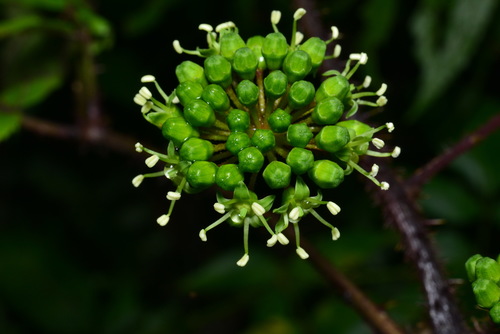
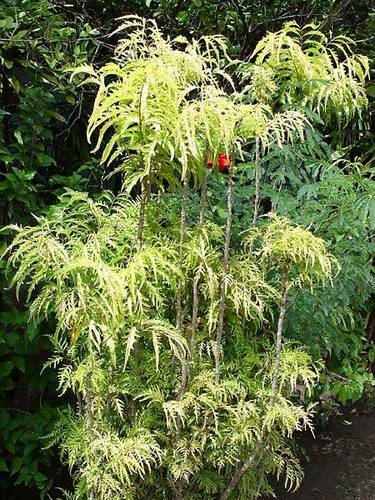
A shrub or small tree. It grows 2-5 m high. The leaves are alternate and they are divided into leaflets along the stalk. The leaves are 50-100 cm long by 6-12 cm wide. There is a sheath base. The leaflet shapes can vary even on the one plant. The flowers are in a large branched group at the end of the stalk.
How to Grow
Plants can be grown from seeds. It is easily grown from cuttings. It can be used as a hedge.
Propagation: Seed - Cuttings of softwood. Leafless stem sections during the growing season. Air-layering.
Other Uses
Widely cultivated from Malaysia to the SW Pacific as a hedge plant. This species produces few, if any, side branches, so it seems strange to use it as a hedge plant - the report is quite possible referring to P. Filicifolia, a distinct species that has sometimes been included in this species.
Other Information
It is cultivated.
Notes
There are about 100 Polyscias species.
Names & Synonyms
Lautagitagi, Pohon daun grisik
References (11)
- Bradacs, G., 2008, Ethnobotanical Survey and Biological Screening of Medicinal Plants from Vanuatu. PhD thesis Frankurt University. p 101
- Conn, B.J., (Ed.) 1995, Handbooks of the Flora of Papua New Guinea. Vol 3. Melbourne University Press. p 30
- http://palaeoworks.anu.edu.au/Nuno_PhD/04.pdf re Timor
- Nov. app. 102. 1880
- Ochse, J.J. et al, 1931, Vegetables of the Dutch East Indies. Asher reprint. p 66 (As Nothopanax pinnatum)
- Peekel, P.G., 1984, (Translation E.E.Henty), Flora of the Bismarck Archipelago for Naturalists, Division of Botany, Lae, PNG. p 421, 420
- Smith, A.C., 1985, Flora Vitiensis Nova, Lawaii, Kuai, Hawaii, Volume 3 p 639
- Sukarya, D. G., (Ed.) 2013, 3,500 Plant Species of the Botanic Gardens of Indonesia. LIPI p 466
- Walter, A. & Lebot, V., 2007, Gardens of Oceania. ACIAR Monograph No. 122. p 171
- World Checklist of Useful Plant Species 2020. Royal Botanic Gardens, Kew
- Zeven, A. C. & de West, J. M. J., 1982, Dictionary of cultivated plants and their regions of diversity. Wageningen. p 50