Polyscias fruticosa
(L.) Harms
Parsley panax

(c) veroalpizar, some rights reserved (CC BY-NC)
(c) savagewench77, some rights reserved (CC BY-NC), uploaded by savagewench77

(c) marez, some rights reserved (CC BY-NC)
What to Eat
Edible parts: Leaves, Roots
Young leaves and shoots are cooked and eaten as greens or added to soups and other dishes as a flavouring, with an aromatic taste reminiscent of parsley. Leaves, young shoots, and roots can all be consumed raw or cooked as a vegetable or flavouring.
Known Hazards
Where to Find It
A tropical plant. It suits tropical and subtropical regions. They need well drained acid soils. It is grown at low altitudes and up to about 1000 m. It is often grown as a hedge. In XTBG Yunnan. It grows on atolls.
Africa, Asia, Australia, Caroline Islands, China, Chuuk, Dominican Republic, East Africa, Fiji, FSM, Guam, Haiti, Hawaii, India, Indochina, Indonesia, Kiribati, Laos, Malaysia, Marquesas, Mozambique, Myanmar, Nauru, Pacific*, Papua New Guinea, PNG, Puerto Rico, Rotuma, Samoa, SE Asia, Sierra Leone, Solomon Islands, Sri Lanka, Tonga, Thailand, Tuvalu, USA, Vanuatu, Vietnam, Virgin Islands, West Africa, West Indies,
How to Identify
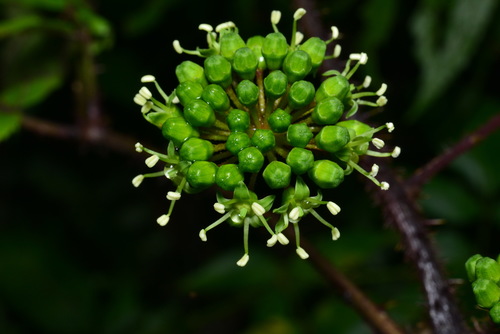
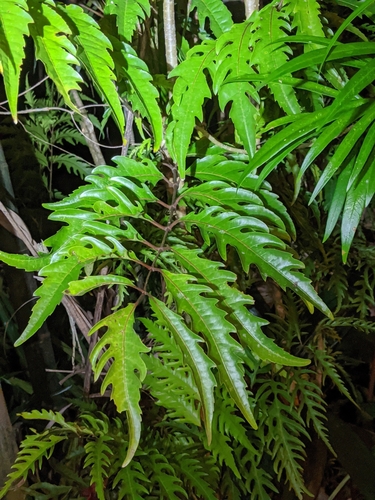
A tall shrub. It grows 3-5 m high and spreads 2-3 m wide. The branches are spreading. The leaves are clustered near the tips. The leaves are divided 3 times. They are 75 cm long. They sheath the stem at the base. The leaflet stalks are 25 cm long and the leaflets are 1-12 cm long by 0.5-4 cm wide. They vary in shape. They can be lobed or have teeth. The flowers are 0.5 cm across and in a spreading group 60 cm long. The fruit are 0.5 cm across. They are fleshy. The plant varies a lot and it can be like Polyscias cumingiana.
How to Grow
Plants can be grown from fresh seed. They can also be grown from cuttings.
Propagation: Sow seed when fresh for best results. Stem cuttings can be taken from the tops of old plants, which also encourages new growth to form on the parent plant; use shoots around 10cm long. The optimal rooting temperature requires bottom heat of 21–23°C. Avoid heavy misting as waterlogged soil slows root development, and avoid disturbing roots during propagation. Root cuttings are made using 25mm root segments with the top of the root level with the soil surface. Air layering is also possible. Root suckers can be divided once their root system is sufficiently developed; some cultivars produce suckers in abundance.
Medicinal Uses
The plant has been used for centuries in traditional medicine and is regarded as analgesic, febrifuge, and diuretic. The root has an agreeable, strongly aromatic smell, tastes like parsley, and is used specifically as a diuretic. The bark is also used medicinally.
Other Uses
The plant is widely grown as a hedge in the tropics and is one of the most common hedging plants in tropical lowlands. It is also used to make joss sticks by Buddhist monks in Cambodia.
Wikipedia
Source ↗Polyscias fruticosa, or Ming aralia, is a perennial dicot evergreen shrub or dwarf tree in the ivy family Araliaceae, found in tropical and subtropical regions. The plant grows fairly slowly, up to 3–5 metres (9.8–16.4 ft) in height. The leaves are tripinnate, with a glossy surface. Ming aralia is commonly grown as an ornamental and a potherb, valued for its culinary and medicinal uses.
Other Information
It is cultivated as a food plant.
Notes
There are about 100 Polyscias species. It stimulates milk production by women.
Names & Synonyms
Bebenu, Bebero, Bei, Bei ghailoro, Berobero, Danidani, Denngi, Dinh lang, Geke, Goi ca, Kadongdong laut, Kalon-letthe, Kobikobi, Kudu gerda, Kuku gerda, La nho, Lautagitagi, Lebkrud, Lep krut, Ming aralia, Momotu, Nyia kalo, Paa, Panax, Pokok teh, Siku keluang, Tagitagi, Taqala, Tataqala, Te kaimamara
References (38)
- Ambasta, S.P. (Ed.), 2000, The Useful Plants of India. CSIR India. p 482
- Arora, R. K., 2014, Diversity in Underutilized Plant Species - An Asia-Pacific Perspective. Bioversity International. p 43, 105 (As Nothopanax fruticosum)
- Bodkin, F., 1991, Encyclopedia Botanica. Cornstalk publishing, p 820
- Borrell, O.W., 1989, An Annotated Checklist of the Flora of Kairiru Island, New Guinea. Marcellin College, Victoria Australia. p 54
- Bot. Jahrb. Syst. 56:412. 1921
- Burkill, H. M., 1985, The useful plants of west tropical Africa, Vol. 1. Kew. (As Polyscias guilfoylei)
- Burkill, I.H., 1966, A Dictionary of the Economic Products of the Malay Peninsula. Ministry of Agriculture and Cooperatives, Kuala Lumpur, Malaysia. Vol 2 (I-Z) p 1589 (As Nothopanax fruticosum) and p 1826
- Cabalion, P. and Morat, P., 1983, Introduction le vegetation, la flore et aux noms vernaculaires de l'ile de Pentcoste (Vanuatu), In: Journal d'agriculture traditionnelle et de botanique appliquee JATBA Vol. 30, 3-4
- Conn, B.J., (Ed.) 1995, Handbooks of the Flora of Papua New Guinea. Vol 3. Melbourne University Press. p 31
- Elliot, W.R., & Jones, D.L., 1997, Encyclopedia of Australian Plants suitable for cultivation. Vol 7. Lothian. p 419
- Facciola, S., 1998, Cornucopia 2: a Source Book of Edible Plants. Kampong Publications, p 26
- French, B.R., 2010, Food Plants of Solomon Islands. A Compendium. Food Plants International Inc. p 91
- Hedrick, U.P., 1919, (Ed.), Sturtevant's edible plants of the world. p 460 (As Panax fruticosum)
- Hill, M. & Hallam, D., (eds), 1997, Na Hang Nature Reserve, Tat Ke Sector. Site description and conservation evaluation. Hanoi. p 72
- Jacquat, C., 1990, Plants from the Markets of Thailand. D.K. Book House p 83
- Jiwajinda, S., et al, 2002, Suppressive Effects of Edible Thai Plants on Superoxide and Nitric Oxide Generation. Asian Pacific Journal of Cancer Prevention, Vol 3, 2002
- Lembogi Biologi Nasional, 1980m Sayur-sayuran. Balai Pustaka, Jakarta. p 22
- Liefting, A., et al, Samoan plant names. http://en.wikipedia.org
- Maisuthisakul, P., 2012, Phenolic Constituents and Antioxidant Properties of some Thai Plants. Chp. 9 in Book Phytochemicals - A Global Perspective of Their Role in Nutrition and Health
- Martin, F.W. & Ruberte, R.M., 1979, Edible Leaves of the Tropics. Antillian College Press, Mayaguez, Puerto Rico. p 176
- Nakahara, K. et al, 2002, Antimutagenicity of Some Edible Thai Plants, and a Bioactive Carbazole Alkaloid, Mahanine, Isolated from Micromelum minutum. Journal of Agricultural and Food Chemistry. 50: 4796-4892
- Ochse, J.J. et al, 1931, Vegetables of the Dutch East Indies. Asher reprint. p 64 (As Nothopanax fruticosum)
- Parham, H. B. R., 1940, Fiji Plants Their Names and Uses. Supplement to the Journal of the Polynesian Society. Memoir No. 16
- Peekel, P.G., 1984, (Translation E.E.Henty), Flora of the Bismarck Archipelago for Naturalists, Division of Botany, Lae, PNG. p 421, 422
- Reis, S. V. and Lipp, F. L., 1982, New Plant Sources for Drugs and Foods from the New York Botanical Garden herbarium. Harvard. p 221
- Smith, A.C., 1985, Flora Vitiensis Nova, Lawaii, Kuai, Hawaii, Volume 3 p 640
- Staples, G.W. and Herbst, D.R., 2005, A tropical Garden Flora. Bishop Museum Press, Honolulu, Hawaii. p 134 (Drawing)
- Stone, B.,
- Sakunpak, A. & Panichayupakaranant, P., 2012, Antibacterial activity of Thai edible plants against gastrointestinal pathogenic bacteria and isolation of a new broad spectrum antibacterial polyisoprenylated benzophenone, chamuangone. Food Chemistry 130 (2012) 826–831
- Tanaka, Y. & Van Ke, N., 2007, Edible Wild Plants of Vietnam: The bountiful garden. Orchid books. p 32
- Terra, G.J.A., 1973, Tropical Vegetables. Communication 54e Royal Tropical Institute, Amsterdam, p 63
- Thaman, R. R., 1987, Plants of Kiribati: A listing and analysis of vernacular names. Atoll Research Bulletin No. 296
- Thaman, R. R, 2016, The flora of Tuvalu. Atoll Research Bulletin No. 611. Smithsonian Institute p 66
- Van Sam, H. et al, 2008, Uses and Conservation of Plant Species in a National Park. A case study of Ben En, Vietnam. Economic Botany 62:574-593
- Walter, A. & Lebot, V., 2007, Gardens of Oceania. ACIAR Monograph No. 122. p 171
- World Checklist of Useful Plant Species 2020. Royal Botanic Gardens, Kew
- Yuncker, T.G., 1959, Plants of Tonga, Bernice P. Bishop Museum, Hawaii, Bulletin 220. p 207
- Zeven, A. C. & de West, J. M. J., 1982, Dictionary of cultivated plants and their regions of diversity. Wageningen. p 50