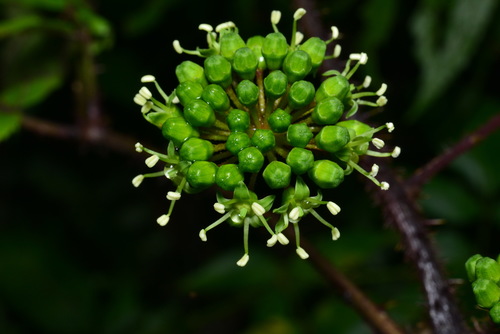
Polyscias pinnata
J. R. Forst. & G. Forst.
AraliaceaeLeaves

wikimedia · cc-by-sa
Wikimedia Commons - Mokkie
Wikimedia Commons - Mokkie

wikimedia · cc-by-sa
Wikimedia Commons - Mokkie
Wikimedia Commons - Mokkie
What to Eat
Edible parts: Leaves
The young leaves are eaten as a vegetable.
Where to Find It
A tropical plant. It can tolerate salt spray. It is best in a moist well-drained soil. It suits hardiness zones 10-12.
Asia, Chuuk, Dominican Republic, FSM, Guam, Haiti, India, Indonesia, North America, Pacific*, Papua New Guinea, PNG, Puerto Rico, SE Asia, USA, Vanuatu, West Indies,
Countries: United Arab Emirates, Afghanistan, Antigua & Barbuda, Armenia, Australia, Azerbaijan, Barbados, Bangladesh, Bahrain, Brunei, Bahamas, Bhutan, Belize, Canada, China, Costa Rica, Cuba, Dominica, Dominican Republic, Fiji, Micronesia, Grenada, Georgia, Guatemala, Honduras, Haiti, Indonesia, Israel, India, Iraq, Iran, Jamaica, Jordan, Japan, Kyrgyzstan, Cambodia, Kiribati, St Kitts & Nevis, North Korea, South Korea, Kuwait, Kazakhstan, Laos, Lebanon, St Lucia, Sri Lanka, Marshall Islands, Myanmar, Mongolia, Maldives, Mexico, Malaysia, Nicaragua, Nepal, Nauru, New Zealand, Oman, Panama, Papua New Guinea, Philippines, Pakistan, Puerto Rico, Palau, Qatar, Saudi Arabia, Solomon Islands, Singapore, El Salvador, Syria, Thailand, Tajikistan, Timor-Leste, Turkmenistan, Tonga, Turkey, Trinidad & Tobago, Tuvalu, Taiwan, United States, Uzbekistan, St Vincent, Vietnam, Vanuatu, Samoa, Yemen
How to Identify
A shrub. It grows 2-3 m tall and spreads up to 1 m wide. The leaves are alternate and they have 3 leaflets. There are teeth along the edge. The leaf blade is 10-20 cm long. The flowers are white.
How to Grow
Plants can be grown by seed, cuttings or air-layering. It can be planted as a hedge.
Other Information
It is a cultivated plant.
Notes
There are about 100 Polyscias species.
Names & Synonyms
Aralia polyscias Spreng. ex Seem.Panax forsteri Decne. & Planch.Panax manguette Vieill.Panax pinnatus (J. R. Forst. & G. Forst.) Baill. [Illegitimate]Polyscias umbellata Spreng.
References (9)
- Ambasta, S.P. (Ed.), 2000, The Useful Plants of India. CSIR India. p 482
- Andarwulan, N., et al, 2010, Flavonoid content and antioxidant activity of vegetables from Indonesia. Food Chemistry 121: 1231-1235
- Arora, R. K., 2014, Diversity in Underutilized Plant Species - An Asia-Pacific Perspective. Bioversity International. p 43, 105 (As Nothopanax pinnatum)
- Barrau, J., 1976, Subsistence Agriculture in Melanesia. Bernice P. Bishop Museu, Bulletin 219 Honolulu Hawaii. Kraus reprint. p 58
- Martin, F.W. & Ruberte, R.M., 1979, Edible Leaves of the Tropics. Antillian College Press, Mayaguez, Puerto Rico. p 177
- Massal, E. and Barrau, J., 1973, Food Plants of the South Sea Islands. SPC Technical Paper No 94. Noumea, New Caledonia. p 35
- Plants of Haiti Smithsonian Institute http://botany.si.edu
- Stone, B.,
- Terra, G.J.A., 1973, Tropical Vegetables. Communication 54e Royal Tropical Institute, Amsterdam, p 63