Polyscias sambucifolia
(Sieber ex DC.) Harms
Elderberry panax, Ornamental Ash
(c) Nick Lambert, some rights reserved (CC BY-NC-SA), uploaded by Nick Lambert
(c) Leon Perrie, some rights reserved (CC BY), uploaded by Leon Perrie

(c) John Tann, some rights reserved (CC BY)
What to Eat
Edible parts: Fruit
This plant produces a gum similar to gum arabic (the type obtained from various Acacia species), though it is not wholly soluble.
Where to Find It
It is a warm temperate to tropical plant. It grows in rainforest and coastal woodland. It grows in acid soils. It is best in shaded locations. It suits hardiness zones 9-12. Tasmania Herbarium.
Australia*, Tasmania*,
How to Identify
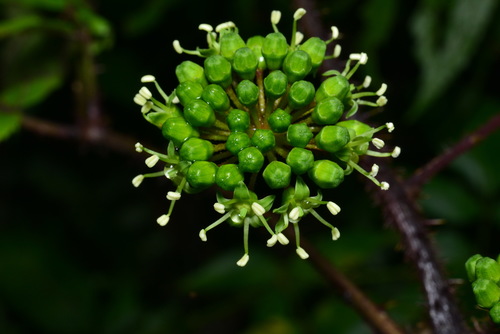
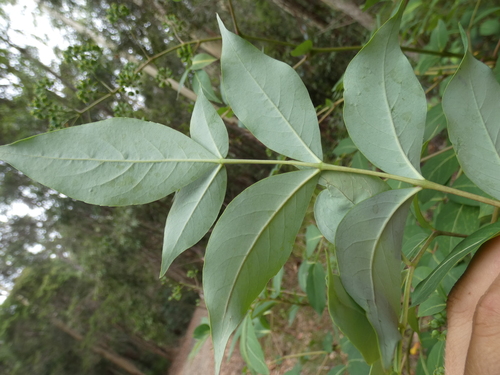
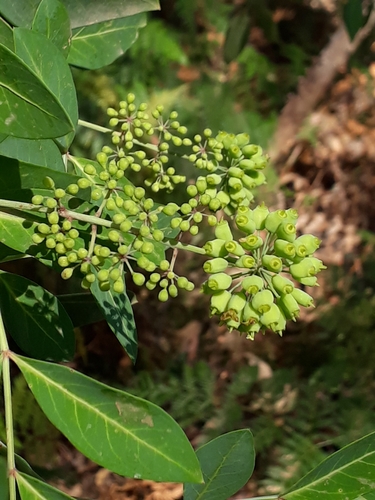
A shrub or small tree. It grows 4-10 m high and spreads 3-6 m wide. It often has suckers from the roots. It can form large colonies. The bark is black and with pimples in lines. The leaves are 4-35 cm long by 4-15 cm wide. The leaves are blue-green. They can be entire or divided once or twice. There are 5-21 leaflets which are 4-20 cm long by 2-6 cm wide. They are sword shaped or deeply lobed. The flowers are 0.4 cm across and yellow-green. They occur in open groups about 12 cm long. The fruit is about 0.6 cm long and ribbed.
How to Grow
Plants can be grown from seed or cuttings. Plants spread by layering.
Propagation: Sow seed in spring in a greenhouse. Prick seedlings out into individual pots once large enough to handle, and grow on under glass for at least their first winter. Plant out in late spring or early summer after the last expected frosts, and consider providing cold protection during at least the first winter outdoors. Softwood cuttings taken in early summer root easily in a closed case. Leafless stem cuttings taken in summer also root easily in a closed case.
Medicinal Uses
None known.
Other Uses
This species grows fairly quickly and tolerates shearing well, making it suitable for use as a hedge. The gum it produces is similar to gum arabic but is not wholly soluble. The wood is too soft and perishable to have economic value.
Wikipedia
Source ↗Polyscias sambucifolia, commonly known as elderberry panax or small basswood, is a species of plant native to eastern Australia.
Production
It is fast growing.
Notes
There are about 100 Polyscias species.
Names & Synonyms
References (12)
- Bodkin, F., 1991, Encyclopedia Botanica. Cornstalk publishing, p 820
- Cherikoff V. & Isaacs, J., The Bush Food Handbook. How to gather, grow, process and cook Australian Wild Foods. Ti Tree Press, Australia p 196
- Cundall, P., (ed.), 2004, Gardening Australia: flora: the gardener's bible. ABC Books. p 1069
- Elliot, W.R., & Jones, D.L., 1997, Encyclopedia of Australian Plants suitable for cultivation. Vol 7. Lothian. p 420
- Hibbert, M., 2002, The Aussie Plant Finder 2002, Florilegium. p 238
- Lazarides, M. & Hince, B., 1993, Handbook of Economic Plants of Australia, CSIRO. p 195
- Morley, B.D., & Toelken, H.R., (Eds), 1983, Flowering Plants in Australia. Rigby. p 216, 219 (As Tieghemopanax sambucifolius)
- Oates, A. and Seeman, A, 1979, Victorian Aborigines: Plant Foods. National Museum: Melbourne. (As Tieghemopanax sambucifolius)
- Ratcliffe D & P., 1987, Australian Native Plants for Indoors. Little Hills press. p 120
- Tasmanian Herbarium Vascular Plants list p 3
- Whiting, J. et al, 2004, Tasmania's Natural Flora. Tasmania's Natural Flora Editorial Committee PO Box 194, Ulverstone, Tasmania, Australia 7315 p 22
- Williams, J.B., Harden, G.J., and McDonald, W.J.F., 1984, Trees and shrubs in rainforests of New South Wales and Southern Queensland. Univ. of New England, Armidale. p 41