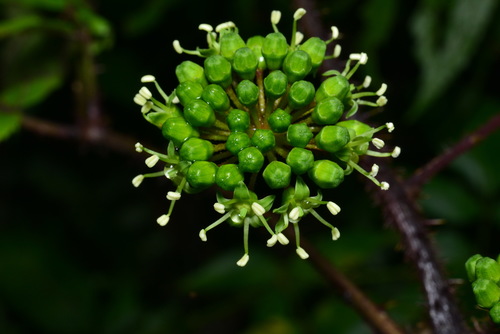
Polyscias verticillata
Stone
Valanguar

President and Fellows of Harvard College

President and Fellows of Harvard College

President and Fellows of Harvard College
What to Eat
Edible parts: Leaves, Vegetable
The young leaves are cooked and eaten as a vegetable with a pleasant aroma, and are used to flavor stews.
Where to Find It
A tropical plant. It occurs in coastal areas and probably up to 1000 m altitude. It is mostly planted around houses. It occurs at Madang, Manus, New Britain and New Ireland in Papua New Guinea. Usually it is near the sea level and below 140 m altitude.
Asia, Indonesia, Pacific, Papua New Guinea, PNG, SE Asia, Solomon Islands,
How to Identify
A shrub grown as a hedge and of which the young leaves are eaten. It grows up to 7 m high. The leaves are arranged in spirals towards the ends. The leaves can be 1 m long. The leaves are twice divided. The leaf stalk is 24-30 cm long. The leaf sheaths form a flat section clasping the leaf stalk. Leaf shapes, colours and size vary between species and varieties. The leaf blades are oblong and often more broad near the base. The midrib and side veins are visible. The leaf blades are 16-27 cm by 5-13 cm. The flowering stalks are large and at the ends of the branches. The flower stalks branch and radiate out. The fruit are round and fleshy and black. The leaves are like Polyscias macgillivrayi but the flower arrangement is different.
How to Grow
Plants are grown by cuttings. They are often used as an ornamental hedge. This plant is often used to form a hedge around their houses and gardens. Constantly picking the leaves helps maintain it as a small pruned shrub. As a shrub they grow from 2 to 5 m tall. Seeds are produced and spread by birds. These self sown seedlings are sometimes replanted.
Propagation: Seed - Cuttings.
Medicinal Uses
The plant is used in traditional medicine.
Other Uses
The plant responds very well to constant pruning and is often grown as a hedge within its native range. Grows well under coconuts.
Other Information
In Papua New Guinea it is moderately common as an ornamental in coastal areas, but not always eaten. It is popular in the Gazelle Peninsula.
Notes
There are about 100 Polyscias species.
Names & Synonyms
References (35)
- Valanguar references Polyscias verticillata
- Bailey, L.H., 1916, Rhodora 18 153.
- Barrau. J., 1958, Subsistence Agriculture in Melanesia. B. P. Bishop Museum
- Borrell, O.W., 1989, An Annotated Checklist of the Flora of Kairiru Island, New Guinea. Marcellin College, Victoria Australia. p 54
- Burkill, p 1589,
- Conn, B.J., (Ed.) 1995, Handbooks of the Flora of Papua New Guinea. Vol 3. Melbourne University Press. p 34
- Corner, Nothopanax
- De Clerq, 1927, Niew Plantk. Woordenb. 2 nd ed. p160 no.2863
- Engler, & Prant Die Nat. Pflan. Fam. 3.7.8
- Filet, , 1888, Plantk. Woordenb. 2nd Ed. p 5 No. 76.
- Fosberg, 1948, Univ. Hawaii Occ. Paper 46, 9
- French, B.R., 1986, Food Plants of Papua New Guinea, A Compendium. Asia Pacific Science Foundation p 74
- French, B.R., 2010, Food Plants of Solomon Islands. A Compendium. Food Plants International Inc. p 94
- Harms, 1923, Polyscias pinnata Bot. Jahrb. 56:409
- Heyne, 1927, Nutt. Planten 2nd Ed p1209
- Holmes, 1892, Bull. Pharm 6 p111
- Koorders, 1912, Exkflora von Java, 2, p717;
- Koorders, Atlas Baumart. Java 4.2 fig 697
- Martin, F.W., & Ruberte, R.M., 1975, Edible Leaves of the Tropics. Antillian College Press, Mayaguez, Puerto Rico.
- Menaut, 1929, Bull. Econ. Indochine p246
- Miquel, 1856, Flora Ind. Bt. 1(1):765
- Ochse, , 1925, Tropische Groenten p 17 with a fig.
- Ochse, Nothopanax fruticosum (L.)Miq.
- Oomen, H.A.P.C., & Grubben, G.J.H., 1978, Tropical Leaf Vegetables in Human Nutrition, Communication 69, Department of Agricultural research, RTI Amsterdam, p 24
- Parham, Plants of the Fiji Is. p129.
- Peekel,
- Philipson,W.R.,1979, Araliaceae, in Flora Malesiana Ser. 1 vol. 9:1 p71
- PROSEA handbook Volume 13 Spices. p 279
- Sharma, A.K. & Chatterji, A.K., 1964, Cytological study as an aid in the interpretation of the systematic status of the different genera of Araliaceae. Cytologia 29:1-12.
- Smith, A.C. & Stone, B.C., 1968, The Araliaceae of the New Hebrides, Fiji, Samoa, and Tonga. J. Arnold. Arb. 49(4):431-493 8 pls.
- Stone, B.C., 1965, Notes on Polyscias (Araliaceae) from Micronesia. Micronesica. Journ. Coll. of Guam 2(1).
- Stone, B.C., 1965, Notes on the type species of Polyscias J.R.& G.Forst. (Araliaceae). Taxon 14(8): 281-285
- Stone, B.C., 1966, Polyscias verticillata (Araliaceae), A New Species from the Solomon Islands. Journal of the Arnold Arboretum, Vol. 47 p270
- Stone, B.C. & Loo, A.H., 1969, Cytotaxonomic notes on some species of Polyscias (Aralaceae) Journ. Jap. Bot. Vol. 44 No.11. p321-
- World Checklist of Useful Plant Species 2020. Royal Botanic Gardens, Kew