Ptychosperma elegans
(R. Brown) Blume
Solitaire palm, Alexander Palm, Seaforthia palm
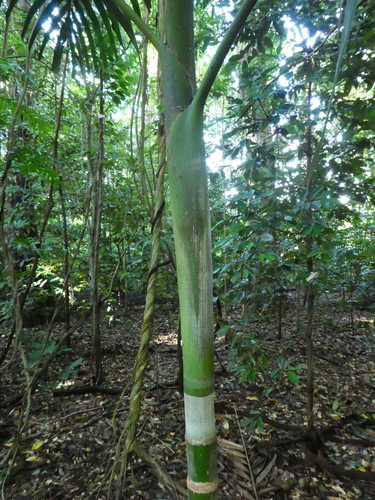
(c) Steve Fitzgerald, some rights reserved (CC BY-SA), uploaded by Steve Fitzgerald

(c) palmlover, some rights reserved (CC BY-NC), uploaded by palmlover

(c) scott.zona, some rights reserved (CC BY)
What to Eat
Edible parts: Fruit, Palm heart
The young unexpanded leaves are eaten as a vegetable, and the flesh of the bright red fruit (15–20 mm long) is edible. The palm heart is also harvested.
Where to Find It
A tropical plant. It grows in the rainforest in NE Queensland, in Australia. They will grow in the subtropics. It needs well drained soil. It can grow in part shade or full sun. It suits seasonally moist and dry climates. In the Cairns Botanical Gardens. In Townsville palmetum. They are sensitive to frost. It suits plant hardiness zones 10-11.
Asia, Australia*, Dominican Republic, Haiti, Indonesia, North America, Pacific, Papua New Guinea, PNG, SE Asia, USA, West Indies,
How to Identify
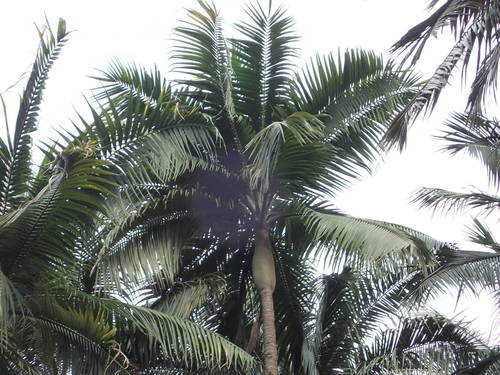
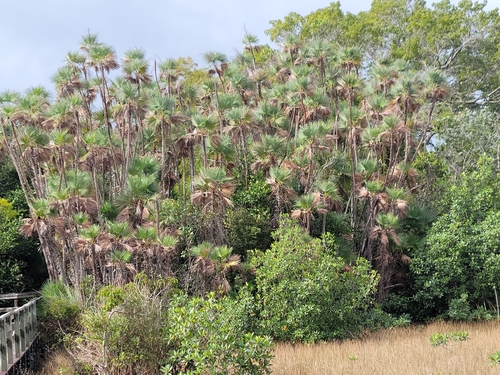
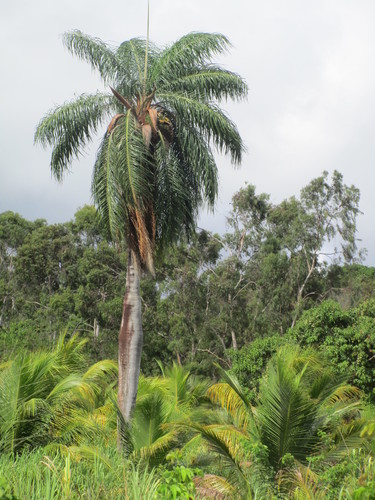
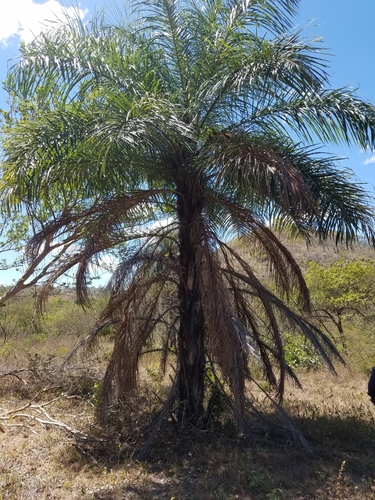
A solitary palm which grows to 10 m high. The trunk is slender and grey. It is 7-20 cm across. The trunk has rings along it. The crown-shaft is whitish-green. The leaves are bright green and arching. The leaves are compound. They are 1-2.5 m long. There are 40-60 leaflets which are 50-60 cm long. They are smooth. The fruit is 15-20 mm long. They occur in bunches below the crown-shaft. The fruit are bright red. There is one seed which is about 15 mm long. The flesh of the fruit is edible.
How to Grow
Plants are grown from fresh seed. Seed is produced in large quantities and grows readily. Seed germinate in 5-6 months. They need protection from direct sunlight for the first 2-4 years. Seedlings transplant easily.
Propagation: Seed - if sown fresh, it germinates reliably within a few months.
Wikipedia
Source ↗Ptychosperma elegans, commonly known as the solitaire palm (or elegant palm after the scientific name), is a very slender palm endemic to Queensland in Australia. In the nursery trade and in the United States it may be confusingly referred to as Alexander palm, which is an often-used but misnomered name of another Australian palm species Archontophoenix alexandrae, the Alexandra palm (note the difference in gender between the two names).
Production
They can be very fast growing. It flowers in warm, wet months.
Names & Synonyms
Bangalow, Elegant palm, Palem solitari
References (28)
- Balick, M.J. and Beck, H.T., (Ed.), 1990, Useful palms of the World. A Synoptic Bibliography. Colombia p 381
- Blomberry, A. & Rodd, T., 1982, Palms. An informative practical guide. Angus & Robertson. p 152
- Bodkin, F., 1991, Encyclopedia Botanica. Cornstalk publishing, p 852
- Brickell, C. (Ed.), 1999, The Royal Horticultural Society A-Z Encyclopedia of Garden Plants. Convent Garden Books. p 846
- Cooper W & Cooper W T, 1994, Fruits of the Rain Forest. RD Press p 240
- Cooper, W. and Cooper, W., 2004, Fruits of the Australian Tropical Rainforest. Nokomis Editions, Victoria, Australia. p 75
- Cronin, L., 1989, The Concise Australian Flora. Reed. p 212
- Cronin, L., 2000, Australian Palms, Ferns, Cycads and Pandans. Cronin Publications. p 30
- Cundall, P., (ed.), 2004, Gardening Australia: flora: the gardener's bible. ABC Books. p 1109
- Facciola, S., 1998, Cornucopia 2: a Source Book of Edible Plants. Kampong Publications, p 30
- Gibbons, M., 1993, Palms. Compact study Guide and Identifier. Sandstone. p 65
- Hibbert, M., 2002, The Aussie Plant Finder 2002, Florilegium. p 243
- Hiddins, L., 1999, Explore Wild Australia with the Bush Tucker Man. Penguin Books/ABC Books. p 162
- Jackes, B.R., 2001, Plants of the Tropics. Rainforest to Heath. An Identification Guide. James Cook University. p 42
- Jones D, L, 1986, Ornamental Rainforest Plants in Australia, Reed Books, p 330
- Jones, D.L., 1994, Palms throughout the World. Smithtonian Institution, Washington. p 320
- Jones, D.L., 2000, Palms of Australia 3rd edition. Reed/New Holland. p 107
- Leiper, G & Houser, J., Mutooroo. Plant Use by Australian Aboriginal People. Assembly press, Queensland.
- Llamas, K.A., 2003, Tropical Flowering Plants. Timber Press. p 114
- Melzer, R., & Plumb, J., 2011, Plants of Capricornia. Belgamba, Rockhampton. p 43
- Plants of Haiti Smithsonian Institute http://botany.si.edu
- Ratcliffe D & P., 1987, Australian Native Plants for Indoors. Little Hills press. p 123
- Riffle, R.L. & Craft, P., 2003, An Encyclopedia of Cultivated Palms. Timber Press. p 426
- Rumphia 2:118. 1839 ("1836")
- Staples, G.W. and Herbst, D.R., 2005, A tropical Garden Flora. Bishop Museum Press, Honolulu, Hawaii. p 626
- Sukarya, D. G., (Ed.) 2013, 3,500 Plant Species of the Botanic Gardens of Indonesia. LIPI p 810
- Townsend, K., 1994, Across the Top. Gardening with Australian Plants in the tropics. Society for Growing Australian Plants, Townsville Branch Inc. p 324
- Tucker, R., 1988, The Palms of Subequatorial Queensland. Palm and Cycad Society of Australia, Milton, Queensland. p 54