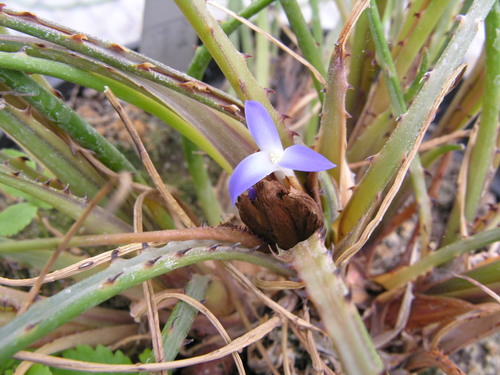
Puya chilensis
Molina
Cardon, Chilean puya, Chagual

(c) charif_tala, some rights reserved (CC BY-NC)

(c) Eric Rojas-Abarca, some rights reserved (CC BY-NC), uploaded by Eric Rojas-Abarca

(c) Camilo Contreras Landa, some rights reserved (CC BY-NC), uploaded by Camilo Contreras Landa
What to Eat
Edible parts: Leaves
Very young shoots are eaten raw in salads.
Where to Find It
It is a subtropical to tropical plant. In Chile it grows from sea level to 2,000 m altitude. It grows in dry and arid areas. It grows in full sun. It suits hardiness zones 10 & 11. It cannot tolerate frost.
Andes, Australia, Chile*, South America,
How to Identify
A small plant which forms a trunk with age. It grows 4.5 m high and spreads 2 m wide. The leaves are green and narrow and triangle shaped. There are strong teeth along the edge. They form a dense ring. The flower stem is 3.5 m high. It is erect and stout. The flower head is 100 cm long. There are up to 100 side branches each with up to 12 large yellow flowers. The upper part of the branches does not have flowers.
How to Grow
Requires a hot dry position. Requires a lime-free soil. Requires a sheltered well-drained position. This species is not very cold-hardy in Britain. However, plants can tolerate infrequent short-lived frosts down to about -5°c and can be grown outdoors in the mildest parts of the country. They are growing well at Probus Gardens in Cornwall where they survived temperatures lower than -6°c in the winter of 1995 - 6. The leaves have large, viciously hooked spines. Is the plant monocarpic? A self-sterile species, it is pollinated by birds in the wild. In cultivation, cross-pollination with P. alpestris can be effective.
Propagation: Sow seed in spring in a greenhouse. Prick seedlings into individual pots when large enough to handle and grow on under glass through at least their first winter. Plant out in late spring or early summer after the last expected frosts. Offsets can be divided in spring; larger divisions go directly into permanent positions. Smaller divisions are better potted and grown on in light shade in a cold frame until well established, then planted out in late spring or early summer.
Medicinal Uses
None known
Other Uses
Fibre extracted from the leaves is used to make nets. A soft material from the stems is used to make corks and bungs. A gum is obtained from the plant as a result of insect damage.
Wikipedia
Source ↗Puya chilensis is a species of terrestrial bromeliad. It is endemic to central Chile.
Notes
There are about 80-200 Puya species. They are mostly from the Andes of South America.
Names & Synonyms
References (7)
- Cundall, P., (ed.), 2004, Gardening Australia: flora: the gardener's bible. ABC Books. p 1115
- Kermath, B. M., et al, 2014, Food Plants in the Americas: A survey of the domesticated, cultivated and wild plants used for Human food in North, Central and South America and the Caribbean. On line draft. p 729
- Leon-Lobos, P., et al, 2022, Patterns of Traditional and Modern Uses of Wild Edible Native Plants of Chile: Challenges and Future Perspectives. Plants (Basel) v 11 (6) Table S1
- Plant Ecology - Reviews of Research. 1955, Arid Zone Research VI. UNESCO p 98
- Plants for a Future database, The Field, Penpol, Lostwithiel, Cornwall, PL22 0NG, UK. http://www.scs.leeds.ac.uk/pfaf/
- Sag. stor. nat. Chili 160, 351. 1782
- www.chileflora.com