Annona stenophylla
Engl. & Diels

(c) i_c_riddell, some rights reserved (CC BY), uploaded by i_c_riddell

Troos van der Merwe
(c) Bart Wursten, some rights reserved (CC BY-NC)
(c) Nicholas Wightman, some rights reserved (CC BY-NC)
What to Eat
Edible parts: Fruit
The pulp of ripe fruit is eaten raw or cooked. The ripe fruit can also be soaked in water, squeezed, and filtered to make juice. It is a staple food of the Bushmen and particularly enjoyed by children.
Where to Find It
A tropical plant. It grows in sandy or burnt out ground. In Tanzania it grows between 500-1,600 m above sea level.
Africa, Angola, Botswana, Central Africa, Congo, East Africa, Malawi, Mozambique, Namibia, South Africa, Southern Africa, Tanzania, Zambia, Zimbabwe,
How to Identify
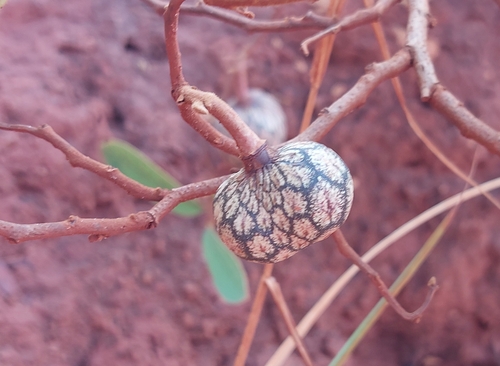
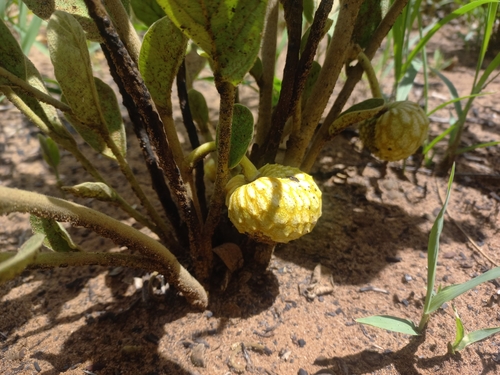
A low bush. It has underground stems or rhizomes. It grows 1 m high. The stems are usually annual and simple. The leaves are 4-18 cm long by 1-6 cm wide. They are narrowly oval. The veins are orange or red. The flowers occur singly. The fruit are 2-3 cm long by 2-3 cm wide. There are several seeds. They are 7-9 mm long. It has large fruit.
How to Grow
Plants can be grown from seeds.
Propagation: The seed of many species in this genus has a hard seedcoat and may benefit from scarification before sowing in order to speed up germination. This can usually be done by pouring a small amount of nearly boiling water on the seeds (being careful not to cook them!) and then soaking them for 12 - 24 hours in warm water. By this time they should have imbibed moisture and swollen - if they have not, then carefully make a nick in the seedcoat (being careful not to damage the embryo) and soak for a further 12 hours before sowing.
Medicinal Uses
A paste of the roots is used in traditional medicine in Zimbabwe to treat Sexually transmitted infections and as a snake repellant. Bioactive molecules extracted from the bark of the root are reported to have hypoglycemic activity in diabetic mice. The pulp of the ripe fruit is edible, with a sweet and pleasant taste. It is sought after for eating out of hand and also pressing for juice.
Wikipedia
Source ↗Annona stenophylla is a species of plant in the family Annonaceae. It is native to Tanzania and Zambia. Adolf Engler and Ludwig Diels, the German botanists who first formally described the species, named it after its narrow leaves (Latinized forms of Greek στενός, stenós, and φύλλον, phúllon).
Other Information
They are a staple food of the Bushmen. The fruit are enjoyed by children.
Notes
There are about 100-150 Annona species.
Names & Synonyms
Maroro, Mfila, Mshofu, Mtopetope, Muroro, Omutyaalale
References (18)
- Cheikhyoussef, A & Embashu, W., 2013, Ethnobotanical knowledge on Indigenous fruits in Ohangwena and Oshito regions in Northern Namibia. Journal of Ethnobiology and Ethnomedicine 9:34
- Flora Zambesiaca. http://apps.kew.org/efloras
- Fox, F. W. & Young, M. E. N., 1982, Food from the Veld. Delta Books. p 82
- Lee, 1979,
- Maguire, 1978,
- Marshall, 1976,
- Maundu, P. et al, 1999, Traditional Food Plants of Kenya. National Museum of Kenya. 288p
- Maroyi, A., 2011, The Gathering and Consumption of Wild Edible Plants in Nhema Communal Area, Midlands Province, Zimbabwe. Ecology of Food and Nutrition 50:6, 506-525
- Maroyi, A. & Cheikhyoussef, A., 2017, Traditional knowledge of wild edible fruit in southern Africa: A comparative use patterns in Namibia and Zimbabwe. Indian Journal of Traditional Knowledge. 16(3): 385-392
- Mpasiwakomu, R. A., 2017, The Diversity and Utilization of Wild Edible and Medicinal Plant Species found in Uvinza Miombo Woodlands, Tanzania. M. Sc. thesis University of Tanzania.
- Palmer, E and Pitman, N., 1972, Trees of Southern Africa. Vol. 1. A.A. Balkema, Cape Town p 587
- Peters, C. R., O'Brien, E. M., and Drummond, R.B., 1992, Edible Wild plants of Sub-saharan Africa. Kew. p 54
- Ruiters-Welcome, A. K., 2019, Food plants of southern Africa. Ph.D. thesis. Univ. of Johannesburg p 17
- Ruffo, C. K., Birnie, A. & Tengnas, B., 2002, Edible Wild Plants of Tanzania. RELMA p 138
- Tredgold, M.H., 1986, Food Plants of Zimbabwe. Mambo Press. p 84
- Welcome, A. K. & Van Wyk, B.-E., 2019, An inventory and analysis of the food plants of southern Africa. South African Journal of Botany 122 (2019) 136–179
- Wild, 1975,
- World Checklist of Useful Plant Species 2020. Royal Botanic Gardens, Kew


