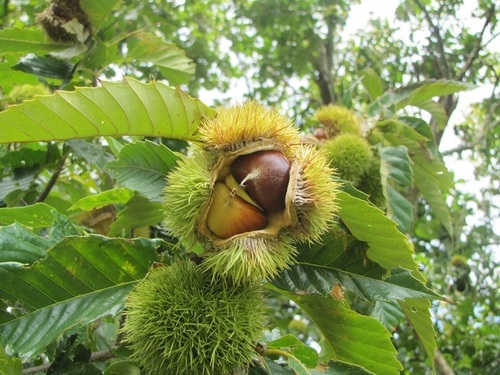
Quercus acutissima
Carruthers
Bristle-tipped oak, Sawthorn oak

(c) Bruce Kirchoff, some rights reserved (CC BY)
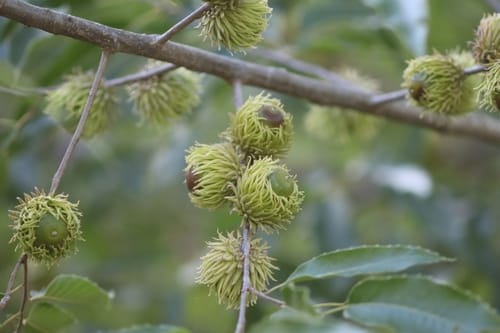
(c) lcart, some rights reserved (CC BY-NC)
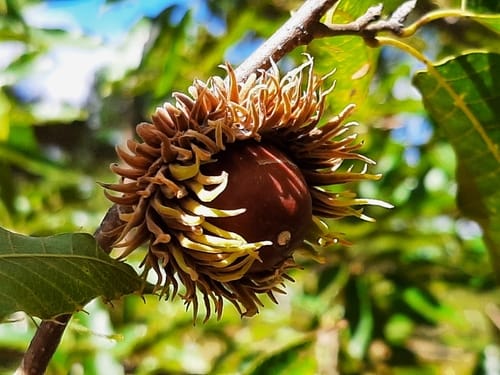
(c) lcart, some rights reserved (CC BY-NC)
What to Eat
Edible parts: Leaves, Seeds, Nuts
The seed, up to 25mm long, is edible when cooked. It can be dried and ground into a flour for thickening stews or mixed with cereals for bread. The seed contains bitter tannins that can be removed by washing thoroughly in running water, though minerals are also lost in the process. Tannins can be leached from whole seeds or from the dried ground powder, with the powder leaching faster. Leaching whole seeds can take several days to several weeks; one method was to place them in a cloth bag in a running stream. A taste test confirms when tannin levels are acceptable. A traditional preparation involved burying seed in boggy ground over winter and digging it up in spring once germinating, by which point most astringency would have gone. Young leaves can also be cooked, though they are considered a famine food used only when nothing else is available. The roasted seed makes a coffee substitute.
Where to Find It
It is a temperate plant. It is native in regions from the Himalayas to Japan. In China it grows in deciduous forest between 100-2200 m altitude. It suits hardiness zones 5-10. Mt Cootha Botanical Gardens. In Melbourne Botanical Gardens. Temperate. Hobart Botanical Gardens. Kyneton Botanical Gardens.
Africa, Asia, Australia, Bhutan, Cambodia, China, East Africa, Himalayas, India, Indochina, Japan, Korea, Laos, Myanmar, Nepal, SE Asia, Tasmania, Thailand, Vietnam, USA, Zimbabwe,
How to Identify
A tree. It grows to 30 m tall. It loses its leaves during the year. The leaf stalk is 1-3 cm long. The leaf blade is narrowly sword shape. It is 8-19 cm long by 2-6 cm wide. It is the same colour on both sides. The base is rounded and there are teeth along the edge. It tapers towards the tip. There are 13-18 secondary veins on each side of the main vein. The fruit are on the previous year's growth. There are 1-2 and they are 1.9-4.2 cm across the cup including the bract. The cup encloses up to half the nut. The nut is 1.5-2 cm long by 1.7-2.2 cm wide.
How to Grow
Prefers a good deep fertile loam which can be on the stiff side. Lime tolerant. Young plants tolerate reasonable levels of side shade. Tolerates moderate exposure, surviving well but being somewhat stunted. Prefers warmer summers than are usually experienced in Britain, trees often grow poorly in this country and fail to properly ripen their wood resulting in frost damage overwinter. Intolerant of root disturbance, trees should be planted in their permanent positions whilst young. The seed ripens in its second year. This species is closely related to Q. variabilis. Often cultivated in China as a coppiced tree for fuel and charcoal. Hybridizes freely with other members of the genus. Plants in this genus are notably resistant to honey fungus.
Propagation: Seed quickly loses viability if allowed to dry out. It can be stored moist and cool over winter but is best sown as soon as it is ripe in an outdoor seed bed, with protection from mice and squirrels. Small quantities can be sown in deep pots in a cold frame. Plants develop a deep taproot and should be moved to their permanent positions as soon as possible; seed sown in situ produces the best trees. Trees left in a nursery bed for more than 2 growing seasons will transplant very badly.
Medicinal Uses
The stem bark is used to clean foul sores. The seeds are used in treating diarrhoea, menorrhagia, and gastrointestinal hypertrophy. The cupule (seed cup) is astringent. Any galls produced on the tree are strongly astringent and have been used in treating haemorrhages, chronic diarrhoea, and dysentery.
Other Uses
A mulch of the leaves repels slugs and grubs; fresh leaves should be avoided as they can inhibit plant growth. Oak galls — caused by larvae of various insects feeding within the growths — are a rich source of tannin once the insect has pupated and departed, and can also be used as a dyestuff. A black dye is obtained from the seed cups. The wood is used for boat building and construction, as well as for fuel and charcoal production.
Wikipedia
Source ↗Quercus acutissima, the sawtooth oak, is an Asian species of oak native to China, Tibet, Korea, Japan, Taiwan, Siberia, Mongolia, Bangladesh, Philippines, Indonesia, Malaysia, India, Pakistan, Sri Lanka, Brunei, Indochina (Vietnam, Thailand, Myanmar, Cambodia, Laos), Himalayas (Nepal, Bhutan, Northeast India). It is widely planted in many lands and has become naturalized in parts of North America. Quercus acutissima is closely related to the Turkey oak, classified with it in Quercus sect. Cerris, a section of the genus characterized by shoot buds surrounded by soft bristles, bristle-tipped leaf lobes, and acorns that mature in about 18 months.
Other Information
It is available in markets in Korea.
Notes
There are about 600 Quercus species.
Names & Synonyms
Japanese chestnut oak, Japanese oak, Kunugi, Sangsurinamu, Sawtooth oak
References (19)
- Altschul, S.V.R., 1973, Drugs and Foods from Little-known Plants. Notes in Harvard University Herbaria. Harvard Univ. Press. Massachusetts. no. 658
- Ambasta S.P. (Ed.), 2000, The Useful Plants of India. CSIR India. p 508
- Bodkin, F., 1991, Encyclopedia Botanica. Cornstalk publishing, p 861
- Brickell, C. (Ed.), 1999, The Royal Horticultural Society A-Z Encyclopedia of Garden Plants. Convent Garden Books. p 853
- Coombes, A.J., 2000, Trees. Dorling Kindersley Handbooks. p 158
- Cundall, P., (ed.), 2004, Gardening Australia: flora: the gardener's bible. ABC Books. p 1122
- Facciola, S., 1998, Cornucopia 2: a Source Book of Edible Plants. Kampong Publications, p 115
- Hibbert, M., 2002, The Aussie Plant Finder 2002, Florilegium. p 244
- Huang Chengjiu, Zhang Yongtian, Bartholomew, B., Fagaceae, Flora of China.
- Hu, Shiu-ying, 2005, Food Plants of China. The Chinese University Press. p 350
- Jackes, D. A., 2007, Edible Forest Gardens
- J. Proc. Linn. Soc., Bot. 6:33. 1862
- Kim, H. & Song, M., 2013, Ethnobotanical analysis for traditional knowledge of wild edible plants in North Jeolla Province (Korea). Genetic. Resour. Crop Evol. (2013) 60:1571-1585
- Levy-Yamamori, R., & Taaffe, G., 2004, Garden Plants of Japan. Timber Press. p 202
- Lord, E.E., & Willis, J.H., 1999, Shrubs and Trees for Australian gardens. Lothian. p 69
- Pemberton, R. W. & Lee, N. S., 1996, Wild Food Plants in South Korea: Market Presence, New Crops, and Exports to the United States. Economic Botany, Vol. 50, No. 1, pp. 57-70
- Plants for a Future database, The Field, Penpol, Lostwithiel, Cornwall, PL22 0NG, UK. http://www.scs.leeds.ac.uk/pfaf/
- S.C.A.P.,
- Song, M., et al, 2013, Traditional knowledge of wild edible plants in Jeju Island, Korea. Indian Journal of Traditional Knowledge. 12(2) pp 177-194
More from Fagaceae