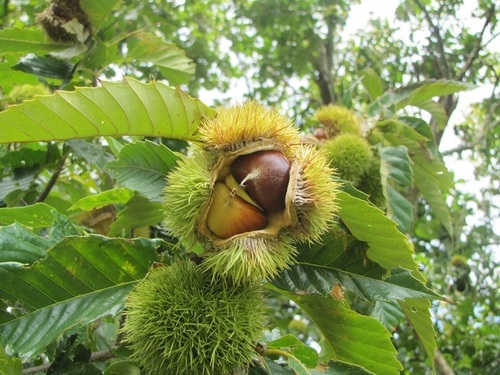
Quercus alba
L.
White oak, Quebec oak, Stave oak

(c) sophia_herrmeyer, some rights reserved (CC BY), uploaded by sophia_herrmeyer

(c) Douglas Goldman, some rights reserved (CC BY-SA), uploaded by Douglas Goldman
(c) alayna_flapjack, some rights reserved (CC BY-NC), uploaded by alayna_flapjack
What to Eat
Edible parts: Seeds
The seed, about 1–3cm long and ripening in its first year, can be eaten raw or cooked and is somewhat sweet. It contains around 6% protein and 65% carbohydrates and is low in tannin, requiring little if any leaching. Seeds with red or pink blotches on the shell are said to be the sweetest. Any bitter tannins present can be removed by washing the dried, ground seed thoroughly in water, though minerals are lost in the process. Whole seeds can also be leached but this takes several days to several weeks — one method was to place them in a cloth bag in a running stream, while powder leaches more quickly. A taste test confirms when tannin has been adequately removed. The traditional preparation involved burying seeds in boggy ground over winter and digging up the germinating seed in spring, by which point most astringency would be gone. The seed can be roasted and eaten, with a flavour described as something between sunflower seeds and popcorn. The roasted seed also makes a caffeine-free coffee substitute.
Where to Find It
It is native to eastern North America. Temperate. It grows in a variety of soils. It can tolerate some shade. It suits hardiness zones 5-9. Arboretum Tasmania.
Australia, Canada, Europe, France, Germany, Netherlands, North America*, Spain, Tasmania, USA,
How to Identify
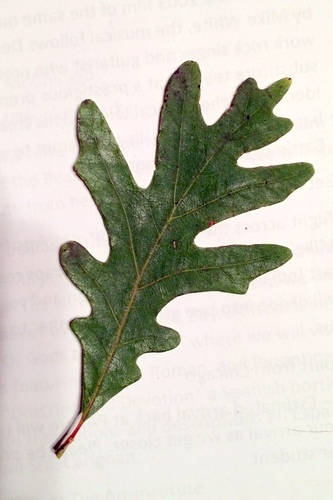
A medium to large tree. It grows to 35 m high. It spreads about 30 m wide. The trunk is 120 cm across. The leaves are 10-20 cm long and with 7-9 lobes. The leaves are usually widest above the middle. The lobes are rounded and narrow. There are deep notches between the lobes. The leaves are pinkish and downy when unfolded. The upper surface becomes bright green and they are paler underneath. They can turn reddish-purple in autumn. The acorns are 12-20 mm long. They occur either singly or in pairs. The cup is bowl shaped. It encloses about one quarter of the nut.
How to Grow
Prefers a good deep fertile loam which can be on the stiff side. Lime tolerant. Young plants tolerate reasonable levels of side shade. Tolerates moderate exposure, surviving well but being somewhat stunted. The white oak prefers warmer summers than are usually experienced in Britain, trees often grow poorly in this country and fail to properly ripen their wood resulting in frost damage over the winter. There are, however, a number of trees 20 metres tall in Britain, mainly in the south-east of the country. Sometimes cultivated for its edible seed, there are some named varieties. Trees take about 30 years before they start to bear good crops of seed, they then have heavy crops about every 3 years with light crops in the other years. They continue to yield commercial crops for about 120 years. The tree flowers on new growth produced in spring, the seed ripening in its first year. Intolerant of root disturbance, trees should be planted in their permanent positions whilst young, though they may require protection for the first winter or two. Hybridizes freely with other members of the genus. Plants in this genus are notably resistant to honey fungus. Oaks are generally not self-fertile; they require cross-pollination between different trees for acorn production. White oak (Quercus alba) trees can be self-fertile, but they produce more fruit when cross-pollinated with other white oaks. Acorns are harvested in Autumn, usually from September to November(Northern Hemisphere) , depending on the species and local climate. Oaks flower in Spring, with male flowers (catkins) appearing in April to June (Northern Hemisphere). Oaks generally have a slow to moderate growth rate, often taking several decades to reach full maturity. Some species may grow 1-2 feet per year under optimal conditions.
Propagation: Seed quickly loses viability if allowed to dry out. It can be stored moist and cool over winter but is best sown as soon as it is ripe in an outdoor seed bed, with protection from mice and squirrels. Small quantities can be sown in deep pots in a cold frame. Plants develop a deep taproot and should be moved to their permanent positions as soon as possible; seed sown in situ produces the best trees. Trees left in a nursery bed for more than 2 growing seasons will transplant very badly.
Medicinal Uses
White oak was widely used medicinally by several native North American Indian tribes, who valued it particularly for its antiseptic and astringent properties, applying it to a wide range of complaints. It is little if at all used in modern herbalism. The inner bark contains 6–11% tannin and has powerful antiseptic and astringent properties; it is also expectorant and tonic. A decoction of the bark has been drunk to treat bleeding piles, diarrhoea, intermittent fevers, coughs and colds, consumption, asthma, and lost voice. The bark has been chewed to treat mouth sores, and used externally as a wash for skin eruptions, burns, rashes, bruises, and ulcers, as a vaginal douche, and as a wash for muscular pains. Bark is best collected in spring. Any galls on the tree are strongly astringent and have been used in treating haemorrhages, chronic diarrhoea, and dysentery.
Other Uses
A mulch of the leaves can be placed around vulnerable plants to repel slugs, snails, and grubs; fresh leaves should be used with caution as they can reduce available soil nitrogen and inhibit plant growth. The bark is a rich source of tannin. Oak galls — caused by larvae of various insects feeding within the growths — are a rich source of tannin once the insect has left, and can also be used as a dyestuff. A brown dye obtained from the bark or galls requires no mordant; yellow, chrome, and gold can be obtained when mordants are used. The wood is strong, very heavy, hard, tough, close-grained, and durable, weighing around 46lb per cubic foot. When properly dried and treated it glues well, machines very well, and accepts a variety of finishes. It is one of the most important timbers in North America, used for cabinetmaking, furniture, panelling, flooring, construction, mine props, and agricultural tools, and is highly valued for making barrel staves for storing wine and liquor. The wood is also a good fuel, giving off considerable heat. White oak shows potential for use in reforestation and on disturbed sites including strip-mined lands in Ohio, Indiana, and Illinois, where it has shown good growth and survival on cast overburden and graded topsoil overlying mine spoils; it is well adapted to loamy and clayey spoils with a pH of 5.5 to 8.0.
Wikipedia
Source ↗Quercus alba, the white oak, is one of the preeminent hardwoods of eastern and central North America. It is a long-lived oak, native to eastern and central North America and found from Minnesota, Ontario, Quebec, and southern Maine south as far as northern Florida and eastern Texas. Specimens have been documented to be over 450 years old. Although called a white oak, it is very unusual to find an individual specimen with white bark; the usual colour is a light gray. The name comes from the colour of the undersides of the leaves. In the forest it can reach a magnificent height and in the open it develops into a massive broad-topped tree with large branches striking out at wide angles.
Production
It can live for several hundred years old.
Notes
There are about 600 Quercus species.
Names & Synonyms
Eastern white oak, Ecino
References (24)
- Beckstrom-Sternberg, Stephen M., and James A. Duke. "The Foodplant Database." http://probe.nalusda.gov:8300/cgi-bin/browse/foodplantdb.(ACEDB version 4.0 - data version July 1994)
- Bodkin, F., 1991, Encyclopedia Botanica. Cornstalk publishing, p 861
- Brickell, C. (Ed.), 1999, The Royal Horticultural Society A-Z Encyclopedia of Garden Plants. Convent Garden Books. p 853
- Coombes, A.J., 2000, Trees. Dorling Kindersley Handbooks. p 158
- Cundall, P., (ed.), 2004, Gardening Australia: flora: the gardener's bible. ABC Books. p 1122
- Elias, T.S. & Dykeman P.A., 1990, Edible Wild Plants. A North American Field guide. Sterling, New York p 228
- Esperanca, M. J., 1988. Surviving in the wild. A glance at the wild plants and their uses. Vol. 2. p 317
- Facciola, S., 1998, Cornucopia 2: a Source Book of Edible Plants. Kampong Publications, p 115
- Farrar, J.L., 1995, Trees of the Northern United States and Canada. Iowa State University press/Ames p 256
- Glowinski, L., 1999, The Complete Book of Fruit Growing in Australia. Lothian. p 137
- Grandtner, M. M., 2008, World Dictionary of Trees. Wood and Forest Science Department. Laval University, Quebec, Qc Canada. (Internet database http://www.wdt.qc.ca)
- Hedrick, U.P., 1919, (Ed.), Sturtevant's edible plants of the world. p 544
- Jackes, D. A., 2007, Edible Forest Gardens
- Kermath, B. M., et al, 2014, Food Plants in the Americas: A survey of the domesticated, cultivated and wild plants used for Human food in North, Central and South America and the Caribbean. On line draft. p 734
- Little, E.L., 1980, National Audubon Society Field Guide to North American Trees. Alfred A. Knopf. p 382
- Lord, E.E., & Willis, J.H., 1999, Shrubs and Trees for Australian gardens. Lothian. p 69
- MacKinnon, A., et al, 2009, Edible & Medicinal Plants of Canada. Lone Pine. p 58
- Menninger, E.A., 1977, Edible Nuts of the World. Horticultural Books. Florida p 19
- Moerman, D. F., 2010, Native American Ethnobotany. Timber Press. p 458
- Plants for a Future database, The Field, Penpol, Lostwithiel, Cornwall, PL22 0NG, UK. http://www.scs.leeds.ac.uk/pfaf/
- Schuler, S., (Ed.), 1977, Simon & Schuster's Guide to Trees. Simon & Schuster. No. 149
- Sp. pl. 2:996. 1753
- Toupal, R. S. & Hollenback, K., 2009, An Ethnobotany of Indiana Dunes National Lakeshore: Plant Uses of the Ojibwa People. Bureau of Applied Research in Anthropology. University of Arizona
- Wickens, G.E., 1995, Edible Nuts. FAO Non-wood forest products. FAO, Rome. p 127
More from Fagaceae