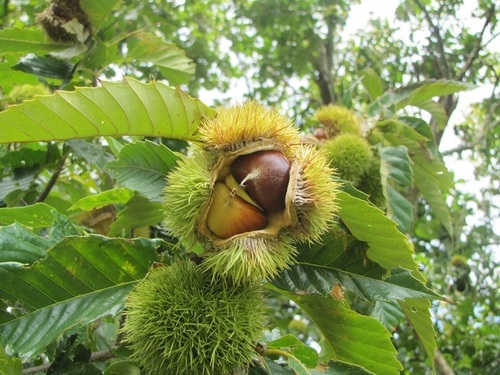
Quercus bicolor
Willd.
Swamp White Oak

(c) Bart Lawrence, some rights reserved (CC BY-NC), uploaded by Bart Lawrence

(c) Jean-Pol GRANDMONT, some rights reserved (CC BY-SA)

(c) Maggie, some rights reserved (CC BY-NC)
What to Eat
Edible parts: Seeds, Nuts
The seed has a fairly sweet flavour and can be eaten raw or cooked. It is notably large — around 2–3cm long and 15–20mm wide — and, unusually for oaks, hangs from the tree on a long stem. It matures in its first year. The seed can be dried and ground into a powder for use as a stew thickener or bread-making ingredient when combined with cereals. Seeds from some trees carry bitter tannins, which can be leached out by washing thoroughly in running water, though this also removes some minerals. Either whole seeds or ground powder can be leached. Whole seeds may take several days or weeks — wrapping them in a cloth bag in a stream is one established method. Powder leaches more quickly. A taste test will confirm when tannin levels are acceptable. Traditionally, seeds were also buried in boggy ground over winter; the germinating seed dug up in spring would have lost most of its astringency. The roasted seed serves as a coffee substitute.
Known Hazards
Where to Find It
It is a temperate plant. It grows in moist flat land and along the edges of swamps. It can tolerate some shade. In Melbourne Botanical Gardens. It suits hardiness zones 4-10. Arboretum Tasmania.
Australia, Canada, North America, Tasmania, USA,
How to Identify
A medium sized tree. It grows to 22 m high. The trunk can be 90 cm across. The trunk is short and forked. The crown is open and rounded. The leaves are 12-17 cm long. They are widest above the middle. They taper to a wedge shaped base. Each vein ends in a shallow rounded lobe. The leaves are shiny dark green on the upper surface and pale greyish-green underneath. There are many white hairs. The acorns are 20-30 mm long. They occur either singly or in pairs. The acorn stalks are 2-10 cm long. The tips of the scales of the cup curve backwards. The cup encloses about one third of the nut. The cup usually has a fringe along the edge.
How to Grow
Prefers a good deep fertile loam which can be on the stiff side. Young plants tolerate reasonable levels of side shade. Tolerates moderate exposure, surviving well but being somewhat stunted. Prefers warmer summers than are usually experienced in Britain, trees often grow poorly in this country and fail to properly ripen their wood resulting in frost damage overwinter. A relatively fast-growing tree in the wild, living 300 - 350 years, though it is relatively shallow-rooted and is considerably more susceptible to forest fires than most other oaks. This species is one of the best of the white oaks for growing in this country. However, it is said that the seed is rarely formed in Britain. The tree flowers on new growth produced in spring, the seed ripening in its first year. Trees do not commence bearing until about 25 - 30 years old, large crops being produced every 3 - 5 years. Intolerant of root disturbance, trees should be planted in their permanent positions whilst young. The seed of this species is attached to the tree by unusually long (by oak tree standards) stems. Hybridizes freely with other members of the genus. Plants in this genus are notably resistant to honey fungus.
Propagation: Seed loses viability quickly if allowed to dry out. It can be stored moist and cool over winter, but is best sown as soon as it ripens in an outdoor seed bed with protection against mice and squirrels. Small quantities can be sown in deep pots in a cold frame. Plants develop a deep taproot and should be placed in their permanent positions as soon as possible — seed sown in situ produces the best trees. Trees should not be left in a nursery bed for more than two growing seasons, as they transplant very poorly after that point.
Medicinal Uses
Any galls that form on the tree are strongly astringent and have been used in the treatment of haemorrhages, chronic diarrhoea, and dysentery.
Other Uses
The leaves of most oaks are more or less rich in tannins. Partially decayed leaves can be used as a mulch around vulnerable plants to repel slugs, snails, and grubs. Fresh leaves should be used with caution, as their decomposition can draw on soil nitrogen and inhibit plant growth. Oak galls — formed through the activity of insect larvae — serve as a tannin source once the insects have left, and can also be used as a dyestuff. The bark has been boiled together with hemlock (Tsuga sp.) and soft maple bark (Acer spp.), and the resulting liquid used to remove rust and reportedly to prevent its return. The wood is close-grained, strong, hard, tough, and heavy, weighing 48lb per cubic foot. Trees do not self-prune, so dead branches remain and the wood tends to be knotty. It machines well but can check and warp if not dried properly. It has some commercial importance and is used for construction, cabinetmaking, furniture, interior finishes, veneers, and fence posts. It also makes a good fuel.
Wikipedia
Source ↗Quercus bicolor, the swamp white oak, is a North American species of medium-sized trees in the beech family. It is a common element of America's north central and northeastern mixed forests. It can survive in a variety of habitats. It forms hybrids with bur oak where they occur together in the wild.
Production
Trees can live for 200 years.
Notes
There are about 600 Quercus species.
Names & Synonyms
References (16)
- Beckstrom-Sternberg, Stephen M., and James A. Duke. "The Foodplant Database." http://probe.nalusda.gov:8300/cgi-bin/browse/foodplantdb.(ACEDB version 4.0 - data version July 1994)
- Brickell, C. (Ed.), 1999, The Royal Horticultural Society A-Z Encyclopedia of Garden Plants. Convent Garden Books. p 853
- Cundall, P., (ed.), 2004, Gardening Australia: flora: the gardener's bible. ABC Books. p 1122
- Facciola, S., 1998, Cornucopia 2: a Source Book of Edible Plants. Kampong Publications, p 115
- Farrar, J.L., 1995, Trees of the Northern United States and Canada. Iowa State University press/Ames p 260
- Ges. Naturf. Freunde Berlin Neue Schriften 3:396. 1801
- Grandtner, M. M., 2008, World Dictionary of Trees. Wood and Forest Science Department. Laval University, Quebec, Qc Canada. (Internet database http://www.wdt.qc.ca)
- Hibbert, M., 2002, The Aussie Plant Finder 2002, Florilegium. p 244
- Jackes, D. A., 2007, Edible Forest Gardens
- Kermath, B. M., et al, 2014, Food Plants in the Americas: A survey of the domesticated, cultivated and wild plants used for Human food in North, Central and South America and the Caribbean. On line draft. p 734
- Little, E.L., 1980, National Audubon Society Field Guide to North American Trees. Alfred A. Knopf. p 384
- MacKinnon, A., et al, 2009, Edible & Medicinal Plants of Canada. Lone Pine. p 58
- Menninger, E.A., 1977, Edible Nuts of the World. Horticultural Books. Florida p 19
- Moerman, D. F., 2010, Native American Ethnobotany. Timber Press. p 459
- Plants for a Future database, The Field, Penpol, Lostwithiel, Cornwall, PL22 0NG, UK. http://www.scs.leeds.ac.uk/pfaf/
- Toupal, R. S. & Hollenback, K., 2009, An Ethnobotany of Indiana Dunes National Lakeshore: Plant Uses of the Ojibwa People. Bureau of Applied Research in Anthropology. University of Arizona
More from Fagaceae