Quercus cerris
L.
Turkey Oak, Bitter oak, Mossy-cupped oak, Cerro, Italian oak, European Turkey oak
no rights reserved, uploaded by Stephen James McWilliam

(c) Douglas Goldman, some rights reserved (CC BY-SA), uploaded by Douglas Goldman
(c) Alexey, some rights reserved (CC BY-NC), uploaded by Alexey
What to Eat
Edible parts: Manna, Seeds, Sap, Nut, Nuts - coffee
The seed, up to 2.5cm long, must be cooked before use. It can be dried, ground into a powder, and used as a stew thickener or combined with cereals for bread-making. Bitter tannins are present and can be leached out by thoroughly washing the seed in running water, though this also removes some minerals. Whole seeds or ground powder can both be leached — whole seeds may take several days or even weeks, and placing them in a cloth bag in a running stream is one traditional method. Powder leaches faster, and a taste test confirms when sufficient tannin has been removed. Alternatively, the seed can be buried in boggy ground over winter; the germinating seed dug up in spring will have lost most of its astringency. The roasted seed serves as a coffee substitute. A sweet fluid also exudes from insect-damaged stems and solidifies on the bark. This substance is edible, sold as a manna in local markets in Iran, and can be boiled down into a syrup for sweetening food.
Where to Find It
It is a temperate plant. It is native to central and southern Europe. They grow well on chalky soils. It can tolerate hot climates. It can tolerate drought. It suits hardiness zones 7-10. Arboretum Tasmania. In Melbourne Botanical Gardens. Hobart Botanical Gardens.
Australia, Balkans, Bosnia, Britain, Europe, France, Greece, Hungary, Italy, Mediterranean, San Marino, Slovenia, Tasmania, Turkey, Türkiye,
How to Identify
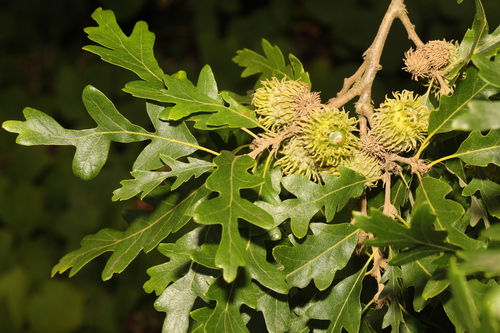
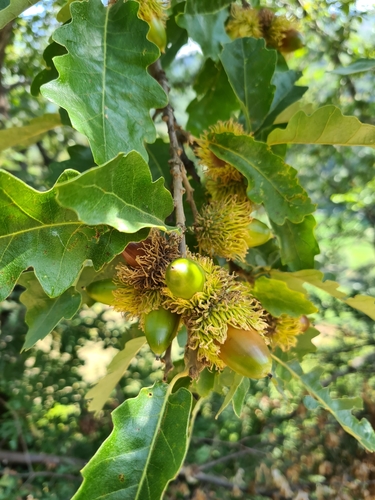
A large tree which loses its leaves. It grows to 38 m high. It has a large broad crown. The bark is cracked and rough. The leaves are alternate. They have deeply cut lobes. They are rough, dark green and shiny on top. There are leafy stipules around the leaf base. The flowers are separately male and female. The male flowers hang in dense bunches and the female flowers are small. The acorns are produced in very mossy cups.
How to Grow
Prefers a good deep fertile loam which can be on the stiff side. Grows well on chalk, even when the soil is shallow. Young plants tolerate reasonable levels of side shade. Tolerates moderate exposure, surviving well but being somewhat stunted. Grows well near the coast. Intolerant of root disturbance, trees should be planted in their permanent positions whilst young. A very ornamental tree, it grows very well in Britain and is the fastest growing of the oaks in cultivation in this country. The seed ripens in its second year. Trees transplant badly unless they are moved regularly. Hybridizes freely with other members of the genus. This species is notably resistant to honey fungus.
Propagation: Seed loses viability quickly if allowed to dry out. It can be stored moist and cool over winter, but is best sown as soon as it ripens in an outdoor seed bed with protection against mice and squirrels. Small quantities can be sown in deep pots in a cold frame. Plants develop a deep taproot and should be placed in their permanent positions as soon as possible — seed sown in situ gives the best results. Trees should not be left in a nursery bed for more than two growing seasons, as they transplant very poorly after that point.
Medicinal Uses
Any galls that form on the tree are strongly astringent and have been used in the treatment of haemorrhages, chronic diarrhoea, and dysentery.
Other Uses
The dried seed cups can be used as buttons. A leaf mulch repels slugs and grubs, though fresh leaves should not be used as they can inhibit the growth of young plants. Oak galls — growths triggered by insect larvae living inside them — are a useful tannin source once the insects have pupated and left, and can also be used as a dyestuff. The leaves, bark, and wood are all commercially used as tannin sources. The wood is valued by wheelwrights, turners, and cabinetmakers, though it is considered of limited overall value and does not weather well.
Wikipedia
Source ↗Quercus cerris, the Turkey oak or Austrian oak, is an oak native to south-eastern Europe and Asia Minor. It is the type species of Quercus sect. Cerris, a section of the genus characterised by shoot buds surrounded by soft bristles, bristle-tipped leaf lobes, and acorns that usually mature in 18 months.
Production
It is fast growing.
Notes
There are about 600 Quercus species.
Names & Synonyms
Cserelfa, Cserfa, Ghianda, Hrast cer, Mese
References (24)
- Bodkin, F., 1991, Encyclopedia Botanica. Cornstalk publishing, p 862
- Brickell, C. (Ed.), 1999, The Royal Horticultural Society A-Z Encyclopedia of Garden Plants. Convent Garden Books. p 853
- Coombes, A.J., 2000, Trees. Dorling Kindersley Handbooks. p 160
- Cundall, P., (ed.), 2004, Gardening Australia: flora: the gardener's bible. ABC Books. p 1123
- Denes, A., et al, 2012, Wild plants used for food by Hungarian ethnic groups living in the Carpathian Basin. Acta Societatis Botanicorum Poloniae 81 (4): 381-396
- Ertug, F., 2000, An Ethnobotanical Study in Central Anatolia (Turkey). Economic Botany Vol. 54. No. 2. pp. 155-182
- Ertug, F, Yenen Bitkiler. Resimli Türkiye Florası -I- Flora of Turkey - Ethnobotany supplement
- Facciola, S., 1998, Cornucopia 2: a Source Book of Edible Plants. Kampong Publications, p 115
- Harris, E & J., 1983, Field Guide to the Trees and Shrubs of Britain. Reader's Digest. p 158
- Hedrick, U.P., 1919, (Ed.), Sturtevant's edible plants of the world. p 545
- Hibbert, M., 2002, The Aussie Plant Finder 2002, Florilegium. p 244
- http://www.botanic-gardens-ljubljana.com/en/plants
- Lord, E.E., & Willis, J.H., 1999, Shrubs and Trees for Australian gardens. Lothian. p 69
- Menninger, E.A., 1977, Edible Nuts of the World. Horticultural Books. Florida p 19
- Morley, B. & Everard, B., 1970, Wild Flowers of the World. Ebury press. Plate 12
- Pieroni, A., 1999, Gathered wild food plants in the Upper Valley of the Serchio River (Garfagnana), Central Italy. Economic Botany 53(3) pp 327-341
- Plants for a Future database, The Field, Penpol, Lostwithiel, Cornwall, PL22 0NG, UK. http://www.scs.leeds.ac.uk/pfaf/
- Polat, R., et al, 2015, Survey of wild food plants for human consumption in Elazig (Turkey). Indian Journal of Traditional Knowledge. Vol. 1(1): 69-75
- Redzic, S. J., 2006, Wild Edible Plants and their Traditional Use in the Human Nutrition in Bosnia-Herzegovina. Ecology of Food and Nutrition, 45:189-232
- Rivera, D. et al, 2006, Gathered Mediterranean Food Plants - Ethnobotanical Investigations and Historical Development, in Heinrich M, Müller WE, Galli C (eds): Local Mediterranean Food Plants and Nutraceuticals. Forum Nutr. Basel, Karger, 2006, vol 59, pp 18–74
- Schuler, S., (Ed.), 1977, Simon & Schuster's Guide to Trees. Simon & Schuster. No. 151
- Sfikas, G., 1984, Trees and shrubs of Greece. Efstathiadis Group. Athens. p 148
- Sp. pl. 2:997. 1753
- Svanberg, I. et al, 2012, Uses of tree saps in northern and eastern parts of Europe. Acta Societatis Botanicorum Poloniae 81 (4): 343-357
More from Fagaceae