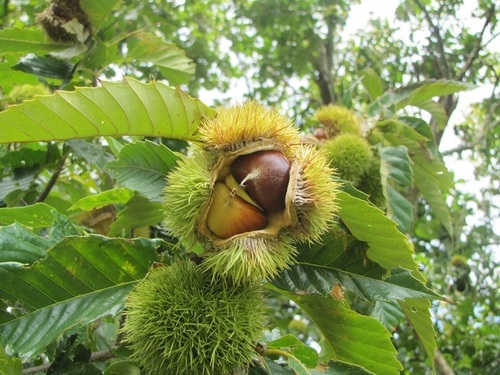
Quercus coccifera
L.
Kermes Oak, Grain tree
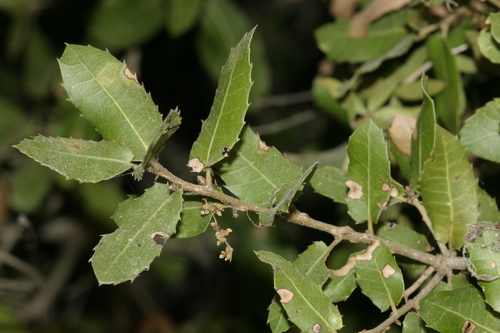
(c) Errol Véla, some rights reserved (CC BY-NC), uploaded by Errol Véla
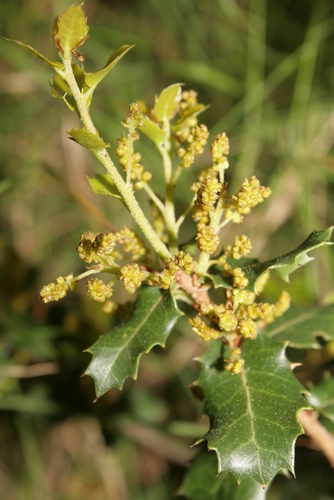
(c) Errol Véla, some rights reserved (CC BY-NC), uploaded by Errol Véla
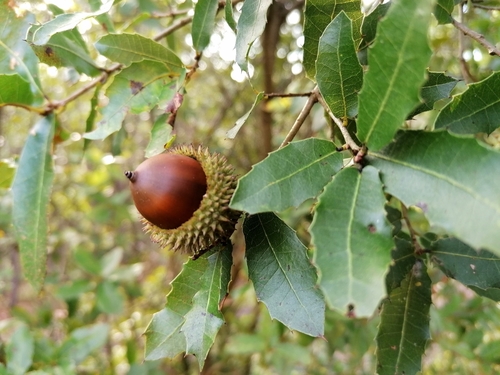
(c) Mariana Dias, some rights reserved (CC BY-NC), uploaded by Mariana Dias
What to Eat
Edible parts: Seeds, Acorns, Nuts
The seed must be cooked before use. It can be dried, ground into a powder, and used as a stew thickener or mixed with cereals for bread-making. Bitter tannins are present and can be removed by thoroughly washing the seed in running water, though this also leaches out some minerals. Either whole seeds or ground powder can be used for leaching. Whole seeds may take several days or weeks — placing them in a cloth bag in a running stream is one proven method. Ground powder leaches more quickly, and a taste test confirms when enough tannin has been removed. Traditionally, seeds were buried in boggy ground over winter; the germinating seed dug up in spring would have lost most of its astringency. The roasted seed serves as a coffee substitute.
Where to Find It
It grows in Mediterranean countries. In Melbourne Botanical Gardens. Temperate.
Africa, Australia, Europe, Greece, Jordan, Mediterranean, Middle East, North Africa, Slovenia, Spain, Turkey, Türkiye,
How to Identify
A low evergreen shrub. It grows 3-4 m high. The bark is grey and smooth. It becomes scaly when old. The leaves are like holly. They are shiny on both upper and lower surface. They are leathery. They are 1-4 cm long. The fruit occur singly or in pairs. It has sharp scales on the cup around the acorn. The cup is 1-3 cm across. The acorn is 1.5-3 cm long.
How to Grow
Prefers a good deep fertile loam which can be on the stiff side. Lime tolerant. Young plants tolerate reasonable levels of side shade. Tolerates moderate exposure, surviving well but being somewhat stunted. A very ornamental plant, it thrives in Britain. A shrub growing in dappled woodland shade at Cambridge Botanical Gardens produced a few ripe seeds after the hot summer of 1989, though the vast majority of seeds were aborted. The fruit ripens in its second year. Intolerant of root disturbance, trees should be planted in their permanent positions whilst young. Any transplanting should be done once growth has commenced in late May or in September. Hybridizes freely with other members of the genus. This species is notably resistant to honey fungus.
Propagation: Seed loses viability quickly if allowed to dry out. It can be stored moist and cool over winter, but is best sown as soon as it ripens in an outdoor seed bed protected from mice and squirrels. Small quantities can be sown in deep pots in a cold frame. Plants develop a deep taproot and should be moved to permanent positions as soon as possible — seed sown in situ gives the best results. Trees should not be left in a nursery bed for more than two growing seasons, as they transplant very poorly after that point.
Medicinal Uses
Any galls that form on the tree are strongly astringent and have been used in the treatment of haemorrhages, chronic diarrhoea, and dysentery.
Other Uses
A leaf mulch helps repel slugs and grubs, though fresh leaves should not be used as they can inhibit plant growth. Oak galls — produced when insect larvae develop inside growths on the tree — are a rich tannin source once the insects have left, and this tannin can also be used as a dyestuff. The bark is rich in tannin, and a black dye can be extracted from both the bark and the seeds.
Wikipedia
Source ↗Quercus coccifera, commonly known as kermes oak, holly oak, or Palestine oak, is an evergreen oak shrub or tree in section Ilex of the genus. It has many synonyms, including Quercus calliprinos. It is native to the Mediterranean region and Northern African Maghreb, south to north from Morocco to France and west to east from Portugal to Cyprus and Turkey, crossing Spain, Italy, Libya, the Balkans, and Greece, including Crete. The Kermes oak was historically important as the food plant of Kermes scale insects, from which a red dye called crimson was obtained. The etymology of the specific name coccifera is related to the production of red cochineal (crimson) dye and derived from Latin coccum which was from Greek κόκκος, the kermes insect. The Latin -fera means 'bearer'.
Notes
There are about 600 Quercus species. The cochineal insect often grows on this tree.
Names & Synonyms
Ballut, Coscoja, Kermes mesesi, Marana, Mese, Pilit, Piynar, Sidian
References (17)
- Al-Qura'n, S. A., 2010, Ethnobotanical and Ecological Studies of Wild Edible Plants in Jordan. Libyan Agriculture Research Center Journal International 1(4):231-243
- Blamey, M and Grey-Wilson, C., 2005, Wild flowers of the Mediterranean. A & C Black London. p 31
- Brickell, C. (Ed.), 1999, The Royal Horticultural Society A-Z Encyclopedia of Garden Plants. Convent Garden Books. p 853
- Ertug, F., 2004, Wild Edible Plants of the Bodrum Area. (Mugla, Turkey). Turk. J. Bot. 28 (2004): 161-174
- Ertug, F, Yenen Bitkiler. Resimli Türkiye Florası -I- Flora of Turkey - Ethnobotany supplement
- Gunes, S. et al, 2018, Survey of wild food plants for human consumption in Karaisali (Adana-Turkey). Indian Journal of Traditional Knowledge. Vol. 17(2), April 2018, pp 290-298
- Hedrick, U.P., 1919, (Ed.), Sturtevant's edible plants of the world. p 545
- http://www.botanic-gardens-ljubljana.com/en/plants
- Menninger, E.A., 1977, Edible Nuts of the World. Horticultural Books. Florida p 19
- Morley, B. & Everard, B., 1970, Wild Flowers of the World. Ebury press. Plate 31
- Oran, S. A. S., 2015, Selected Wild Aromatic Plants in Jordan. International Journal of Medicinal Plants. Photon 108 (2015) 686-699
- Plants for a Future database, The Field, Penpol, Lostwithiel, Cornwall, PL22 0NG, UK. http://www.scs.leeds.ac.uk/pfaf/
- Sfikas, G., 1984, Trees and shrubs of Greece. Efstathiadis Group. Athens. p 154
- Sp. pl. 2:995. 1753
- Tardio, J., et al, Ethnobotanical review of wild edible plants in Spain. Botanical J. Linnean Soc. 152 (2006), 27-71
- Tukan, S. K., et al, 1998, The use of wild edible plants in the Jordanian diet. International Journal of Food Sciences and Nutrition. 49:225-235
- Wickens, G.E., 1995, Edible Nuts. FAO Non-wood forest products. FAO, Rome. p 127
More from Fagaceae