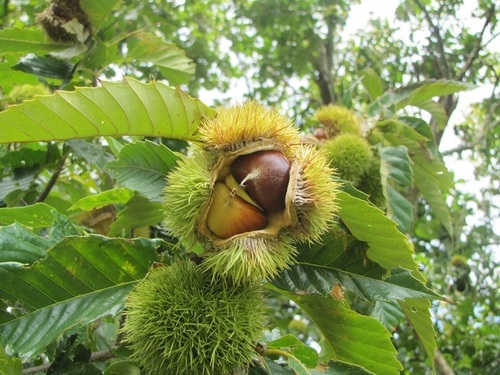
Quercus dentata
Thunb.
Japanese emperor oak, Daimyo oak, Kashiwa

(c) Chuangzao, some rights reserved (CC BY-NC), uploaded by Chuangzao
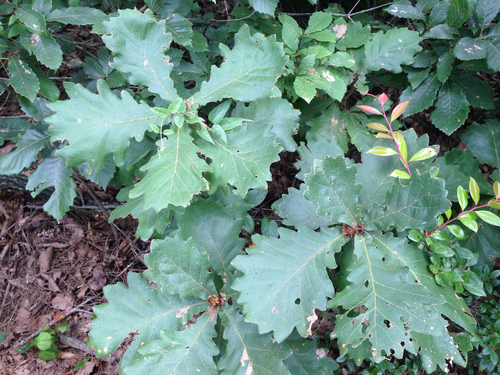
(c) Kim, Hyun-tae, some rights reserved (CC BY), uploaded by Kim, Hyun-tae
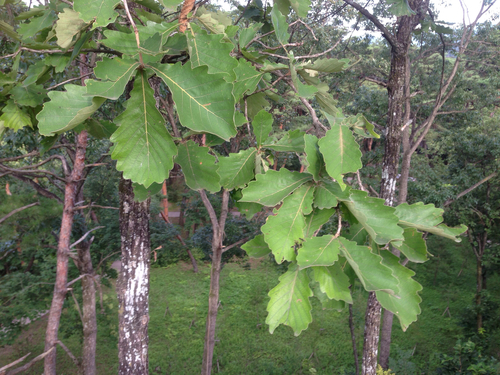
(c) Kim, Hyun-tae, some rights reserved (CC BY), uploaded by Kim, Hyun-tae
What to Eat
Edible parts: Seeds, Nuts, Leaves - flavouring
The seed, up to 23mm long and 15mm wide, is rich in starch and must be cooked before use. It can be dried, ground into a powder, and used as a stew thickener or mixed with cereals for bread-making. Bitter tannins are present and can be leached out by thoroughly washing the seed in running water, though this also removes some minerals. Either whole seeds or ground powder can be used. Whole seeds may take several days or even weeks to leach properly — placing them in a cloth bag in a running stream is one traditional approach. Ground powder leaches more quickly. A taste test confirms when sufficient tannin has been removed. Seeds could also be buried in boggy ground over winter; the germinating seed dug up in spring would have lost most of its astringency. The roasted seed serves as a coffee substitute.
Where to Find It
It is a temperate plant. In China it grows in mixed forest between 100-2700 m altitude. It suits hardiness zones 7-9. Hobart Botanical Gardens. In Melbourne Botanical Gardens. Arboretum Tasmania.
Asia, Australia, China*, Japan*, Korea, Manchuria, Mongolia, Taiwan, Tasmania,
How to Identify
A tree. It grows about 7-25 m tall. It loses its leaves during the year. The small branches have a yellow covering. The leaf stalk is 2-5 mm long. The leaf blade is oval and 10-30 cm long by 6-30 cm wide. The edges have a few wavy or rough teeth. There are 4-10 secondary veins on each side of the mid vein. The female flower is in the axils of leaves near the ends of young branches. They are 1-3 cm long. The cup is 1.2-2 cm long by 2-5 cm wide including the bracts. The nut is oval and 1.5-2.3 cm long by 1.2-1.5 cm wide.
How to Grow
Prefers a good deep fertile loam which can be on the stiff side. Prefers an acid soil. Young plants tolerate reasonable levels of side shade. Tolerates moderate exposure, surviving well but being somewhat stunted. Trees are fast growing, but they prefer warmer summers than are usually experienced in Britain and often grow poorly in this country, failing to properly ripen their wood which results in frost damage overwinter. Intolerant of root disturbance, trees should be planted in their permanent positions whilst young. The seed ripens in its first year. Hybridizes freely with other members of the genus. Plants in this genus are notably resistant to honey fungus.
Propagation: Seed loses viability quickly if allowed to dry out. It can be stored moist and cool over winter, but is best sown as soon as it ripens in an outdoor seed bed with protection from mice and squirrels. Small quantities can be sown in deep pots in a cold frame. Plants develop a deep taproot and should be moved to permanent positions as soon as possible — seed sown in situ gives the best results. Trees should not be left in a nursery bed for more than two growing seasons, as they transplant very poorly after that point.
Medicinal Uses
Any galls that form on the tree are strongly astringent and have been used in the treatment of haemorrhages, chronic diarrhoea, and dysentery.
Other Uses
A leaf mulch helps repel slugs and grubs, though fresh leaves should not be used as they can inhibit plant growth. Oak galls — formed when insect larvae develop inside growths on the tree — are a useful tannin source once the insects have left, and the tannin can also be used as a dyestuff. Tannin is also obtained from the bark.
Wikipedia
Source ↗Quercus dentata, also called Japanese emperor oak, daimyo oak, or Korean oak (Japanese: 柏, kashiwa; traditional Chinese: 柞櫟; simplified Chinese: 柞栎; pinyin: zuòlì; Korean: 떡갈나무, tteokgalnamu), is a species of oak native to East Asia (Japan, Korea and China). The name of the tree is often translated as "sweet oak" in English to distinguish it from Western varieties. It is placed in section Quercus.
Production
It is slow growing.
Notes
There are about 600 Quercus species.
Names & Synonyms
Kom-ni, Konmu-ni, Tteokgalnamu
References (14)
- Cundall, P., (ed.), 2004, Gardening Australia: flora: the gardener's bible. ABC Books. p 1123
- Facciola, S., 1998, Cornucopia 2: a Source Book of Edible Plants. Kampong Publications, p 115
- Hibbert, M., 2002, The Aussie Plant Finder 2002, Florilegium. p 244
- Huang Chengjiu, Zhang Yongtian, Bartholomew, B., Fagaceae, Flora of China.
- Hwang, H., et al, 2013, A Study on the Flora of 15 Islands in the Western Sea of Jeollanamdo Province, Korea. Journal of Asia-Pacific Biodiversity Vol. 6, No. 2 281-310
- Kim, H. & Song, M., 2013, Ethnobotanical analysis for traditional knowledge of wild edible plants in North Jeolla Province (Korea). Genetic. Resour. Crop Evol. (2013) 60:1571-1585
- Levy-Yamamori, R., & Taaffe, G., 2004, Garden Plants of Japan. Timber Press. p 201
- Lord, E.E., & Willis, J.H., 1999, Shrubs and Trees for Australian gardens. Lothian. p 69
- J. A. Murray, Syst. veg. ed. 14:858. 1784 May-Jun (Fl. jap. 177. 1784 Aug)
- Plants for a Future database, The Field, Penpol, Lostwithiel, Cornwall, PL22 0NG, UK. http://www.scs.leeds.ac.uk/pfaf/
- Ryan, S., 2008, Dicksonia. Rare Plants Manual. Hyland House. p 50
- Williams, D., 2017, Ainu Ethnobiology. Contributions in Ethnobiology. Society of Ethnobiology. p 138
- World Checklist of Useful Plant Species 2020. Royal Botanic Gardens, Kew
- Zeven, A. C. & de West, J. M. J., 1982, Dictionary of cultivated plants and their regions of diversity. Wageningen. p 36
More from Fagaceae