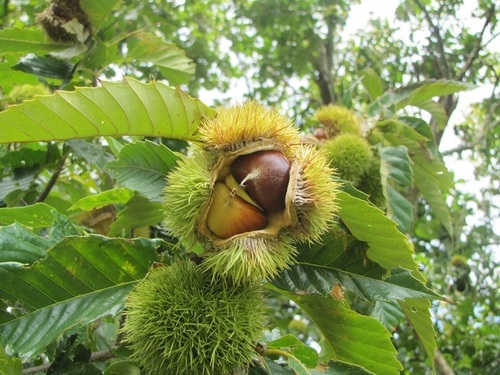
Quercus falcata
Michx.
Southern red oak, Spanish oak

(c) Lisa Travis, some rights reserved (CC BY-NC), uploaded by Lisa Travis
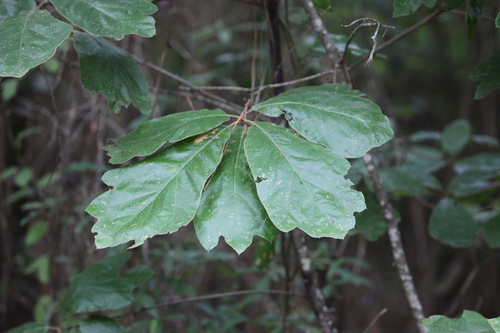
(c) reginagsnow, some rights reserved (CC BY-NC), uploaded by reginagsnow

(c) Scott Ward, some rights reserved (CC BY), uploaded by Scott Ward
What to Eat
Edible parts: Seeds, Nut
The acorn, about 12mm long, must be cooked before eating. It can be dried and ground into flour for thickening stews or mixing with cereals for bread. Bitter tannins are present and must be removed by washing thoroughly in running water, though minerals are lost in the process. Whole seeds may take several days or weeks to leach properly; wrapping them in a cloth bag and placing in a running stream is one method. Ground meal leaches faster. A taste test confirms when enough tannin has been removed. The traditional preparation method was to bury the seeds in boggy ground over winter and dig them up in spring, once most of the astringency had gone. The roasted seed makes a coffee substitute.
Where to Find It
It is a temperate plant. It is native to the S.E. United States. They grow in dry woods from the coast to the mountains. It suits hardiness zones 8-10. Arboretum Tasmania.
Australia, North America, Tasmania, USA,
How to Identify
A deciduous tree. It grows 25 m high. It is a broadly spreading oak tree. The bark is dark grey-brown and has cracks. These form narrow ridges. The leaves are narrowly oval and 20 cm long by 15 cm across. They are deeply divided into lobes. They are dark green and smooth above and have brown or grey hairs underneath. The male and female flowers are separate on the same plant. The males are more obvious in yellow-green catkins which droop. The fruit is an acorn 2 cm long. It is about one third enclosed in a narrow cup.
How to Grow
Prefers a good deep fertile loam which can be on the stiff side. Young plants tolerate reasonable levels of side shade. Tolerates moderate exposure, surviving well but being somewhat stunted. A moderately fast-growing tree in its native range, where it lives about 100 - 10 years. It prefers warmer summers than are usually experienced in Britain, trees often grow poorly in this country and fail to properly ripen their wood resulting in frost damage overwinter. Trees commence bearing seed when about 25 years old, production is cyclic with a year of high yields being followed by a few years of low yields. The tree flowers on new growth produced in spring, the seed taking two summers to ripen. Intolerant of root disturbance, trees should be planted in their permanent positions whilst young. Hybridizes freely with other members of the genus. Plants in this genus are notably resistant to honey fungus.
Propagation: Acorns lose viability quickly if allowed to dry out. They can be stored moist and cool over winter, but are best sown as soon as ripe in an outdoor seed bed with protection from mice and squirrels. Small quantities can be sown in deep pots in a cold frame. Because plants develop a deep taproot early, they should be moved to permanent positions as soon as possible — seed sown in situ produces the best trees. Do not leave trees in a nursery bed for more than 2 growing seasons, as they transplant very poorly after that point.
Medicinal Uses
The bark is antiseptic, astringent, febrifuge, and tonic. An infusion has been used to treat chronic dysentery, indigestion, asthma, lost voice, and intermittent fevers. The bark has been chewed to treat mouth sores, and an infusion of bark has been applied as a wash to sore, chapped skin. Any galls that form on the tree are strongly astringent and have been used to treat haemorrhages, chronic diarrhoea, and dysentery.
Other Uses
A mulch of the leaves repels slugs and grubs, though fresh leaves should not be used as they can inhibit plant growth. Oak galls, produced by larvae of various insects, can be harvested once the insect has left and used as a rich source of tannin that also functions as a dyestuff. The bark is also a good source of tannin. The wood is coarse-grained, durable, heavy, hard, and strong, weighing 43lb per cubic foot. It cracks badly when exposed to sun and rots in contact with soil, limiting its usefulness — it is used for rough lumber, tools, furniture, and fuel rather than prime timber.
Wikipedia
Source ↗Quercus falcata, also called southern red oak, spanish oak, bottomland red oak or three-lobed red oak is an oak (part of the genus Quercus). Native to the southeastern United States, it gets its name the "Spanish Oak" as these are the areas of early Spanish colonies, whilst "southern red oak" comes from both its range and leaf color during late summer and fall. The southern red oak is a deciduous angiosperm, so has leaves that die after each growing period and come back in the next period of growth.
Notes
There are about 600 Quercus species.
References (6)
- Coombes, A.J., 2000, Trees. Dorling Kindersley Handbooks. p 162
- Cundall, P., (ed.), 2004, Gardening Australia: flora: the gardener's bible. ABC Books. p 1124
- Hist. chenes Amer. t. 28. 1801
- Little, E.L., 1980, National Audubon Society Field Guide to North American Trees. Alfred A. Knopf. p 388
- Moerman, D. F., 2010, Native American Ethnobotany. Timber Press. p 460
- Plants for a Future database, The Field, Penpol, Lostwithiel, Cornwall, PL22 0NG, UK. http://www.scs.leeds.ac.uk/pfaf/
More from Fagaceae