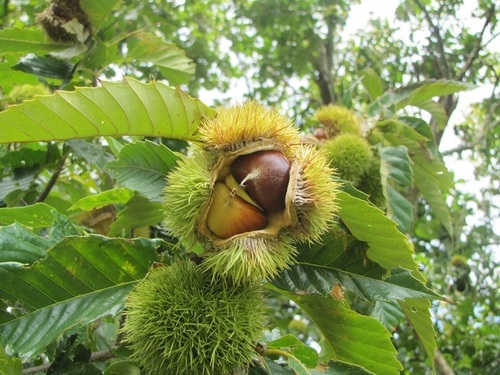
Quercus glauca
Thunberg
White Shin Oak, Blue Japanese oak
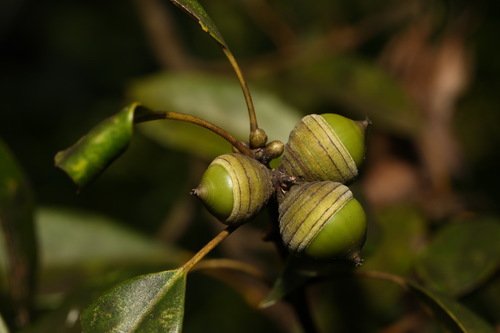
(c) Sunny Corey Tsai, some rights reserved (CC BY-NC), uploaded by Sunny Corey Tsai

(c) Lijin Huang (紫楝), some rights reserved (CC BY-NC), uploaded by Lijin Huang (紫楝)
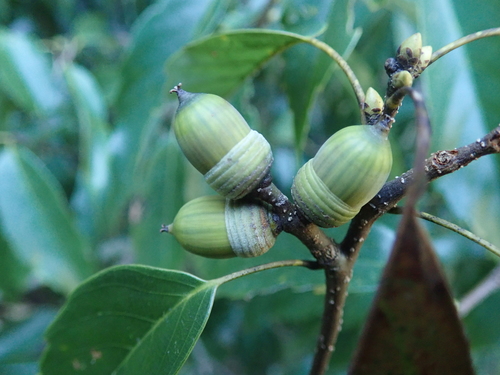
(c) 謝忠良, some rights reserved (CC BY-NC), uploaded by 謝忠良
What to Eat
Edible parts: Leaves, Seeds, Nuts
The acorn can be eaten raw or cooked and has a sweet flavour. The seed is about 15mm long and can be dried and ground into flour for thickening stews or mixing with cereals for bread. Where bitter tannins are present, they can be leached out by washing thoroughly in running water, though minerals are also lost. Whole seeds may take several days or weeks to leach properly; wrapping in a cloth bag and placing in a running stream is one method. Ground meal leaches faster. A taste test confirms when enough tannin has been removed. Traditionally, seeds were buried in boggy ground over winter and dug up in spring once most astringency had gone. The roasted seed makes a coffee substitute. Leaves can also be eaten cooked and have been used as a famine food.
Where to Find It
It is a temperate plant. It grows in mountain and moist forests between 800-3,000 m above sea level. In Pakistan it grows between 700-2,000 m altitude. Melbourne Botanical gardens. It suits hardiness zones 7-10.
Afghanistan, Asia, Australia, Bhutan, China, Europe, Germany, Himalayas, India, Indochina, Indonesia, Italy, Japan, Korea, Laos, Mediterranean, Myanmar, Nepal, Pakistan, SE Asia, Taiwan, Vietnam,
How to Identify
A small evergreen tree. It grows 15 m tall and spreads 4.5 m wide. The branches are stout and leafy. The bark is tough and cracked. The leaves are oval and have teeth along the edge. They are bronze coloured when young. They turn shiny green above and waxy underneath. The fruit are oval acorns in cups. They are 2 cm long.
How to Grow
Prefers a good deep fertile loam which can be on the stiff side. Young plants tolerate reasonable levels of side shade. Tolerates moderate exposure, surviving well but being somewhat stunted. Only suitable for the milder areas of Britain. It prefers warmer summers than are usually experienced in Britain, trees often grow poorly in this country and fail to properly ripen their wood resulting in frost damage overwinter. A polymorphic species. The seed ripens in its first year. Intolerant of root disturbance, trees should be planted in their permanent positions whilst young. Hybridizes freely with other members of the genus. Plants in this genus are notably resistant to honey fungus.
Propagation: Acorns lose viability quickly if allowed to dry out. They can be stored moist and cool over winter, but are best sown as soon as ripe in an outdoor seed bed with protection from mice and squirrels. Small quantities can be sown in deep pots in a cold frame. Because plants develop a deep taproot early, they should be moved to permanent positions as soon as possible — seed sown in situ produces the best trees. Do not leave trees in a nursery bed for more than 2 growing seasons, as they transplant very poorly after that point.
Medicinal Uses
Any galls that form on the tree are strongly astringent and have been used in the treatment of haemorrhages, chronic diarrhoea, and dysentery.
Other Uses
A mulch of the leaves repels slugs and grubs, though fresh leaves should not be used as they can inhibit plant growth. Oak galls, formed by the larvae of various insects, can be harvested after the insect pupates and leaves — they are a rich source of tannin that also serves as a dyestuff. The wood is tough and very hard, takes a good polish, but warps during seasoning. It is used for general construction and as fuel.
Wikipedia
Source ↗Quercus glauca (syn. Cyclobalanopsis glauca), commonly called ring-cupped oak or Japanese blue oak, is a tree in the beech family (Fagaceae). It is native to eastern and southern Asia, where it is found in Afghanistan, Bhutan, China, northern and eastern India, southern Japan, Kashmir, Korea, Myanmar, Nepal, Taiwan, and Vietnam. It is placed in subgenus Cerris, section Cyclobalanopsis.
Notes
There are about 600 Quercus species.
Names & Synonyms
Banku, Banni, Bran, Imbri, Meik-kekawpa, Phalat, Phaniant, Pharonj, Sagat, Siri, Thit-e
References (13)
- Ambasta S.P. (Ed.), 2000, The Useful Plants of India. CSIR India. p 508
- Bodkin, F., 1991, Encyclopedia Botanica. Cornstalk publishing, p 863
- Cundall, P., (ed.), 2004, Gardening Australia: flora: the gardener's bible. ABC Books. p 1124
- Flora of Pakistan. www.eFloras.org
- Hu, Shiu-ying, 2005, Food Plants of China. The Chinese University Press. p 350
- Levy-Yamamori, R., & Taaffe, G., 2004, Garden Plants of Japan. Timber Press. p 201
- Manandhar, N.P., 2002, Plants and People of Nepal. Timber Press. Portland, Oregon. p 388
- J. A. Murray, Syst. veg. ed. 14:858. 1784 May-Jun (Fl. Jap. 175. 1784 Aug)
- Plants for a Future database, The Field, Penpol, Lostwithiel, Cornwall, PL22 0NG, UK. http://www.scs.leeds.ac.uk/pfaf/
- READ,
- Sukarya, D. G., (Ed.) 2013, 3,500 Plant Species of the Botanic Gardens of Indonesia. LIPI p 483
- Wickens, G.E., 1995, Edible Nuts. FAO Non-wood forest products. FAO, Rome. p 128
- www.worldagroforestrycentre.org/treedb/
More from Fagaceae