Quercus grisea
Liebm.
Mexican blue oak
(c) Javier Cruz Nieto, some rights reserved (CC BY-NC), uploaded by Javier Cruz Nieto

(c) KB, some rights reserved (CC BY-NC)

(c) KB, some rights reserved (CC BY-NC)
What to Eat
Edible parts: Nuts, Seeds
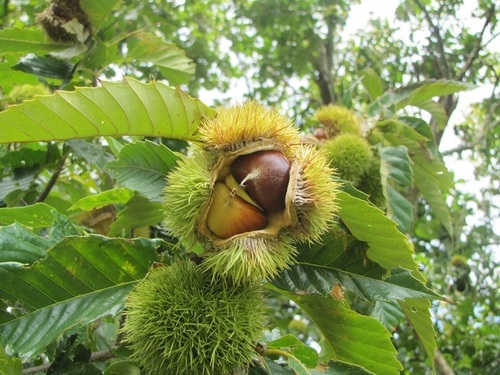
Gray oak produces light brown, ovoid to narrowly ovoid or ellipsoid seeds measuring 12–18mm long and 8–12mm wide. This species belongs to the white oak subgenus, where seeds tend to be lower in tannins than other oaks, though they still require processing before eating. The seed can be eaten raw or cooked, consumed whole or dried and ground into a flour for thickening stews or mixing with cereals for bread. Seeds are whitish inside with dark-brown shells. Because tannins are water-soluble, several leaching methods can be used to reduce bitterness. A traditional approach was to bury the seeds in boggy ground overwinter, digging them up in spring once the germinating seeds had lost most of their astringency. Another method involves wrapping seeds in a cloth bag and placing them in a running stream for several weeks. Grinding the dried seed into powder speeds up leaching considerably. The quickest method uses hot water — cook the powder and change the water repeatedly until it no longer tastes bitter. Cold water leaching is reported to produce the best quality flour: soak powdered seed in cold water for 12–24 hours, discard the water, and repeat until the soaking water is no longer bitter. Roasting the leached nutmeat develops a nuttier flavour and reduces moisture, making it suitable for longer storage. Roasted seeds can also serve as a coffee substitute. Harvest typically falls from late summer into autumn, though timing varies with elevation and rainfall.
Known Hazards
Where to Find It
It is a temperate plant. In Melbourne Botanical Gardens.
Central America, Mexico, North America, USA,
How to Identify
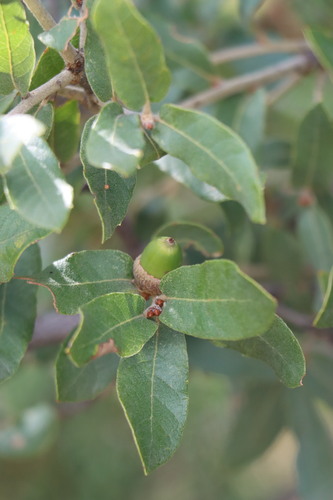
A deciduous oak reaching 6m tall and 6m wide. Hardy to UK zone 8. Wind-pollinated, noted for attracting wildlife. Grows in light sandy, medium loamy, and heavy clay soils preferring well-drained conditions and tolerating nutritionally poor soil. Adapts to mildly acid through basic pH including very acid soils. Requires full sun, cannot grow in shade. Tolerates both dry and moist soil with good drought resilience.
How to Grow
Quercus grisea occurs in semiarid climates with mild winters, hot summers, and dry springs. It is a fairly cold-hardy tree, tolerating temperatures down to around -20°c when dormant. It grows best in areas with hot summers, however. In areas with cooler summers, such as the maritime regions of the temperate zone, it often grows poorly, failing to properly ripen its wood and suffering frost damage over the winter. Requires a sunny position. It prefers an acidic soil, though it can tolerate a pH of 6.9. It is found in the wild on shallow, rocky soils with textures that range from clays to sandy loams. The soils often are derived from igneous or dolomitic parent materials. The tree resprouts from the base if cut down or top-killed by fire. The tree has a low-growing form in open savannahs, reaching tree size when growing in mesic canyons. Numerous hybrids between Quercus grisea and other white oaks, including Quercus gambelii , Quercus mohriana , Quercus arizonica , and numerous species in northern Mexico, have been reported. In the Hueco and Quitman mountains of trans-Pecos Texas, putative hybrids of Quercus grisea × Quercus turbinella Greene occur. USDA Hardiness & Weed Potential: Gray oak thrives in the mountains of Arizona and New Mexico and extends south into Mexico. It is well adapted to the arid and semi-arid environments of the Southwest and is generally found at USDA Hardiness Zones 7–10. As a native species, it is not considered weedy or invasive.
Propagation: Seed loses viability quickly if allowed to dry out. It can be stored moist and cool overwinter, but is best sown as soon as it is ripe in an outdoor seed bed with protection from mice and squirrels. Small quantities can be sown in deep pots in a cold frame. Because plants develop a deep taproot, they should be moved to their permanent positions as soon as possible — trees sown in situ produce the best results. Do not leave trees in a nursery bed for more than 2 growing seasons, as they transplant very poorly after that point.
Medicinal Uses
Oak species are widely valued in traditional medicine, particularly for their tannin content. Leaves, bark, seeds, seed cups, and insect galls can all be used medicinally. A decoction or infusion is astringent, antibacterial, antifungal, antiseptic, styptic, and haemostatic. Taken internally, it is used to treat acute diarrhoea, dysentery, and haemorrhages. Externally, it serves as a mouthwash for toothache and gum problems, and is applied topically to cuts, burns, skin problems, haemorrhoids, and inflammation of the oral, genital, and anal mucosa. Plant extracts can also be incorporated into ointments to aid wound healing.
Other Uses
The leaves are moderately rich in tannins. A mulch of partially decayed leaves placed around vulnerable plants can repel slugs, snails, and grubs, and will eventually break down to add humus and nutrients to the soil. Fresh leaves should be used cautiously, as their decomposition can consume soil nitrogen and inhibit plant growth. Oak galls, caused by the larvae of various insects living and feeding inside the growths, can be harvested after the insect pupates and leaves. These galls are a rich source of tannin and can be used as a dyestuff or processed into ink. The bark is also rich in tannins and can be used as a dyestuff and for waterproofing rope. The wood is hard and heavy but generally of limited commercial value due to its small dimensions; it is used for fence posts and, when larger pieces are available, for furniture. The wood also serves as fuel.
Wikipedia
Source ↗Quercus grisea, commonly known as the gray oak, shin oak or scrub oak, is a North American species deciduous or evergreen shrub or medium-sized tree in the white oak group. It is native to the mountains of the southwestern United States and northern Mexico. It hybridizes with four other oak species where the ranges overlap, the Arizona white oak (Q. arizonica), the Gambel oak (Q. gambelii), the Mohr oak (Q. mohriana) and the sandpaper oak (Q. pungens).
Notes
There are about 600 Quercus species.
Names & Synonyms
Grey oak, Evergreen oak, Live oak
References (4)
- MINNIS,
- Moerman, D. F., 2010, Native American Ethnobotany. Timber Press. p 461
- VESTAL,
- Wickens, G.E., 1995, Edible Nuts. FAO Non-wood forest products. FAO, Rome. p 128
More from Fagaceae