Quercus ilex
L.
Holm oak, Holly Oak, Evergreen oak
(c) Izan Lopez Vergel, some rights reserved (CC BY-NC), uploaded by Izan Lopez Vergel
(c) Izan Lopez Vergel, some rights reserved (CC BY-NC), uploaded by Izan Lopez Vergel

(c) Sébastien SANT, some rights reserved (CC BY-NC)
What to Eat
Edible parts: Seeds, Nuts
The seed, which grows up to 3cm long, can be eaten raw or cooked, and ranges from sweet to bitter depending on the individual tree. It can be dried, ground into a powder, and used as a thickening in stews or mixed with cereals for making bread. An edible oil is also obtained from the seed. Seeds from some trees contain bitter tannins that can be leached out by thoroughly washing in running water, though this also removes many minerals. Either whole seeds or dried ground powder can be used. Leaching whole seeds can take several days or even weeks; wrapping them in a cloth bag and placing them in a stream is one traditional method. Grinding to powder speeds up leaching, and a simple taste test indicates when tannins have been sufficiently removed. The traditional method was to bury seeds in boggy ground overwinter and dig up the germinating seeds in spring once astringency had faded. Roasted seeds serve as a coffee substitute. In Moroccan forests, around 20% of Quercus ilex trees produce tannin-free, sweet acorns that can be eaten raw with a flavour similar to raw chestnuts; the skin removes quite easily on these.
Where to Find It
It grows in Mediterranean climates. It can tolerate salt laden winds. It can grow in poor soils. In Melbourne Botanical Gardens. Temperate. Hobart Botanical Gardens. Kyneton Botanical Gardens. It suits hardiness zones 7-11. Arboretum Tasmania.
Africa, Albania, Algeria, Andorra, Arabia, Asia, Australia, Austria, Algeria, Balkans, Bosnia, Britain, Croatia, East Africa, Europe, France, Greece, India, Italy, Libya, Malta, Mediterranean, Middle East, Morocco, Myanmar, North Africa, Palestine, Portugal, Romania, San Marino, SE Asia, Slovenia, Spain, St Helena, Tasmania, Tunisia, Turkey, Türkiye, Yugoslavia, Zimbabwe,
How to Identify
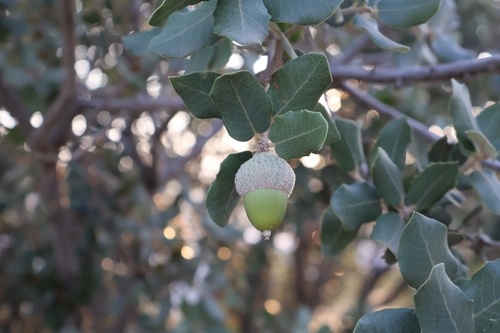
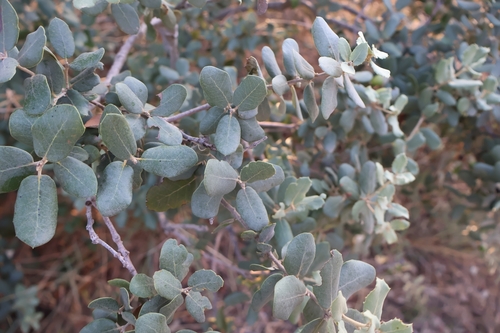
A large tree. It grows to 20-25 m tall and spreads 18-22 m wide. It has a dense rounded crown. It is evergreen. The leaves are alternate. The younger leaves are broad and spiny and older leaves are narrow and do not have teeth. The leaves are glossy and dark green but grey underneath. The male flowers are long and yellow catkins. The acorns are round and small. They can be produced singly or in clusters. They are 2/3 rds enclosed in a scaly cup. The acorns are edible.
How to Grow
Prefers a good deep fertile loam which can be on the stiff side. Thrives on shallow chalky soils. Succeeds in all soils except those that are cold and poorly drained. Grows well in sandy soils. Young plants tolerate reasonable levels of side shade. Very resistant to maritime exposure. A very ornamental tree but it is quite slow-growing. Transplants badly unless moved regularly and this should be done as growth commences in late May or in September. Fruits very freely in Britain. The seed ripens in its first year. The sub-species Q. ilex ballota is cultivated for its sweet-tasting edible seed in Portugal and Spain. Hybridizes freely with other members of the genus. This species is notably resistant to honey fungus.
Propagation: Seed loses viability quickly if allowed to dry out. It can be stored moist and cool overwinter, but is best sown as soon as it is ripe in an outdoor seed bed with protection from mice and squirrels. Small quantities can be sown in deep pots in a cold frame. Because plants develop a deep taproot, they should be moved to their permanent positions as soon as possible — trees sown in situ produce the best results. Do not leave trees in a nursery bed for more than 2 growing seasons, as they transplant very poorly after that point.
Medicinal Uses
Any galls produced on the tree are strongly astringent and can be used in the treatment of haemorrhages, chronic diarrhoea, and dysentery.
Other Uses
A mulch of the leaves repels slugs and grubs, though fresh leaves should not be used as they can inhibit plant growth. Oak galls, produced in response to insect larvae living inside them, become a rich source of tannin once the insect has pupated and left, and can be used as a dyestuff. The tree is very tolerant of maritime exposure and trimming, making it suitable as a shelterbelt tree or hedge in coastal areas. The wood is strong, hard, and durable, and is used for furniture. It makes excellent charcoal and burns well even when green. The bark is a source of tannin.
Wikipedia
Source ↗Quercus ilex, the holly oak, also (ambiguously, as many oaks are evergreen) evergreen oak, is a large evergreen oak native to the Mediterranean region. It is a member of the section Ilex of the genus, with acorns that mature in a single summer.
Production
It produces acorns in 5-10 years.
Other Information
Nuts are sold in markets.
Notes
There are about 600 Quercus species.
Names & Synonyms
Ballota, Ballout, Belloot, Belote oak, Bre-chur, črničevje, Irri
References (39)
- Ambasta S.P. (Ed.), 2000, The Useful Plants of India. CSIR India. p 509
- Blamey, M and Grey-Wilson, C., 2005, Wild flowers of the Mediterranean. A & C Black London. p 31
- Bodkin, F., 1991, Encyclopedia Botanica. Cornstalk publishing, p 863
- Brickell, C. (Ed.), 1999, The Royal Horticultural Society A-Z Encyclopedia of Garden Plants. Convent Garden Books. p 854
- Brouk, B., 1975, Plants Consumed by Man. Academic Press, London. p 208
- Coombes, A.J., 2000, Trees. Dorling Kindersley Handbooks. p 163
- Cundall, P., (ed.), 2004, Gardening Australia: flora: the gardener's bible. ABC Books. p 1124
- Facciola, S., 1998, Cornucopia 2: a Source Book of Edible Plants. Kampong Publications, p 116
- Ghanimi, R., et al, 2022, Ethnobotanical study on wild edible plants traditionally used by Messiwa people, Morocco. Journal of Ethnobiology and Ethnomedicine. 18:16
- Glowinski, L., 1999, The Complete Book of Fruit Growing in Australia. Lothian. p 137
- Gonzalez, J. A., et al, 2011, The consumption of wild and semi-domesticated edible plants in the Arribes del Duero (Salamanca-Zamora, Spain): an analysis of traditional knowledge. Genetic. Resour Crop Evolution 58:991-1006
- Gouldstone, S., 1983, Growing your own Food-bearing Plants in Australia. Macmillan p 175
- Hadjichambis, A. C., et al, 2007, Wild and semi-domesticated food plant consumption in seven circum-Mediterranean areas. International Journal of Food Sciences and Nutrition. 2007, 1-32.
- Harris, E & J., 1983, Field Guide to the Trees and Shrubs of Britain. Reader's Digest. p 109
- Hedrick, U.P., 1919, (Ed.), Sturtevant's edible plants of the world. p 545
- Heywood, V.H., Brummitt, R.K., Culham, A., and Seberg, O. 2007, Flowering Plant Families of the World. Royal Botanical Gardens, Kew. p 148
- Hibbert, M., 2002, The Aussie Plant Finder 2002, Florilegium. p 244
- http://www.botanic-gardens-ljubljana.com/en/plants
- Jardin, C., 1970, List of Foods Used In Africa, FAO Nutrition Information Document Series No 2.p 36
- Joyce, D., 1998, The Garden Plant Selector. Ryland, Peters and Small. p 117
- Lord, E.E., & Willis, J.H., 1999, Shrubs and Trees for Australian gardens. Lothian. p 70
- Luczaj, L. et al, 2013, Wild food plants used in the villages of the Lake Vrana Nature Park (northern Dalmatia, Croatia). Acta Societatis Botanicorum Poloniae, 82(4): 275-281
- Luczaj, L. et al, 2014, Wild Food Plants of Dalmatia (Croatia). in A. Pieroni, C. L. Quave (eds.), Ethnobotany and Biocultural Diversities in the Balkans, p 138
- Menendez-Baceta, G., et al, 2012, Wild edible plants traditionally gathered in Gorbeialdea (Biscay, Basque Country) Genetic Resources and Crop Evolution 59:1329-1347
- Menninger, E.A., 1977, Edible Nuts of the World. Horticultural Books. Florida p 19
- Morley, B. & Everard, B., 1970, Wild Flowers of the World. Ebury press. Plate 31
- Pardo-de-Santayana, M., et al, 2007, Traditional knowledge of wild edible plants used in the northwest of the Iberian Peninsula (Spain and Portugal): a comparative study. Journal of Ethnobiology and Ethnomedicine 2007, 3:27
- Plants for a Future database, The Field, Penpol, Lostwithiel, Cornwall, PL22 0NG, UK. http://www.scs.leeds.ac.uk/pfaf/
- Redzic, S. J., 2006, Wild Edible Plants and their Traditional Use in the Human Nutrition in Bosnia-Herzegovina. Ecology of Food and Nutrition, 45:189-232
- Rivera, D. et al, 2006, Gathered Mediterranean Food Plants - Ethnobotanical Investigations and Historical Development, in Heinrich M, Müller WE, Galli C (eds): Local Mediterranean Food Plants and Nutraceuticals. Forum Nutr. Basel, Karger, 2006, vol 59, pp 18–74
- Ryan, S., 2008, Dicksonia. Rare Plants Manual. Hyland House. p 50
- Schuler, S., (Ed.), 1977, Simon & Schuster's Guide to Trees. Simon & Schuster. No. 153
- Sfikas, G., 1984, Trees and shrubs of Greece. Efstathiadis Group. Athens. p 152
- Sp. pl. 2:995. 1753
- Tardio, J., et al, Ethnobotanical review of wild edible plants in Spain. Botanical J. Linnean Soc. 152 (2006), 27-71
- USDA, ARS, National Genetic Resources Program. Germplasm Resources Information Network - (GRIN). [Online Database] National Germplasm Resources Laboratory, Beltsville, Maryland. Available: www.ars-grin.gov/cgi-bin/npgs/html/econ.pl (10 April 2000)
- Wickens, G.E., 1995, Edible Nuts. FAO Non-wood forest products. FAO, Rome. p 128
- Wiersema, J. H. & Leon, B., 2013, World Economic Plants. A Standard Reference CRC Press. 2nd Ed. p 576
- World Checklist of Useful Plant Species 2020. Royal Botanic Gardens, Kew
More from Fagaceae