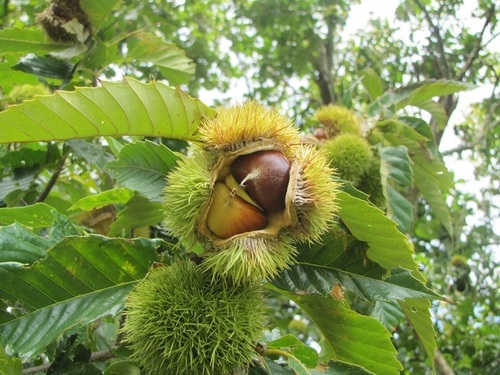
Quercus rotundifolia
Lam.
Holm oak, Spanish holm oak

(c) faluke, some rights reserved (CC BY-NC), uploaded by faluke

(c) Sébastien SANT, some rights reserved (CC BY-NC)

(c) Muriel Bendel, some rights reserved (CC BY-NC), uploaded by Muriel Bendel
What to Eat
Edible parts: Seeds, Acorns, Nut
The holm oak's wood is traditionally used to make charcoal. The acorns can be consumed both by animals and humans. The bark is rich in tannin components for traditional medicinal uses. Quercus rotundifolia is also used as a host plant for the production of both the black truffle (Tuber melanosporum) and the summer truffle (Tuber aestivum var aestivum). The tree's acorns have been used by humans since the Neolithic era. The inhabitants of the southern Iberian Peninsula 9,000 years ago collected acorns of Q. rotundifolia in autumn (November), gently toasted them in order to preserve them, ground them in granite mills, and consumed the flour in soups or breads.
Where to Find It
It is a temperate or Mediterranean plant. It suits hardiness zones 4-8.
Africa, Europe, Mediterranean, Morocco, North Africa, Portugal, Spain, USA,
How to Identify
A tree.
Wikipedia
Source ↗Quercus rotundifolia, the holm oak or ballota oak, is an evergreen oak native to the western Mediterranean region, with the majority of the population in the Iberian Peninsula and minor populations in Northwest Africa. The species was first described by Jean-Baptiste Lamarck in 1785. It is the typical species of the Iberian dehesa or montado, where its sweet-astringent acorns are a source of food for livestock, particularly the Iberian pig. Its acorns have also been used for human nourishment since the Neolithic era (7,000 BC). It is placed in section Ilex. Some authors described it as a subspecies of Quercus ilex.
Notes
There are about 600 Quercus species.
Names & Synonyms
Bellotas, Billotas, Carrasca, Encina
References (13)
- Blanco-Salas, J., et al, 2019, Wild Plants Potentially Used in Human Food in the Protected Area “Sierra Grande de Hornachos” of Extremadura (Spain). Sustainability 2019, 11, 456
- Bol. Soc. Brot. 24:102. 1909 Bol. Soc. Brot. ser. 2, 14:122. 1940 (As Quercus ilex subsp. rotundifolia)
- Facciola, S., 1998, Cornucopia 2: a Source Book of Edible Plants. Kampong Publications, p 116 (As Quercus ilex subsp. ballota)
- Gonzalez, J. A., et al, 2011, The consumption of wild and semi-domesticated edible plants in the Arribes del Duero (Salamanca-Zamora, Spain): an analysis of traditional knowledge. Genetic. Resour Crop Evolution 58:991-1006 (As Quercus ilex subsp. ballota)
- Jackes, D. A., 2007, Edible Forest Gardens (As Quercus ilex subsp. rotundifolia)
- Luczaj, L. et al, 2012, Wild food plant use in 21st century Europe: the disappearance of old traditions and the search for new cuisines involving wild edibles. Acta Soc Bot Pol 81(4):359–370 (As Quercus ilex subsp. ballota)
- Nassif, F., & Tanji, A., 2013, Gathered food plants in Morocco: The long forgotten species in Ethnobotanical Research. Life Science Leaflets 3:17-54 (As Quercus ilex subsp. rotundifolia)
- Plants for a Future database, The Field, Penpol, Lostwithiel, Cornwall, PL22 0NG, UK. http://www.scs.leeds.ac.uk/pfaf/ (As Quercus ilex subsp. ballota)
- Rivera, C., et al, 2005, The Ethnobotanical Study of Local Mediterranean Food Plants as Medicinal Resources in Southern Spain. Journal of Physiologyand Pharmacology. 56, Suppl. 1, 97-114 (As Quercus ilex subsp. ballota)
- Rivera, D. et al, 2006, Gathered Mediterranean Food Plants - Ethnobotanical Investigations and Historical Development, in Heinrich M, Müller WE, Galli C (eds): Local Mediterranean Food Plants and Nutraceuticals. Forum Nutr. Basel, Karger, 2006, vol 59, pp 18–74 (As Quercus ilex subsp. ballota)
- Tardio, J., et al, 2006, Ethnobotanical review of wild edible plants in Spain. Botanical J. Linnean Soc. 152, 27-71 (As Quercus ilex subsp. ballota)
- Wickens, G.E., 1995, Edible Nuts. FAO Non-wood forest products. FAO, Rome. p 128 (As Quercus ilex subsp. rotundifolia)
- World Checklist of Useful Plant Species 2020. Royal Botanic Gardens, Kew
More from Fagaceae