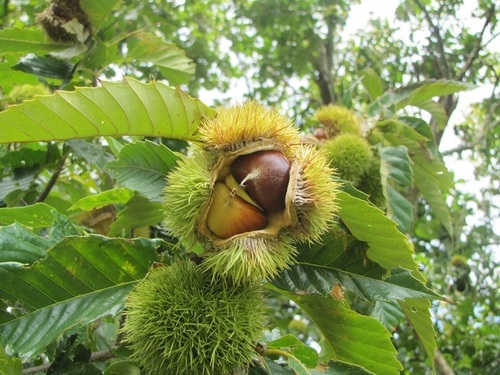
Quercus laevis
Walter
American turkey oak, Catesby oak, Scrub oak

(c) Keith Bradley, some rights reserved (CC BY-NC), uploaded by Keith Bradley
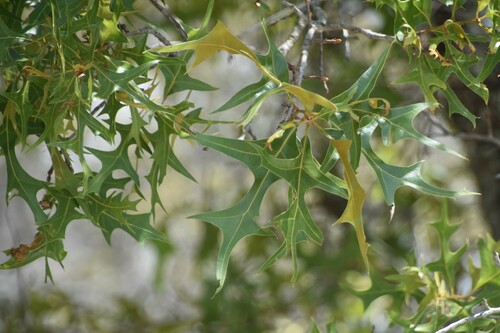
(c) Tom Palmer, some rights reserved (CC BY-NC), uploaded by Tom Palmer

(c) Mary Keim, some rights reserved (CC BY-NC-SA)
What to Eat
Edible parts: Seeds, Nut
The seeds, up to 27mm long and 18mm wide, are cooked before eating. They can be dried, ground into a powder, and used as a thickening in stews or mixed with cereals for making bread. The seeds contain bitter tannins that must be leached out by thoroughly washing in running water, though this also removes many minerals. Either whole seeds or ground powder can be used. Leaching whole seeds can take several days or even weeks; wrapping them in a cloth bag and placing them in a stream is one effective approach. Grinding to powder speeds the process, and a simple taste test shows when enough tannin has been removed. The traditional method was to bury seeds in boggy ground overwinter and dig up the germinating seeds in spring once most astringency had gone. Roasted seeds serve as a coffee substitute.
Where to Find It
It is a temperate plant. It grows on dry sandy ridges and dunes. It is usually near the coast. It SE of the USA it grows up to 150 m altitude.
North America, USA,
How to Identify
A small tree. It grows 6-12 m high. The trunk is 30 cm across. They bark is grey to black and becomes thick and very rough. It becomes furrowed into ridges. It has an irregular open crown. The branches are crooked. The leaves are 10-20 cm long and 7.5-15 cm wide. They are almost triangle shaped. They have a pointed base and 3-5 long narrow lobes. These have 1-3 bristle tipped teeth at the end. The leaves are thick and stiff. They are shiny yellow-green above and paler underneath. There are tufts of rust coloured hairs in the angles of the veins. The leaves turn red in autumn. The acorns are 2-2.5 cm long and egg-shaped. They are in hairy cups.
How to Grow
Prefers a good deep fertile loam which can be on the stiff side. Young plants tolerate reasonable levels of side shade. Tolerates moderate exposure, surviving well but being somewhat stunted. A moderately fast-growing but short-lived species in the wild, trees are very slow-growing in Britain. They prefer warmer summers than are usually experienced in Britain, often growing poorly in this country and failing to properly ripen their wood, resulting in frost damage overwinter. Seed production is cyclic, with a year of high yields being followed by 1 - 2 years of low yields. The tree flowers on new growth produced in spring, the seed taking two summers to ripen. Intolerant of root disturbance, trees should be planted in their permanent positions whilst young. Hybridizes freely with other members of the genus. Plants in this genus are notably resistant to honey fungus.
Propagation: Seed loses viability quickly if allowed to dry out. It can be stored moist and cool overwinter, but is best sown as soon as it is ripe in an outdoor seed bed with protection from mice and squirrels. Small quantities can be sown in deep pots in a cold frame. Because plants develop a deep taproot, they should be moved to their permanent positions as soon as possible — trees sown in situ produce the best results. Do not leave trees in a nursery bed for more than 2 growing seasons, as they transplant very poorly after that point.
Medicinal Uses
Any galls produced on the tree are strongly astringent and can be used in the treatment of haemorrhages, chronic diarrhoea, and dysentery.
Other Uses
A mulch of the leaves repels slugs and grubs, though fresh leaves should not be used as they can inhibit plant growth. Oak galls, caused by insect larvae living and feeding inside them, yield a rich source of tannin once the insect has pupated and left, and can also be used as a dyestuff. The wood is heavy, hard, strong, and rather close-grained. It is too small to be of commercial value but makes excellent fuel.
Wikipedia
Source ↗Quercus laevis, the turkey oak, is a member of the red oak group of oaks. It is native to the southeastern United States. The name turkey oak derives from the resemblance of the leaves to a turkey's foot. A Turkish and southern European species Quercus cerris is also commonly referred to as Turkey oak, so Quercus laevis is sometimes referred to as American turkey oak to distinguish it from the European species.
Notes
There are about 600 Quercus species.
Names & Synonyms
References (4)
- Fl. carol. 234. 1788
- Krochmal, A. & Krochmal, C., 1982, Uncultivated Nuts of The United States. United States Department of Agriculture Forest Service. p 22
- Little, E.L., 1980, National Audubon Society Field Guide to North American Trees. Alfred A. Knopf. p 393
- Plants for a Future database, The Field, Penpol, Lostwithiel, Cornwall, PL22 0NG, UK. http://www.scs.leeds.ac.uk/pfaf/
More from Fagaceae