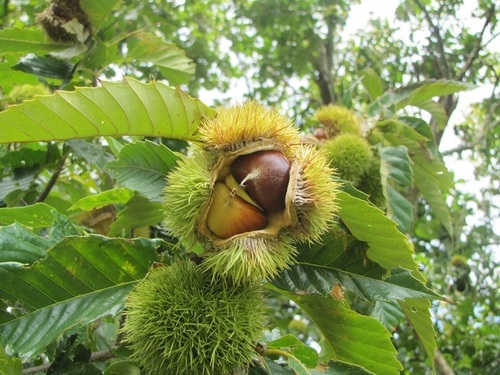
Quercus lobata
Née
Californian White Oak, Valley white oak
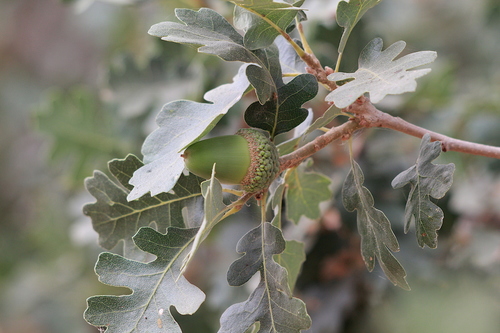
(c) Andrea Kreuzhage, some rights reserved (CC BY-NC), uploaded by Andrea Kreuzhage
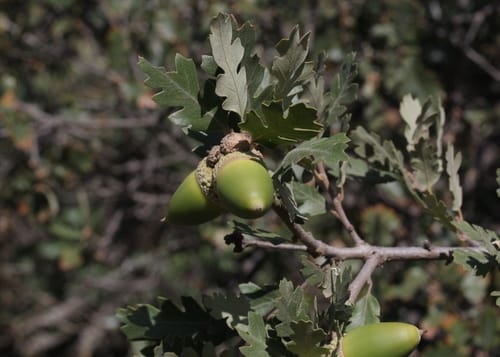
(c) James Bailey, some rights reserved (CC BY-NC)

(c) James Bailey, some rights reserved (CC BY-NC)
What to Eat
Edible parts: Seeds, Nuts
The seed must be cooked and was a staple food for several native North American Indian tribes. It is quite large, reaching up to 5cm long and 15mm wide. The seed of this species is naturally sweet and low in tannin, requiring little if any leaching. Where bitterness is present, it can be removed by thoroughly washing the dried and ground seed in water, though this also removes minerals. A simple taste test confirms when leaching is complete. The traditional preparation method was to bury seeds in boggy ground over winter and dig up the germinating seeds in spring, by which point most astringency would have gone. The seed can also be roasted and eaten whole — the flavour resembles a cross between sunflower seeds and popcorn — or ground into a powder for use in bread. Roasted seed makes a coffee substitute.
Where to Find It
It is a temperate plant. In Melbourne Botanical Gardens. Arboretum Tasmania.
Australia, North America, Tasmania, USA,
How to Identify
Deciduous oak reaching 30m at slow growth rate, hardy to UK zone 7. Monoecious, wind-pollinated. Tolerates loamy and clay soils with mildly acid to basic pH. Grows in semi-shade or full sun, preferring moist conditions. Withstands strong winds but not salt spray.
How to Grow
Prefers a good deep fertile loam which can be on the stiff side. Young plants tolerate reasonable levels of side shade. Tolerates moderate exposure, surviving well but being somewhat stunted. Prefers warmer summers than are usually experienced in Britain, trees often grow poorly in this country and fail to properly ripen their wood resulting in frost damage overwinter. A fairly long-lived tree in the wild, with specimens 300 - 400 years old recorded. It is very slow growing in Britain, but there is a specimen at Kew that was 27 metres tall in 1988. The tree flowers on new growth produced in spring, the seed ripening in its first year. Good crops are produced in the wild every 2 - 3 years. Intolerant of root disturbance, trees should be planted in their permanent positions whilst young. Hybridizes freely with other members of the genus. Plants in this genus are notably resistant to honey fungus.
Propagation: Seed loses viability quickly if allowed to dry out. It can be stored moist and cool over winter, but is best sown as soon as it is ripe in an outdoor seed bed with protection from mice and squirrels. Small quantities can be sown in deep pots in a cold frame. Because plants develop a deep taproot, they should be moved to their permanent positions as soon as possible — seeds sown in situ produce the best trees. Do not leave trees in a nursery bed for more than 2 growing seasons, as they will transplant very poorly.
Medicinal Uses
Any galls produced on the tree are strongly astringent and can be used to treat haemorrhages, chronic diarrhoea, and dysentery. A poultice made from ground galls and salt has been applied to burns, sores, and cuts. A decoction of the bark has been used as a cough medicine and a treatment for diarrhoea. The pulverized bark has been used as a dusting powder to dry up running sores, and is noted as particularly useful for babies with a sore umbilicus.
Other Uses
A mulch of leaves around plants repels slugs, grubs, and similar pests, though fresh leaves should not be used as they can inhibit plant growth. Oak galls, formed by the larvae of various insects, are a rich source of tannin once the insect has pupated and left, and can also be used as a dyestuff. Acorn meal has been used to mend cracks in clay pots. The wood is hard and fine-grained but brittle and weak, and has no commercial timber value — it is used only as fuel.
Wikipedia
Source ↗Quercus lobata, commonly called the valley oak or roble, is the largest of the California oaks. It is endemic to the state, growing in interior valleys and foothills from Siskiyou to San Diego counties. Deciduous, it requires year-round groundwater, and may live up to 600 years. Its thick, ridged bark (resembling alligator hide) and deeply lobed leaves are characteristic, and assist in identification.
Notes
There are about 600 Quercus species.
Names & Synonyms
References (15)
- Anales Ci. Nat. 3:277. 1801
- Beckstrom-Sternberg, Stephen M., and James A. Duke. "The Foodplant Database." http://probe.nalusda.gov:8300/cgi-bin/browse/foodplantdb.(ACEDB version 4.0 - data version July 1994)
- Brickell, C. (Ed.), 1999, The Royal Horticultural Society A-Z Encyclopedia of Garden Plants. Convent Garden Books. p 854
- Bodkin, F., 1991, Encyclopedia Botanica. Cornstalk publishing, p 863
- Facciola, S., 1998, Cornucopia 2: a Source Book of Edible Plants. Kampong Publications, p 116
- Glowinski, L., 1999, The Complete Book of Fruit Growing in Australia. Lothian. p 136
- Grandtner, M. M., 2008, World Dictionary of Trees. Wood and Forest Science Department. Laval University, Quebec, Qc Canada. (Internet database http://www.wdt.qc.ca)
- Hedrick, U.P., 1919, (Ed.), Sturtevant's edible plants of the world. p 546
- Hibbert, M., 2002, The Aussie Plant Finder 2002, Florilegium. p 244
- Kermath, B. M., et al, 2014, Food Plants in the Americas: A survey of the domesticated, cultivated and wild plants used for Human food in North, Central and South America and the Caribbean. On line draft. p 735
- Menninger, E.A., 1977, Edible Nuts of the World. Horticultural Books. Florida p 18, 19
- Moerman, D. F., 2010, Native American Ethnobotany. Timber Press. p 462
- Plants for a Future database, The Field, Penpol, Lostwithiel, Cornwall, PL22 0NG, UK. http://www.scs.leeds.ac.uk/pfaf/
- Saunders, C.F., 1948, Edible and Useful Wild Plants. Dover. New York. p 73
- Wickens, G.E., 1995, Edible Nuts. FAO Non-wood forest products. FAO, Rome. p 129
More from Fagaceae