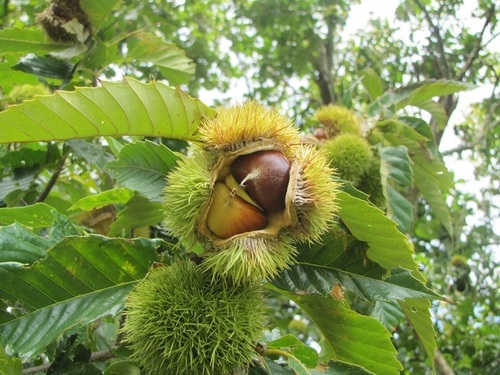
Quercus macrocarpa
Michx.
Burr oak, Mossy-cup oak, Blue oak

(c) Douglas Goldman, some rights reserved (CC BY-SA), uploaded by Douglas Goldman
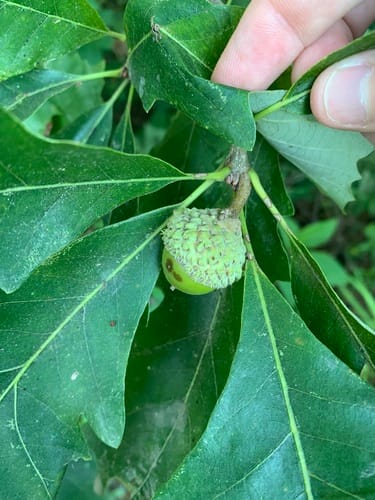
(c) Corey Brooke, some rights reserved (CC BY-NC)
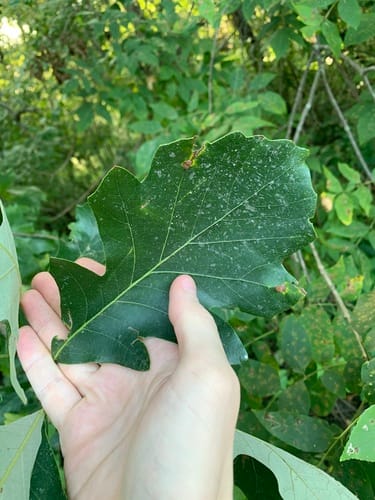
(c) Corey Brooke, some rights reserved (CC BY-NC)
What to Eat
Edible parts: Seeds, Nuts
The seed must be cooked and is notably large, reaching up to 5cm x 4cm, though size and shape vary. It can be ground into a powder for use in bread and dumplings, or used as a thickener in soups. This species is considered to produce one of the most palatable acorns of all the oaks. Many trees yield sweet seeds with little tannin, and these can be eaten raw or cooked without preparation. Where bitterness is present, it is caused by tannins, which can be leached out by washing the dried and ground seed thoroughly in water, though minerals are lost in the process. The traditional preparation method involved burying seeds in boggy ground over winter and digging up the germinating seeds in spring, by which point most astringency would have gone. The roasted seed also works as a coffee substitute.
Known Hazards
Where to Find It
It is a temperate plant. It grows best in deep, rich soils but will also grow on upland limestone soils. It is drought tolerant. It can tolerate some shade. It suits hardiness zones 4-9. Hobart Botanical Gardens. Kyneton Botanical Gardens. National Arboretum Canberra.
Australia, Canada, North America, Tasmania, USA,
How to Identify
A deciduous tree. It grows to 15-40 m high. The trunk is 60 cm across. The leaves are 15-30 cm long. The shape varies. There can be 7-9 deep lobes but also less. The leaves are shiny green on the upper surface and pale and hairy underneath. The acorns are 20-30 mm long. They usually occur singly. The cup is large and encloses half or more of the acorn. There is a fringe near the acorn.
How to Grow
Prefers a good deep fertile loam which can be on the stiff side. Lime tolerant. Succeeds in a hot dry position. Young plants tolerate reasonable levels of side shade. Tolerates moderate exposure, surviving well but being somewhat stunted. A slow-growing tree. Established plants are drought resistant and tolerant of atmospheric pollution. Trees have a thick, fire-resistant bark. Occasionally cultivated for its edible seed, there are some named varieties. Slow growing in the wild, it takes about 30 years to start producing seed, though it then continues to crop for the next 200 - 300 years with large crops being produced every 2 - 3 years. The tree flowers on new growth produced in spring, the seed ripening in its first year. Prefers warmer summers than are usually experienced in Britain, often growing poorly in this country and failing to properly ripen its wood, resulting in frost damage overwinter. A tree at the Hillier Arboretum in Hampshire was growing well in September 1993. It was 9 metres tall but had a lot of mildew, there was no sign of seeds. There is a dwarf form of this species:- Q. macrocarpa depressa (Nutt.)Engelm. grows about 2 metres tall with corky branches and smaller seeds than the species, usually about 1cm long. Hybridizes freely with other members of the genus. Plants in this genus are notably resistant to honey fungus.
Propagation: Seed loses viability quickly if allowed to dry out. It can be stored moist and cool over winter, but is best sown as soon as it is ripe in an outdoor seed bed with protection from mice and squirrels. Small quantities can be sown in deep pots in a cold frame. Because plants develop a deep taproot, they should be moved to their permanent positions as soon as possible — seeds sown in situ produce the best trees. Do not leave trees in a nursery bed for more than 2 growing seasons, as they will transplant very poorly.
Medicinal Uses
The bark is astringent and tonic. An infusion of the bark has been used to treat diarrhoea. A decoction of the root or inner bark has been used to treat cramps. Any galls produced on the tree are strongly astringent and have been used in the treatment of haemorrhages, chronic diarrhoea, and dysentery.
Other Uses
The tree has been widely tested for soil rehabilitation and has been successfully established on coal spoils in the north-central and northern Great Plains, and in the Western Interior Coal Province covering Missouri, Kansas, and Oklahoma. It can be either seeded or transplanted onto disturbed areas. Oak leaves are more or less rich in tannins; a mulch of leaves placed around vulnerable plants repels slugs, snails, and grubs. Fresh leaves should be used with caution, as they can utilize nitrogen in the soil and inhibit plant growth. Oak galls, produced by insect larvae living within them, are a rich source of tannin once the insect has left, and can also be used as a dyestuff. The bark has been used as a mordant for fixing dyes. The wood is hard, heavy, strong, tough, very durable, and close-grained, weighing about 46lb per cubic metre. It is an important timber tree used for all types of construction, basket-making, flooring, cabinet-making, shipbuilding, cooperage, and fence posts. The wood is also a good fuel.
Wikipedia
Source ↗Quercus macrocarpa, the bur oak or burr oak, is a species of oak tree native to central and eastern North America. It is in the white oak section, Quercus sect. Quercus, and is also called mossycup oak, mossycup white oak, or scrub oak. The acorns are the largest of any North American oak (thus the species name macrocarpa, from Ancient Greek μακρός makrós "large" and καρπός karpós "fruit"), and are important food for wildlife.
Production
Trees live for 200 years.
Notes
There are about 600 Quercus species.
Names & Synonyms
References (21)
- Beckstrom-Sternberg, Stephen M., and James A. Duke. "The Foodplant Database." http://probe.nalusda.gov:8300/cgi-bin/browse/foodplantdb.(ACEDB version 4.0 - data version July 1994)
- Brickell, C. (Ed.), 1999, The Royal Horticultural Society A-Z Encyclopedia of Garden Plants. Convent Garden Books. p 854
- Coombes, A.J., 2000, Trees. Dorling Kindersley Handbooks. p 164
- Cundall, P., (ed.), 2004, Gardening Australia: flora: the gardener's bible. ABC Books. p 1125
- Facciola, S., 1998, Cornucopia 2: a Source Book of Edible Plants. Kampong Publications, p 116
- Farrar, J.L., 1995, Trees of the Northern United States and Canada. Iowa State University press/Ames p 258
- Glowinski, L., 1999, The Complete Book of Fruit Growing in Australia. Lothian. p 137
- Grandtner, M. M., 2008, World Dictionary of Trees. Wood and Forest Science Department. Laval University, Quebec, Qc Canada. (Internet database http://www.wdt.qc.ca)
- Hibbert, M., 2002, The Aussie Plant Finder 2002, Florilegium. p 244
- Hist. chenes Amer. t. 2-3. 1801
- Jackes, D. A., 2007, Edible Forest Gardens
- Jordan, J., et al, 2006, Vascular Plants Utilized by the Plains Apache in Southwestern Oklahoma, Publications of the Oklahoma Biological Survey. 2nd Series. Volume 7: 24-33, 2006
- Kermath, B. M., et al, 2014, Food Plants in the Americas: A survey of the domesticated, cultivated and wild plants used for Human food in North, Central and South America and the Caribbean. On line draft. p 735
- Little, E.L., 1980, National Audubon Society Field Guide to North American Trees. Alfred A. Knopf. p 395
- Lord, E.E., & Willis, J.H., 1999, Shrubs and Trees for Australian gardens. Lothian. p 70
- MacKinnon, A., et al, 2009, Edible & Medicinal Plants of Canada. Lone Pine. p 58
- Menninger, E.A., 1977, Edible Nuts of the World. Horticultural Books. Florida p 19
- Moerman, D. F., 2010, Native American Ethnobotany. Timber Press. p 463
- Plants for a Future database, The Field, Penpol, Lostwithiel, Cornwall, PL22 0NG, UK. http://www.scs.leeds.ac.uk/pfaf/
- Toupal, R. S. & Hollenback, K., 2009, An Ethnobotany of Indiana Dunes National Lakeshore: Plant Uses of the Ojibwa People. Bureau of Applied Research in Anthropology. University of Arizona
- Wickens, G.E., 1995, Edible Nuts. FAO Non-wood forest products. FAO, Rome. p 129
More from Fagaceae