Quercus persica
(Mattuschaka)Leibel.
Sessile oak, Mannaoak
FagaceaeSeeds/Nuts

iNaturalist · cc-by
(c) Oleg Kosterin, some rights reserved (CC BY)
(c) Oleg Kosterin, some rights reserved (CC BY)

iNaturalist · cc-by
(c) Oleg Kosterin, some rights reserved (CC BY)
(c) Oleg Kosterin, some rights reserved (CC BY)

iNaturalist · cc-by
(c) Oleg Kosterin, some rights reserved (CC BY)
(c) Oleg Kosterin, some rights reserved (CC BY)
What to Eat
Edible parts: Seeds, Nuts, Manna
The nuts and seeds are edible. The tree produces manna, which is also edible.
Where to Find It
It is a temperate plant.
Britain, Europe, Iran, Middle East,
Countries: Andorra, United Arab Emirates, Albania, Austria, Bosnia & Herzegovina, Belgium, Bulgaria, Bahrain, Belarus, Switzerland, Cyprus, Czechia, Germany, Denmark, Estonia, Spain, Finland, France, United Kingdom, Greece, Croatia, Hungary, Ireland, Israel, Iraq, Iran, Iceland, Italy, Jordan, Kuwait, Lebanon, Liechtenstein, Lithuania, Luxembourg, Latvia, Monaco, Moldova, Montenegro, North Macedonia, Malta, Netherlands, Norway, Oman, Poland, Portugal, Qatar, Romania, Serbia, Russia, Saudi Arabia, Sweden, Slovenia, Slovakia, San Marino, Syria, Ukraine, Yemen
How to Identify
A temperate oak tree in the Fagaceae family, also known as Sessile oak or Manna oak.
Wikipedia
Source ↗Quercus persica is a species of flowering plant in the beech family Fagaceae, native to western Iran. It was first described in 1843. It has been treated as a subspecies of Quercus brantii. It is placed in section Cerris.
Notes
There are about 600 Quercus species.
Names & Synonyms
See Lithocarpus and Quercus aegilops subsp persica
References (2)
- Hedrick, U.P., 1919, (Ed.), Sturtevant's edible plants of the world. p 546
- Menninger, E.A., 1977, Edible Nuts of the World. Horticultural Books. Florida p 19
More from Fagaceae

Castanea alnifolia
Bush chinkapin, Florida chinkapin, Trailing chinkapin, Downy chinquapin

Castanea crenata
Japanese chestnut

Castanea dentata
American chestnut, American sweet chestnut

Castanea henryi
Zhui li, Conic chestnut
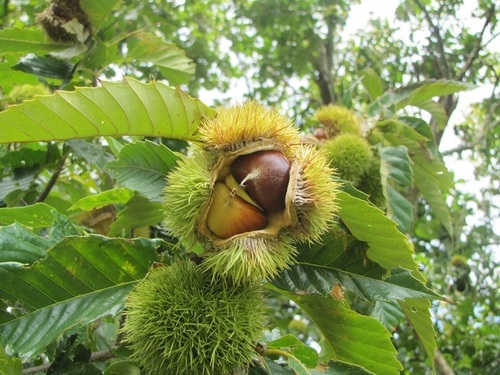
Castanea mollissima
Chinese chestnut

Castanea ozarkensis
Ozark chinkapin, Ozark chestnut