Quercus prinoides
Willd.
Chinquapin oak, Dwarf chinkapin oak

(c) Douglas Goldman, some rights reserved (CC BY-SA), uploaded by Douglas Goldman

(c) Susan Crawford Tracy, some rights reserved (CC BY-NC), uploaded by Susan Crawford Tracy
What to Eat
Edible parts: Seeds, Nut
The seed, up to 15mm long, has a sweet taste and must be cooked before eating. It can be dried and ground into a powder to thicken stews or blended with cereals for bread-making. The seed may contain bitter tannins, which can be leached out by thoroughly washing in running water, though minerals are lost in the process. Either whole seeds or ground powder can be leached — whole seeds may take several days or weeks, and placing them in a cloth bag in a running stream was a traditional method. Ground powder leaches more quickly. A simple taste test confirms when tannin levels are acceptable. Seeds could also be buried in boggy ground over winter and dug up in spring when most of their astringency had gone. The roasted seed makes a coffee substitute.
Where to Find It
It is a cool temperate plant. It grows on dry slopes. It suits hardiness zone 5.
Canada, North America, USA,
How to Identify
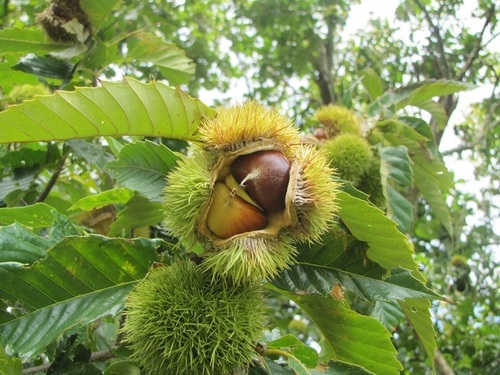
A small tree or shrub. The leaves are 5-15 cm long. There are 4-9 main veins on each side. The acorns are 15-25 mm long. The cup encloses about one half of the acorn.
How to Grow
Prefers a good deep fertile loam which can be on the stiff side. Young plants tolerate reasonable levels of side shade. Tolerates moderate exposure, surviving well but being somewhat stunted. Prefers warmer summers than are usually experienced in Britain, trees often grow poorly in this country and fail to properly ripen their wood resulting in frost damage overwinter. Whereas trees in the wild can reach 5 metres or more in height, they rarely exceed 1.5 metres in Britain. Plants produce suckers and often form thickets. The tree flowers on new growth produced in spring, the seed ripening in its first year. Trees produce heavy crops every year or every other year in the wild. Intolerant of root disturbance, trees should be planted in their permanent positions whilst young. This species is often confused with Q. michauxii, Q. muehlenbergii and Q. prinus. Hybridizes freely with other members of the genus. Plants in this genus are notably resistant to honey fungus. In garden design, as well as the above-ground architecture of a plant, root structure considerations help in choosing plants that work together for their optimal soil requirements including nutrients and water. Thick or swollen - fibrous or tap root.
Propagation: Seed loses viability quickly if allowed to dry out. It can be stored moist and cool over winter, but is best sown as soon as it is ripe in an outdoor seed bed with protection from mice and squirrels. Small quantities can be sown in deep pots in a cold frame. Because plants develop a deep taproot early, they should be moved to permanent positions as soon as possible — seeds sown in situ produce the best trees. Trees left in a nursery bed for more than 2 growing seasons transplant very badly.
Medicinal Uses
Galls produced on the tree are strongly astringent and have been used to treat haemorrhages, chronic diarrhoea, and dysentery.
Other Uses
Leaves of this genus are more or less rich in tannins, and a mulch of partially decayed leaves placed around vulnerable plants repels slugs, snails, and grubs, while also breaking down over time to add humus and nutrients to the soil. Fresh leaves should be used with caution, as during decay they draw on soil nitrogen and can inhibit plant growth. Oak galls, caused by insect larvae, are a rich source of tannin once the insects have left, and can serve as a dyestuff; they are also used across many cultures to make ink. Oak bark is generally rich in tannins and can be used as a dyestuff and for waterproofing rope. The genus Quercus is one of the most important timber groups. Though no specific information is available for this species, oak timber in general is valued for its strength, durability, and beauty, and is used for fuel, railroad ties, building construction, ships, interior trim, flooring, and all grades of furniture. Physical qualities vary across species. Oak wood is also a favoured fuel, burning well and producing a great deal of heat.
Wikipedia
Source ↗Quercus prinoides, commonly known as dwarf chinkapin oak, dwarf chinquapin oak, dwarf chestnut oak or scrub chestnut oak, is a shrubby, clone-forming oak native to central-eastern North America.
Notes
There are about 600 Quercus species.
References (6)
- Beckstrom-Sternberg, Stephen M., and James A. Duke. "The Foodplant Database." http://probe.nalusda.gov:8300/cgi-bin/browse/foodplantdb.(ACEDB version 4.0 - data version July 1994)
- Farrar, J.L., 1995, Trees of the Northern United States and Canada. Iowa State University press/Ames p 263
- Ges. Naturf. Freunde Berlin Neue Schriften 3:397. 1801
- Jackes, D. A., 2007, Edible Forest Gardens
- Menninger, E.A., 1977, Edible Nuts of the World. Horticultural Books. Florida p 19
- Plants for a Future database, The Field, Penpol, Lostwithiel, Cornwall, PL22 0NG, UK. http://www.scs.leeds.ac.uk/pfaf/
More from Fagaceae