Quercus prinus
L.
Chestnut oak, Rock Chestnut Oak, Cow oak, Basket oak

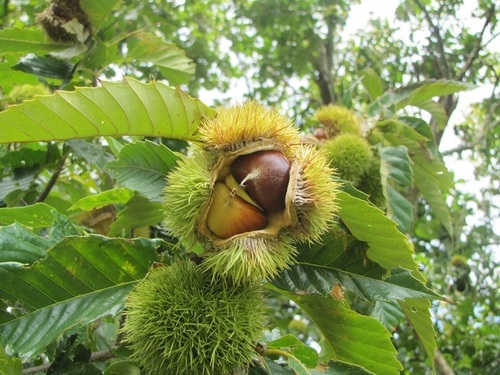
(c) Jim Natale, some rights reserved (CC BY-NC)

(c) Jim Natale, some rights reserved (CC BY-NC)

(c) Jim Natale, some rights reserved (CC BY-NC)
What to Eat
Edible parts: Seeds, Nuts
The seed can be eaten raw or cooked and is quite large, up to 4cm long and 25mm wide. Reports differ on flavour — some describe it as somewhat sweet while others note the presence of bitter tannins. It can be dried and ground into a powder to thicken stews or mixed with cereals for bread. If tannins are present, they can be leached out by thoroughly washing in running water, though this also removes minerals. Either whole seeds or ground powder can be leached — whole seeds may take several days or weeks, and placing them in a cloth bag in a stream was a traditional method. Ground powder leaches more quickly. A simple taste test confirms when tannin has been sufficiently removed. Traditionally, seeds were buried in boggy ground over winter and dug up in spring when most astringency had faded. The roasted seed also makes a coffee substitute.
Where to Find It
It is a temperate plant. It grows in NE regions of the USA between 450-1500 m altitude. It grows in dry and sandy soils. It needs well drained soil. It suits hardiness zones 3-9. Arboretum Tasmania. In Melbourne Botanical Gardens.
Australia, Britain, Canada, Europe, North America, Tasmania, USA,
How to Identify
A medium sized tree. It grows 30 m tall and spreads 18 m wide. It loses its leaves during the year. The tree often forks just above the ground. The branches are large and spreading. The bark is dark red to black and deeply cracked. The leaves are oblong or egg shaped. They are green-yellow. They are paler and finely hairy underneath. The leaves turn rich yellow in autumn. The fruit are acorns half enclosed in hairy cups.
How to Grow
Prefers a good deep fertile loam which can be on the stiff side. Young plants tolerate reasonable levels of side shade. Tolerates moderate exposure, surviving well but being somewhat stunted. Prefers warmer summers than are usually experienced in Britain, but trees still grow well in this country. A slow-growing tree in the wild, though it can live 400 years. The tree produces large crops of acorns every 4 - 7 years, with small crops in the intervening years. The tree flowers on new growth produced in spring, the seed ripening in its first year. This species is often confused with Q. michauxii, Q. muehlenbergii and Q. prinoides. Intolerant of root disturbance, trees should be planted in their permanent positions whilst young. Hybridizes freely with other members of the genus. This species is notably resistant to honey fungus.
Propagation: Seed loses viability quickly if allowed to dry out. It can be stored moist and cool over winter, but is best sown as soon as it is ripe in an outdoor seed bed with protection from mice and squirrels. Small quantities can be sown in deep pots in a cold frame. Because plants develop a deep taproot early, they should be moved to permanent positions as soon as possible — seeds sown in situ produce the best trees. Trees left in a nursery bed for more than 2 growing seasons transplant very badly.
Medicinal Uses
Galls produced on the tree are strongly astringent and have been used to treat haemorrhages, chronic diarrhoea, and dysentery.
Other Uses
A mulch of leaves repels slugs and grubs, though fresh leaves should not be used as they can inhibit plant growth. The seedcups can be used as buttons. The bark is a commercial source of tannin — on a 10% moisture basis, it contains 9.7% tannin. Tannin is also found in the leaves and wood. Oak galls produced by insect larvae are a rich source of tannin once the insects have left, and can also serve as a dyestuff. A red dye is obtained from the bark, though one report describes the colour as tan. The wood is close-grained, heavy, hard, rather tough, strong, and durable in contact with soil, weighing 47lb per cubic foot. Used commercially in a similar manner to Q. alba, it is suitable for furniture, cabinet making, interior finishes, fence posts, and fuel.
Wikipedia
Source ↗Deciduous tree reaching 20 m tall at a slow growth rate. Flowers in May with seeds ripening in October. Monoecious and wind-pollinated. Grows in medium loamy and heavy clay soils across mildly acidic to basic pH ranges. Thrives in semi-shade or full sun, preferring moist conditions. Hardy to UK zone 5. Tolerates strong winds but not salt spray.
Notes
There are about 600 Quercus species. typification of Q. prinus L. uncertain, thus treated as nom. ambig. by some, who accept Q. montana Willd. for this taxon
Names & Synonyms
References (12)
- Bodkin, F., 1991, Encyclopedia Botanica. Cornstalk publishing, p 865
- Cundall, P., (ed.), 2004, Gardening Australia: flora: the gardener's bible. ABC Books. p 1126
- Duke, J.A., 1992, Handbook of Edible Weeds. CRC Press. p 164
- Elias, T.S. & Dykeman P.A., 1990, Edible Wild Plants. A North American Field guide. Sterling, New York p 231
- Esperanca, M. J., 1988. Surviving in the wild. A glance at the wild plants and their uses. Vol. 1. p 211
- Hedrick, U.P., 1919, (Ed.), Sturtevant's edible plants of the world. p 547
- Jackes, D. A., 2007, Edible Forest Gardens
- Little, E.L., 1980, National Audubon Society Field Guide to North American Trees. Alfred A. Knopf. p 405
- Menninger, E.A., 1977, Edible Nuts of the World. Horticultural Books. Florida p 18, 19
- Moerman, D. F., 2010, Native American Ethnobotany. Timber Press. p 464
- Plants for a Future database, The Field, Penpol, Lostwithiel, Cornwall, PL22 0NG, UK. http://www.scs.leeds.ac.uk/pfaf/
- Wickens, G.E., 1995, Edible Nuts. FAO Non-wood forest products. FAO, Rome. p 130
More from Fagaceae