Quercus pubescens
Willd.
Downy oak, White Oak

(c) josefwirth, some rights reserved (CC BY-NC)

(c) josefwirth, some rights reserved (CC BY-NC)
(c) lliriblau, some rights reserved (CC BY-NC)
What to Eat
Edible parts: Seeds, Acorn, Nuts
The seed, up to 2cm long, is considered a famine food used when other options are unavailable. It must be cooked before eating and can be dried and ground into a powder to thicken stews or blended with cereals for bread. Bitter tannins in the seed can be leached out by thoroughly washing in running water, though minerals are lost in the process. Either whole seeds or ground powder can be leached — whole seeds may take several days or weeks, and a traditional method was to place them in a cloth bag in a running stream. Ground powder leaches more quickly. A simple taste test confirms when sufficient tannin has been removed. Seeds were traditionally buried in boggy ground over winter and dug up in spring when most of their astringency had gone. The roasted seed also makes a coffee substitute.
Where to Find It
It is a temperate or Mediterranean plant. It is native to W. Asia and C. and S. Europe. It grows in dry places in hills. In Melbourne Botanical Gardens. Hobart Botanical Gardens.
Andorra, Australia, Balkans, Bosnia, Croatia, Europe, Greece, Hungary, Italy, Luxembourg, Mediterranean, San Marino, Tasmania, Turkey, Türkiye,
How to Identify
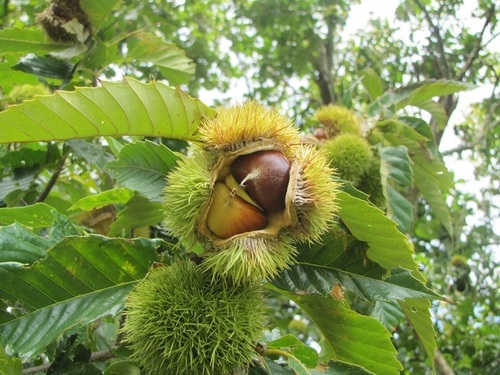
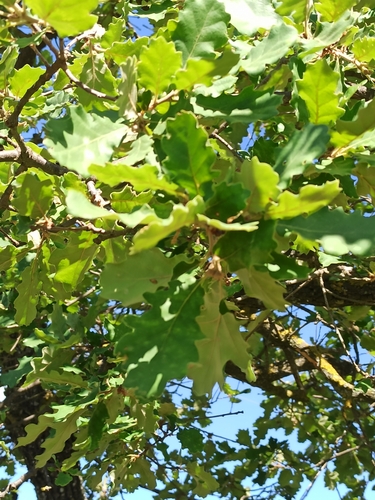
A deciduous tree. It grows 20 m tall. It is a broadly spreading oak tree. The bark is dark grey and deeply furrowed. The leaves are narrowly oval and 10 cm long by 5 cm wide. They have rounded lobes. The lobes end in a small sharp point. The leaves are dark grey-green above and downy underneath. The male and female flowers occur separately on the same plant. The male flowers are easier to see in yellow-green drooping catkins. The fruit is an acorn 4 cm long. It is one third enclosed in a cup. The cup is covered in hairy scales.
How to Grow
Prefers a good deep fertile loam which can be on the stiff side. Young plants tolerate reasonable levels of side shade. Tolerates moderate exposure, surviving well but being somewhat stunted. The seed ripens in its first year. Closely related to Q. petraea. Intolerant of root disturbance, trees should be planted in their permanent positions whilst young. Hybridizes freely with other members of the genus. Plants in this genus are notably resistant to honey fungus.
Propagation: Seed loses viability quickly if allowed to dry out. It can be stored moist and cool over winter, but is best sown as soon as it is ripe in an outdoor seed bed with protection from mice and squirrels. Small quantities can be sown in deep pots in a cold frame. Because plants develop a deep taproot early, they should be moved to permanent positions as soon as possible — seeds sown in situ produce the best trees. Trees left in a nursery bed for more than 2 growing seasons transplant very badly.
Medicinal Uses
Galls produced on the tree are strongly astringent and have been used to treat haemorrhages, chronic diarrhoea, and dysentery.
Other Uses
A mulch of leaves repels slugs and grubs, though fresh leaves should not be used as they can inhibit plant growth. Oak galls, produced by insect larvae feeding within the growths, are a rich source of tannin once the insects have departed, and can also be used as a dyestuff. The wood is hard, durable even under water, and not very elastic. It is used for furniture and similar purposes.
Wikipedia
Source ↗Quercus pubescens (synonyms virgiliana), commonly known as the downy oak, pubescent oak or Italian oak, is a species of white oak (genus Quercus sect. Quercus) native to southern Europe and southwest Asia. It is found from northern Spain (Pyrenees) and France in the West to Turkey and the Caucasus in the East.
Notes
There are about 600 Quercus species.
Names & Synonyms
Hrast medunac, Ispir mesesi, Magyal, Mese, Zir
References (15)
- Berlin. Baumz. 279. 1796, nom. cons. (Sp. pl. 4:450. 1805)
- Blamey, M and Grey-Wilson, C., 2005, Wild flowers of the Mediterranean. A & C Black London. p 32
- Coombes, A.J., 2000, Trees. Dorling Kindersley Handbooks. p 169
- Cundall, P., (ed.), 2004, Gardening Australia: flora: the gardener's bible. ABC Books. p 1127
- Denes, A., et al, 2012, Wild plants used for food by Hungarian ethnic groups living in the Carpathian Basin. Acta Societatis Botanicorum Poloniae 81 (4): 381-396
- Dolina, K. & Luczaj, L., 2014, Wild food plants used on the Dubrovnik coast (south-eastern Croatia) Acta Soc Bot Pol 83(3):175–181
- Ertug, F., 2000, An Ethnobotanical Study in Central Anatolia (Turkey). Economic Botany Vol. 54. No. 2. pp. 155-182
- Ertug, F, Yenen Bitkiler. Resimli Türkiye Florası -I- Flora of Turkey - Ethnobotany supplement
- Kremer, B.P., 1995, Shrubs in the Wild and in Gardens. Barrons. p 161
- Luczaj, L. et al, 2013, Wild food plants used in the villages of the Lake Vrana Nature Park (northern Dalmatia, Croatia). Acta Societatis Botanicorum Poloniae, 82(4): 275-281
- Plants for a Future database, The Field, Penpol, Lostwithiel, Cornwall, PL22 0NG, UK. http://www.scs.leeds.ac.uk/pfaf/
- Redzic, S. J., 2006, Wild Edible Plants and their Traditional Use in the Human Nutrition in Bosnia-Herzegovina. Ecology of Food and Nutrition, 45:189-232
- Rivera, D. et al, 2006, Gathered Mediterranean Food Plants - Ethnobotanical Investigations and Historical Development, in Heinrich M, Müller WE, Galli C (eds): Local Mediterranean Food Plants and Nutraceuticals. Forum Nutr. Basel, Karger, 2006, vol 59, pp 18–74
- Senkardes, I & Tuzlaci, E., 2016, Wild Edible Plants of Southern Part of Nevsehir inTurkey. Marmara Pharmaceutical Journal 20:34-43
- Sfikas, G., 1984, Trees and shrubs of Greece. Efstathiadis Group. Athens. p 146
More from Fagaceae