Quercus robur
L.
English Oak, Truffle Oak, Red Oak, Black oak

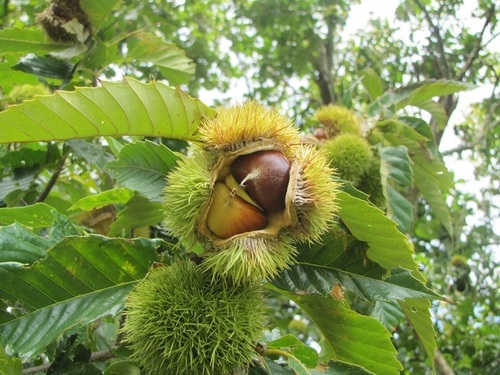
(c) Pom', some rights reserved (CC BY-SA)
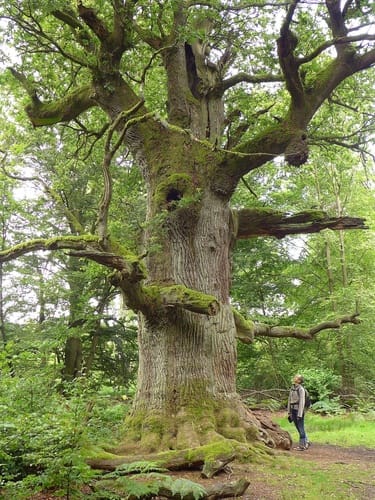
(c) Jakob Fahr, some rights reserved (CC BY-NC)
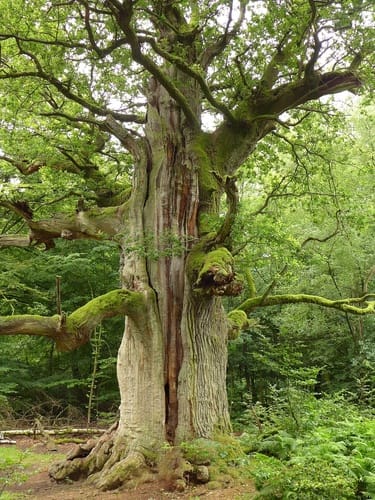
(c) Jakob Fahr, some rights reserved (CC BY-NC)
What to Eat
Edible parts: Gum, Seeds, Nuts, Manna, Seeds - coffee, Leaves - flavouring
The seed must be cooked before eating — it is nourishing but indigestible. Chopped and roasted, it can be used as an almond substitute. It can also be dried and ground into a powder to thicken stews or mixed with cereals for bread-making. Bitter tannins can be leached out by thoroughly washing in running water, though minerals are lost in the process. Either whole seeds or ground powder can be leached — whole seeds may take several days or weeks, and placing them in a cloth bag in a running stream was a traditional method. Ground powder leaches faster. A simple taste test confirms when tannin has been sufficiently removed. Seeds were traditionally buried in boggy ground over winter and dug up in spring when most astringency had faded. The roasted seed also makes a coffee substitute. An edible gum is obtained from the bark. One report mentions that an edible manna is obtained from the plant and used as a butter substitute in cooking, though this likely refers to the same gum.
Known Hazards
Where to Find It
It is a temperate plant. It is native to Europe. It suits light soils. It does well in fertile alkaline soils. It suits hardiness zones 3-10. Arboretum Tasmania. National Arboretum Canberra.
Africa, Australia, Balkans, Belarus, Bosnia, Britain, Bulgaria, Canada, Central Asia, Chile, China, Czech Republic, East Africa, Estonia, Europe, Falklands, France, Germany, Greece, Hungary, Iran, Latvia, Libya, Lithuania, Luxembourg, Mediterranean, Middle East, Netherlands, North America, Pakistan, Poland, Portugal, Romania, Russia, Slovenia, South Africa, Southern Africa, South America, Spain, St Helena, Sweden, Tajikistan, Tasmania, Turkey, Türkiye, Ukraine, USA, Zimbabwe,
How to Identify
A tree with large branches. It grows 36 m high and spreads 25 m across. The crown is broad and often an irregular shape. It loses its leaves during the year. The young bark is smooth and shiny but becomes cracked. The young branches are hairy. The leaves are 5-17 cm long by 2-10 cm wide. The leaves are deep green and almost without leaf stalks. The leaves have rounded lobes. There are 5-7 lobes on each side. The acorns are carried singly or in clusters of 2 or 3. The female flower occurs in the axils of leaves near the tip of young branches. The cup encloses about 1/3 of the nut. The nut is oval and 1.5-1.8 cm long by 1-1.3 cm wide.
How to Grow
Prefers a good deep fertile loam which can be on the stiff side. Young plants tolerate reasonable levels of side shade. Succeeds in heavy clay soils and in wet soils so long as the ground is not water-logged for long periods. Dislikes dry or shallow soils but is otherwise drought tolerant once it is established. Tolerant of exposed sites though it dislikes salt-laden winds. The oak is a very important timber tree in Britain, it is also a very important food plant for the caterpillars of many species of butterfly, there are 284 insect species associated with this tree. It has often been coppiced or pollarded for its wood in the past, though this should not be done too frequently, about once every 50 years is the average. The tree flowers on new growth produced in spring, the seed ripening in its first year. Older trees have a thick corky bark and this can protect them from forest fires, young trees will often regenerate from the base if cut down or killed back by a fire. Intolerant of root disturbance, trees should be planted in their permanent positions whilst young. Hybridizes freely with other members of the genus. Immune to attacks by the tortix moth. This species is notably resistant to honey fungus.
Propagation: Seed loses viability quickly if allowed to dry out. It can be stored moist and cool over winter, but is best sown as soon as it is ripe in an outdoor seed bed with protection from mice and squirrels. Small quantities can be sown in deep pots in a cold frame. Because plants develop a deep taproot early, they should be moved to permanent positions as soon as possible — seeds sown in situ produce the best trees. Trees left in a nursery bed for more than 2 growing seasons transplant very badly.
Medicinal Uses
The oak has a long history of medicinal use, being anti-inflammatory, antiseptic, astringent, decongestant, haemostatic, and tonic. The bark is the most commonly used part, though galls, seeds, and seed cups are also sometimes employed. A decoction of the bark is used for chronic diarrhoea, dysentery, intermittent fevers, and haemorrhages. Externally it is applied to wounds, skin eruptions, sweaty feet, and piles, and used as a vaginal douche for genital inflammations and discharge, and as a wash for throat and mouth infections. Bark is harvested from branches 5–12 years old and dried for later use. Galls on the tree are strongly astringent and used to treat haemorrhages, chronic diarrhoea, and dysentery. The plant is used in Bach flower remedies, prescribed for the states of 'Despondency' and 'Despair, but never ceasing effort'. A homeopathic remedy made from the bark addresses disorders of the spleen and gall bladder. The German Commission E Monographs approve Quercus robur for coughs and bronchitis, diarrhoea, inflammation of the mouth and pharynx, and inflammation of the skin.
Other Uses
A mulch of leaves repels slugs and grubs, though fresh leaves should not be used as they can inhibit plant growth. The bark is an ingredient of 'Quick Return' herbal compost activator — a dried and powdered herbal mixture added to compost heaps to stimulate bacterial activity and shorten composting time. The bark is also very rich in calcium. Oak galls produced by insect larvae are a rich source of tannin once the insects have left, and also serve as a dyestuff. A black dye and an excellent, long-lasting ink are made from the galls mixed with salts of iron, though the colour is not very durable. With alum the dye turns brown; with salts of tin it becomes yellow. A purplish dye is obtained from an infusion of bark with a small quantity of copperas — not bright but said to be durable. Tannin is extracted commercially from the bark and is also found in the leaves — on a 10% moisture basis, bark contains 11.6% tannin and wood 9.2%. Bark strips easily from the wood in April and May. The wood yields tar, quaiacol, acetic acid, creosote, and tannin. The wood itself is hard, tough, and durable even under water, highly valued for furniture and construction, and also makes good fuel and charcoal. Trees can be coppiced for basket making, fuel, and construction.
Wikipedia
Source ↗Quercus robur, the pedunculate (or "English") oak, is a species of flowering plant in the beech and oak family, Fagaceae. It is a large tree, native to most of Europe, North Africa and western Asia, and is widely cultivated in other temperate regions. It grows on soils of near neutral acidity in the lowlands and is notable for its value to natural ecosystems, supporting a very wide diversity of herbivorous insects and other pests, predators and pathogens.
Production
It can live for several hundred years. n
Notes
There are about 600 Quercus species. It is cultivated in China.
Names & Synonyms
Dab, Dob, Dub, Eik, French oak, Leten dab, Ozols, Pedunculate oak, Russian oak, Sapli mese, Tamm, Uzulu, Xia li
References (52)
- Bodkin, F., 1991, Encyclopedia Botanica. Cornstalk publishing, p 865
- Brickell, C. (Ed.), 1999, The Royal Horticultural Society A-Z Encyclopedia of Garden Plants. Convent Garden Books. p 855
- Brouk, B., 1975, Plants Consumed by Man. Academic Press, London. p 208
- Coombes, A.J., 2000, Trees. Dorling Kindersley Handbooks. p 170
- Cundall, P., (ed.), 2004, Gardening Australia: flora: the gardener's bible. ABC Books. p 1127
- Denes, A., et al, 2012, Wild plants used for food by Hungarian ethnic groups living in the Carpathian Basin. Acta Societatis Botanicorum Poloniae 81 (4): 381-396
- Ertug, F., 2000, An Ethnobotanical Study in Central Anatolia (Turkey). Economic Botany Vol. 54. No. 2. pp. 155-182
- Ertug, F, Yenen Bitkiler. Resimli Türkiye Florası -I- Flora of Turkey - Ethnobotany supplement
- Facciola, S., 1998, Cornucopia 2: a Source Book of Edible Plants. Kampong Publications, p 116
- Farrar, J.L., 1995, Trees of the Northern United States and Canada. Iowa State University press/Ames p 266
- Flora of Pakistan. www.eFloras.org
- Harris, E & J., 1983, Field Guide to the Trees and Shrubs of Britain. Reader's Digest. p 148
- Hedrick, U.P., 1919, (Ed.), Sturtevant's edible plants of the world. p 547
- Heywood, V.H., Brummitt, R.K., Culham, A., and Seberg, O. 2007, Flowering Plant Families of the World. Royal Botanical Gardens, Kew. p 148
- Hibbert, M., 2002, The Aussie Plant Finder 2002, Florilegium. p 244
- http://www.botanic-gardens-ljubljana.com/en/plants
- Huang Chengjiu, Zhang Yongtian, Bartholomew, B., Fagaceae, Flora of China.
- Irving, M., 2009, The Forager Handbook, A Guide to the Edible Plants of Britain. Ebury Press p 57
- Joyce, D., 1998, The Garden Plant Selector. Ryland, Peters and Small. p 117
- Kalle, R. & Soukand, R., 2012, Historical ethnobotanical review of wild edible plants of Estonia (1770s-1960s) Acta Societatis Botanicorum Poloniae 81(4):271-281
- Kolosova, V., et al, 2020, Foraging in Boreal Forest: Wild Food Plants of the Republic of Karelia, NW Russia. Foods 2020, 9, 1015; p 14
- Little, E.L., 1980, National Audubon Society Field Guide to North American Trees. Alfred A. Knopf. p 406
- Lord, E.E., & Willis, J.H., 1999, Shrubs and Trees for Australian gardens. Lothian. p 70
- Luczaj, L. et al, 2013, Wild edible plants of Belarus: from Rostakinski's questionnaire of 1883 to the present. Journal of Ethnobiology and Ethnomedicine 9:21
- Luczaj, L., et al, 2015, Wild food plants and fungi used by Ukrainians in the western part of the Maramureş region in Romania. Acta Soc Bot Pol 84(3):339–346
- Mabey, R., 1973, Food for Free. A Guide to the edible wild plants of Britain, Collins. p 34
- Mahklouf, M. H., 2019, Ethnobotanical Study of Edible Wild Plants in Libya. European Journal of Ecology. 5(2): 30-40
- Menendez-Baceta, G., et al, 2012, Wild edible plants traditionally gathered in Gorbeialdea (Biscay, Basque Country) Genetic Resources and Crop Evolution 59:1329-1347
- Menninger, E.A., 1977, Edible Nuts of the World. Horticultural Books. Florida p 19
- Michael, P., 2007, Edible Wild Plants and Herbs. Grub Street. London. p 167
- Nedelcheva A., 2013, An ethnobotanical study of wild edible plants in Bulgaria. EurAsian Journal of BioSciences 7, 77-94
- Pardo-de-Santayana, M., et al, 2007, Traditional knowledge of wild edible plants used in the northwest of the Iberian Peninsula (Spain and Portugal): a comparative study. Journal of Ethnobiology and Ethnomedicine 2007, 3:27
- Pieroni, A. & Soukand, R., 2017, Are Borders more Important than Geographical Distance? The Wild Food Ethnobotany of the Boykos and its Overlap with that of the Bukovinian Hutsuls in Western Ukraine. Journal of Ethnobiology 37(2): 326–345
- Pieroni, A. & Soukand, R., 2018, Forest as Stronghold of Local Ecological Practice: Currently Used Wild Food Plants in Polesia, Northern Ukraine. Economic Botany, XX(X) pp. 1-21
- Plants for a Future database, The Field, Penpol, Lostwithiel, Cornwall, PL22 0NG, UK. http://www.scs.leeds.ac.uk/pfaf/
- Prakofjewa, J., et al, 2023, Boundaries Are Blurred: Wild Food Plant Knowledge Circulation across the Polish-Lithuanian-Belarusian Borderland. Biology 2023, 12, 571.
- Pruse, B., et al, 2021, Active Wild Food Practices among Culturally Diverse Groups in the 21st Century across Latgale, Latvia. Biology 2021, 10, 551.
- Redzic, S. J., 2006, Wild Edible Plants and their Traditional Use in the Human Nutrition in Bosnia-Herzegovina. Ecology of Food and Nutrition, 45:189-232
- Ruiters-Welcome, A. K., 2019, Food plants of southern Africa. Ph.D. thesis. Univ. of Johannesburg p 63
- Schuler, S., (Ed.), 1977, Simon & Schuster's Guide to Trees. Simon & Schuster. No. 156
- Senkardes, I & Tuzlaci, E., 2016, Wild Edible Plants of Southern Part of Nevsehir inTurkey. Marmara Pharmaceutical Journal 20:34-43
- Sfikas, G., 1984, Trees and shrubs of Greece. Efstathiadis Group. Athens. p 146
- Simkova, K. et al, 2014, Ethnobotanical review of wild edible plants used in the Czech Republic. Journal of Applied Botany and Food Quality 88, 49-67
- Solomon, C., 2001, Encyclopedia of Asian Food. New Holland. p 2
- Soukand, R., et al, 2017, Multi-functionality of the few: current and past uses of wild plants for food and healing in Liubań region, Belarus. Journal of Ethnobiology and Ethnomedicine (2017) 13:10
- Sp. pl. 2:996. 1753
- Tardio, J., et al, Ethnobotanical review of wild edible plants in Spain. Botanical J. Linnean Soc. 152 (2006), 27-71
- Upson, R., & Lewis R., 2014, Updated Vascular Plant Checklist and Atlas for the Falkland Islands. Falklands Conservation and Kew.
- van Wyk, B, van Wyk, P, and van Wyk B., 2000, Photographic guide to Trees of Southern Africa. Briza. p 262
- Vorstenbosch, T., et al, 2017, Famine food of vegetal origin consumed in the Netherlands during World War II. Journal of Ethnobiology and Ethnomedicine (2017) 13:63
- Welcome, A. K. & Van Wyk, B.-E., 2019, An inventory and analysis of the food plants of southern Africa. South African Journal of Botany 122 (2019) 136–179
- Wickens, G.E., 1995, Edible Nuts. FAO Non-wood forest products. FAO, Rome. p 130
More from Fagaceae