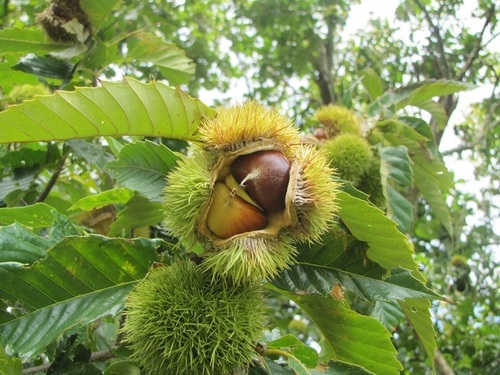
Quercus rubra
L.
Northern red oak, Red Oak
(c) William J. Deml, some rights reserved (CC BY), uploaded by William J. Deml

Famartin (via Wikimedia Commons)

Bay & Gables (via Wikimedia Commons)

Nicholas A. Tonelli from Northeast Pennsylvania, USA (via Wikimedia Commons)

(c) Susan Elliott, some rights reserved (CC BY-NC)
(c) cassi saari, some rights reserved (CC BY-NC)
What to Eat
Edible parts: Seeds, Nuts
The seed was a staple food for several Native North American tribes and must be cooked before eating. Up to 3cm long, it can be dried and ground into a powder to thicken stews or blended with cereals for bread-making. Bitter tannins in the seed can be leached out by thoroughly washing in running water, though minerals are lost in the process. Either whole seeds or ground powder can be leached — whole seeds may take several days or weeks, and placing them in a cloth bag in a stream was a traditional method. Ground powder leaches more quickly. A simple taste test confirms when tannin has been sufficiently removed. Seeds were traditionally buried in boggy ground over winter and dug up in spring when most of their astringency had gone. The roasted seed also makes a coffee substitute.
Where to Find It
It is a temperate plant. It is native to eastern North America. It is frost hardy. It cannot tolerate competition and shade. It suits hardiness zones 3-9. Arboretum Tasmania. Hobart Botanical Gardens.
Australia, Canada, Hungary, North America, Tasmania, USA,
How to Identify
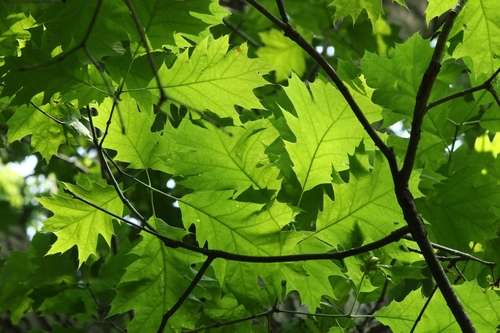
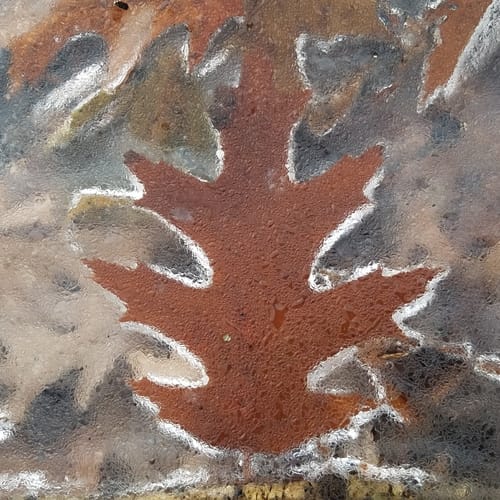
A medium sized tree. It grows to 25 m tall and spreads to 22 m wide. The trunk is 30-90 cm wide. It has long dark green leaves with pointed lobes. The leaves are 10-20 cm long. There are 7-9 lobes. The base is broadly wedge shaped. The are several large bristle tipped teeth. Each lobe tapers towards the tip. The leaf stalk is 2.5-5 cm long. These turn reddish and yellow-brown in autumn. The fruit are acorns. These are 12-25 mm long and almost as wide. The cup is saucer shaped. It encloses one quarter of the nut.
How to Grow
Prefers a good deep fertile loam which can be on the stiff side. Lime tolerant. Young plants tolerate reasonable levels of side shade. Tolerates moderate exposure, surviving well but being somewhat stunted. Prefers a hotter summer than is usually experienced in Britain, but trees still grow well in Britain. A fairly fast-growing tree, it is cultivated for its timber in C. Europe. Trees normally require 20 - 25 years to reach flowering size, and may take another 20 years before heavy crops of seed are produced. Seed production is cyclic, heavy crops being produced every 2 - 5 years in the wild. The tree flowers on new growth produced in spring, the seed taking two summers to ripen. Trees are able to regenerate from root suckers if the top is killed by a forest fire. Intolerant of root disturbance, trees should be planted in their permanent positions whilst young. Hybridizes freely with other members of the genus. Plants in this genus are notably resistant to honey fungus.
Propagation: Seed loses viability quickly if allowed to dry out. It can be stored moist and cool over winter, but is best sown as soon as it is ripe in an outdoor seed bed with protection from mice and squirrels. Small quantities can be sown in deep pots in a cold frame. Because plants develop a deep taproot early, they should be moved to permanent positions as soon as possible — seeds sown in situ produce the best trees. Trees left in a nursery bed for more than 2 growing seasons transplant very badly.
Medicinal Uses
The bark and inner bark are antiseptic, astringent, emetic, febrifuge, and tonic. They are used to treat diarrhoea, chronic dysentery, indigestion, asthma, severe coughs, hoarseness, intermittent fevers, and bleeding. Externally, the bark is applied as a wash for skin eruptions, rashes, and burns, and can be chewed as a treatment for mouth sores. The bark contains tannins that have been experimentally shown to be antiviral, antiseptic, and anticancer, but also carcinogenic. Galls produced on the tree are strongly astringent and used to treat haemorrhages, chronic diarrhoea, and dysentery.
Other Uses
A mulch of leaves repels slugs and grubs, though fresh leaves should not be used as they can inhibit plant growth. Oak galls, produced by insect larvae, are a rich source of tannin once the insects have departed, and can also serve as a dyestuff. Tannin is obtained from the bark, and a reddish-brown dye can also be extracted from it. The wood is coarse-grained, hard, strong, heavy, and not durable, weighing 41lb per cubic foot. It is an important lumber source in America, highly valued for flooring, furniture, veneer, and construction.
Wikipedia
Source ↗Quercus rubra, the northern red oak or common red oak, is an oak tree in the red oak group (Quercus section Lobatae). It is a native of North America, in the eastern and central United States and southeast and south-central Canada. It has been introduced to small areas in Western Europe, where it can frequently be seen cultivated in gardens and parks. It prefers good soil that is slightly acidic. Often simply called red oak, northern red oak is so named to distinguish it from southern red oak (Q. falcata), also known as the Spanish oak.
Production
A fast growing tree. Trees live for 150 years.
Notes
There are about 600 Quercus species.
Names & Synonyms
References (18)
- Bodkin, F., 1991, Encyclopedia Botanica. Cornstalk publishing, p 865
- Coombes, A.J., 2000, Trees. Dorling Kindersley Handbooks. p 171
- Cundall, P., (ed.), 2004, Gardening Australia: flora: the gardener's bible. ABC Books. p 1127
- Denes, A., et al, 2012, Wild plants used for food by Hungarian ethnic groups living in the Carpathian Basin. Acta Societatis Botanicorum Poloniae 81 (4): 381-396
- Elias, T.S. & Dykeman P.A., 1990, Edible Wild Plants. A North American Field guide. Sterling, New York p 233
- Esperanca, M. J., 1988. Surviving in the wild. A glance at the wild plants and their uses. Vol. 2. p 114
- Farrar, J.L., 1995, Trees of the Northern United States and Canada. Iowa State University press/Ames p 248
- Grandtner, M. M., 2008, World Dictionary of Trees. Wood and Forest Science Department. Laval University, Quebec, Qc Canada. (Internet database http://www.wdt.qc.ca)
- Hibbert, M., 2002, The Aussie Plant Finder 2002, Florilegium. p 244
- Joyce, D., 1998, The Garden Plant Selector. Ryland, Peters and Small. p 117
- Kermath, B. M., et al, 2014, Food Plants in the Americas: A survey of the domesticated, cultivated and wild plants used for Human food in North, Central and South America and the Caribbean. On line draft. p 736
- Little, E.L., 1980, National Audubon Society Field Guide to North American Trees. Alfred A. Knopf. p 407
- MacKinnon, A., et al, 2009, Edible & Medicinal Plants of Canada. Lone Pine. p 59
- Moerman, D. F., 2010, Native American Ethnobotany. Timber Press. p 464
- Plants for a Future database, The Field, Penpol, Lostwithiel, Cornwall, PL22 0NG, UK. http://www.scs.leeds.ac.uk/pfaf/
- Ryan, S., 2008, Dicksonia. Rare Plants Manual. Hyland House. p 50
- Sp. pl. 2:996. 1753
- Toupal, R. S. & Hollenback, K., 2009, An Ethnobotany of Indiana Dunes National Lakeshore: Plant Uses of the Ojibwa People. Bureau of Applied Research in Anthropology. University of Arizona
More from Fagaceae