Quercus suber
L.
Cork Oak
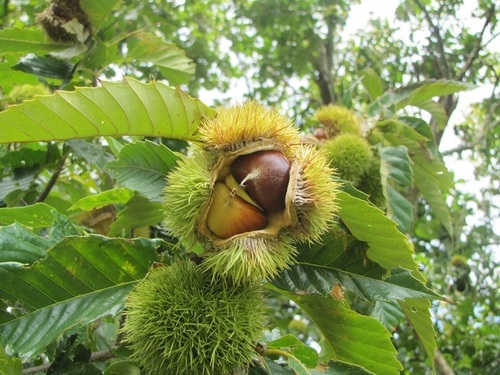
(c) zoe jewell & sky alibhai, some rights reserved (CC BY-NC)
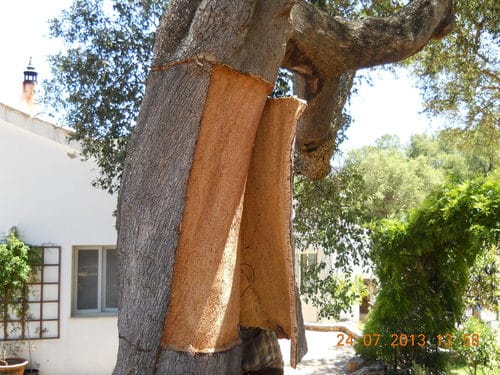
(c) Duarte Frade, some rights reserved (CC BY), uploaded by Duarte Frade
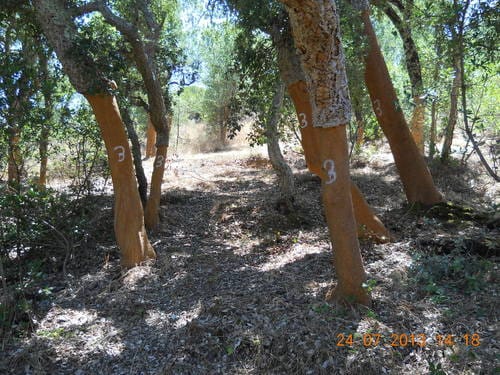
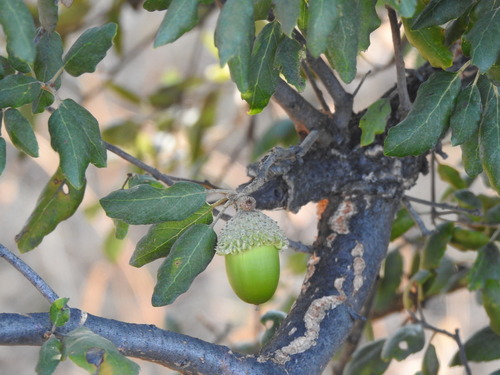
(c) zoe jewell & sky alibhai, some rights reserved (CC BY-NC)
What to Eat
Edible parts: Seeds, Acorn, Nuts
The seed is primarily a famine food and must be cooked before eating. It can be dried and ground into a powder for use as a stew thickener or mixed with cereals for bread. Bitter tannins in the seed can be leached out by washing thoroughly in running water, though many minerals are lost in the process. Either whole seeds or ground powder can be used — whole seeds may take several days or weeks to leach adequately, with one method involving wrapping them in a cloth bag and placing in a stream. Leaching powder is quicker. A taste test indicates when tannin has been sufficiently removed. The traditional preparation involved burying seeds in boggy ground over winter; the germinating seed dug up in spring would have shed most of its bitterness. The roasted seed serves as a coffee substitute. It has been noted that the Q. suber population of the Mamora forest in Morocco produces only sweet acorns that can be eaten raw, with a flavour similar to raw chestnuts and skins that remove quite easily. Quercus ilex also occurs with tannin-free acorns in Moroccan forests, with locals estimating around 20 percent are sweet.
Where to Find It
It is a temperate or Mediterranean plant. It grows naturally in the western Mediterranean. It suits hardiness zones 8-10. Arboretum Tasmania. In Melbourne Botanical Gardens. Kyneton Botanical Gardens. National Arboretum Canberra.
Africa, Algeria, Australia, Britain, Canada, East Africa, Europe, France, Mediterranean, Morocco, North Africa, North America, Portugal, Slovenia, Spain, St Helena, Tasmania, Yugoslavia, Zimbabwe,
How to Identify
A medium sized tree. It grows to 20 m high. The branches are gnarled. The bark is thick and grey and has long cracks. The leaves are alternate and have spine tipped lobes. They are oval and 7 cm long by 4 cm wide. They are dark green on top and white underneath. The female flowers appear on young grey-green shoots. The acorns are in a loose shallow cup. They are 3 cm long.
How to Grow
Prefers a good deep fertile loam which can be on the stiff side. Lime tolerant. Young plants tolerate reasonable levels of side shade. Tolerates moderate exposure, surviving well but being somewhat stunted. Cultivated for its bark in Europe, it is the main source of cork. Trees are first harvested when they are 25 - 30 years old and are then harvested on a 10 - 12 year rotation. Only hardy in the milder areas of Britain, it is not very frost resistant. Trees grow well in Cornwall where there are many large specimens. Trees grow quite well at Kew. Transplants badly unless it is moved regularly, it should only be moved in September or as growth commences in late spring. Does not fruit well in Britain. Most of the trees grown in Britain as Q. suber are in fact Q. suber occidentalis. Hybridizes freely with other members of the genus. This species is notably resistant to honey fungus. Heat Zone: 9-7.
Propagation: Seed loses viability rapidly if allowed to dry out. It can be stored moist and cool over winter but is best sown as soon as it is ripe in an outdoor seed bed, with protection from mice and squirrels. Small quantities can be sown in deep pots in a cold frame. Because plants develop a deep taproot, they should be moved to their permanent positions as soon as possible — seed sown in situ produces the best trees. Trees left in a nursery bed for more than 2 growing seasons transplant very poorly.
Medicinal Uses
Galls produced on the tree are strongly astringent and can be used in treating haemorrhages, chronic diarrhoea, and dysentery.
Other Uses
A mulch of leaves repels slugs and grubs, though fresh leaves should not be used as they can inhibit plant growth. Oak galls caused by insect larvae are a useful source of tannin once the insect has left; the tannin can also be used as a dyestuff. The tree is fairly wind-tolerant and suitable for shelterbelt plantings, and does well on dry banks as a shade tree. The bark is the source of cork, widely used for heat and sound insulation, flooring, and floats. Trees are first harvested at 25–30 years of age and then every 6–12 years thereafter; the bark must be removed carefully to avoid harming the tree. A large tree can yield up to 1 tonne of cork. On a 10% moisture basis, the bark contains 16.9% tannin. The wood has general timber uses.
Wikipedia
Source ↗Quercus suber, commonly called the cork oak, is a medium-sized, evergreen oak tree in the section Quercus sect. Cerris. It is the primary source of cork for wine bottle stoppers and other uses, such as cork flooring and as the cores of cricket balls. It is native to southwest Europe and northwest Africa. In the Mediterranean basin the tree is an ancient species with fossil remnants dating back to the Tertiary period. It can survive for as long as two centuries. Typically, once it reaches 25 years old, its thick bark can be harvested for cork every 9 to 12 years without causing harm to the tree. It endures drought and makes little demand on the soil quality and is regarded as a defence against desertification. Cork oak woodlands are home to a multitude of animal and plant species. Since cork for sealing bottles is increasingly being displaced by other materials, these forests are at risk as part of the cultural landscape and as a result animal species such as the Iberian lynx and imperial eagles are threatened with extinction.
Other Information
It is cultivated.
Notes
There are about 600 Quercus species.
Names & Synonyms
Alcornoque, Hrast plutovec
References (20)
- Blamey, M and Grey-Wilson, C., 2005, Wild flowers of the Mediterranean. A & C Black London. p 32
- Blanco-Salas, J., et al, 2019, Wild Plants Potentially Used in Human Food in the Protected Area “Sierra Grande de Hornachos” of Extremadura (Spain). Sustainability 2019, 11, 456
- Bodkin, F., 1991, Encyclopedia Botanica. Cornstalk publishing, p 865
- Brickell, C. (Ed.), 1999, The Royal Horticultural Society A-Z Encyclopedia of Garden Plants. Convent Garden Books. p 856
- Coombes, A.J., 2000, Trees. Dorling Kindersley Handbooks. p 172
- Cundall, P., (ed.), 2004, Gardening Australia: flora: the gardener's bible. ABC Books. p 1127
- Facciola, S., 1998, Cornucopia 2: a Source Book of Edible Plants. Kampong Publications, p 116
- Harris, E & J., 1983, Field Guide to the Trees and Shrubs of Britain. Reader's Digest. p 108
- Hedrick, U.P., 1919, (Ed.), Sturtevant's edible plants of the world. p 547
- Hibbert, M., 2002, The Aussie Plant Finder 2002, Florilegium. p 244
- http://www.botanic-gardens-ljubljana.com/en/plants
- Jardin, C., 1970, List of Foods Used In Africa, FAO Nutrition Information Document Series No 2.p 36
- Lord, E.E., & Willis, J.H., 1999, Shrubs and Trees for Australian gardens. Lothian. p 70
- Menninger, E.A., 1977, Edible Nuts of the World. Horticultural Books. Florida p 19
- Nassif, F., & Tanji, A., 2013, Gathered food plants in Morocco: The long forgotten species in Ethnobotanical Research. Life Science Leaflets 3:17-54
- Plants for a Future database, The Field, Penpol, Lostwithiel, Cornwall, PL22 0NG, UK. http://www.scs.leeds.ac.uk/pfaf/
- Ryan, S., 2008, Dicksonia. Rare Plants Manual. Hyland House. p 50
- Sp. pl. 2:995. 1753
- Wickens, G.E., 1995, Edible Nuts. FAO Non-wood forest products. FAO, Rome. p 130
- Zeven, A. C. & de West, J. M. J., 1982, Dictionary of cultivated plants and their regions of diversity. Wageningen. p 108
More from Fagaceae