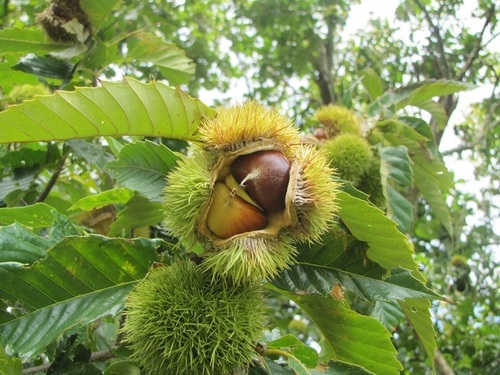
Quercus wislizeni
DC.
Interior Live Oak, Californian Live Oak

(c) Jordan Collins, some rights reserved (CC BY-NC)

(c) Jordan Collins, some rights reserved (CC BY-NC)

(c) Jordan Collins, some rights reserved (CC BY-NC)
What to Eat
Edible parts: Acorns, Nuts
The seed, which can be up to 35mm long and 1cm wide, must be cooked and was a staple food for some Native North American tribes. It can be dried, ground into a powder, and used as a thickener in stews or mixed with cereals for making bread. Bitter tannins in the seed can be leached out by washing thoroughly in running water, though this also removes many minerals. Whole seeds may take several days or even weeks to fully leach — one method was to wrap them in a cloth bag and place them in a stream. Ground powder leaches more quickly, and a simple taste test indicates when the tannin is sufficiently removed. Traditionally, seeds were buried in boggy ground overwinter and dug up in spring, by which point most astringency would have gone. The roasted seed also makes a coffee substitute.
Where to Find It
It is a warm temperate plant. In Melbourne Botanical Gardens. It suits hardiness zones 8-10.
Australia, Mexico, North America, USA,
How to Identify
An evergreen tree. It grows 24 m high and spreads 10 m wide. The bark is thick and dark and deeply cracked with scaly ridges. The leaves are oblong or oval and holly like. They have slender spiny teeth. The fruit are acorns.
How to Grow
Propagation: Seed loses viability quickly if allowed to dry out. It can be stored moist and cool overwinter but is best sown as soon as it is ripe in an outdoor seed bed with protection from mice and squirrels. Small quantities can be sown in deep pots in a cold frame. Plants develop a deep taproot and should be moved to their permanent positions as soon as possible — seed sown in situ produces the best trees. Trees left in a nursery bed for more than 2 growing seasons transplant very badly.
Medicinal Uses
A decoction of the bark has been used as a cough medicine. The pulverized outer bark serves as an astringent and antiseptic dusting powder on burns and running sores, and is particularly useful for babies with a sore umbilicus. A decoction of the inner bark has been used to treat arthritis. Any galls produced on the tree are strongly astringent and can be used in treating haemorrhages, chronic diarrhoea, and dysentery.
Other Uses
A mulch of the leaves repels slugs and grubs, though fresh leaves should not be used as they can inhibit plant growth. Oak galls, sometimes produced in large numbers, are formed by insect larvae living and feeding inside the tissue. Once the insect pupates and leaves, the empty gall provides a rich source of tannin that can also be used as a dye. Acorn meal has been used to mend cracks in clay pots. The wood is heavy, very hard, strong, and close-grained. It has no commercial value due to the trunks being neither tall nor clear, and is used mainly as a fuel.
Notes
There are about 600 Quercus species.
References (5)
- Beckstrom-Sternberg, Stephen M., and James A. Duke. "The Foodplant Database." http://probe.nalusda.gov:8300/cgi-bin/browse/foodplantdb.(ACEDB version 4.0 - data version July 1994)
- Brickell, C. (Ed.), 1999, The Royal Horticultural Society A-Z Encyclopedia of Garden Plants. Convent Garden Books. p 856
- Cundall, P., (ed.), 2004, Gardening Australia: flora: the gardener's bible. ABC Books. p 1128
- Moerman, D. F., 2010, Native American Ethnobotany. Timber Press. p 467
- Prodr. 16(2):67. 1864 - Taxon 23:557. 1974 advocates spelling "wislizenii" but the original spelling, permissible under ICBN Rec. 60C.2, is not correctable under ICBN Art. 60.11
More from Fagaceae