Raphia farinifera
(Gaertn.) Hylander
Raffia palm, Madagascar raffia palm

(c) Joachim Louis, some rights reserved (CC BY-NC-ND), uploaded by Joachim Louis

(c) Mark Hyde, Bart Wursten and Petra Ballings, some rights reserved (CC BY-NC)
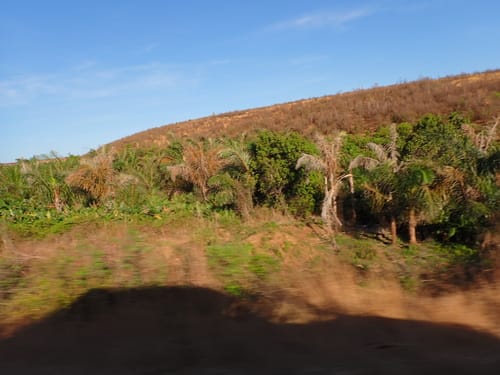
(c) Louis Aureglia, some rights reserved (CC BY)
What to Eat
Edible parts: Nuts, Leaves, Sago, Terminal bud, Fruit, Sap, Vegetable, Fruit - oil
The sap from the trunk is fermented to make palm wine and can also be used to make a sweet beverage. It can be obtained by felling the trunk and allowing the sap to drain, or by boring a hole near the apex of the trunk. An edible starch is obtained from the stem. The fruit is boiled and eaten, and an oil is extracted from it — boiled fruit pulp yields a yellow fat known as raphia butter, which has a good flavour when fresh. To extract it, the fruits are crushed, water is added, the mixture is boiled and left to cool, and the floating oil is skimmed off for use in cooking. The seed is also edible.
Where to Find It
It is a tropical plant. It grows in the lowlands. It grows in swamp areas. It grows from sea level to 880 m altitude. In Tanzania it grows from sea level to 2,500 m above sea level. It suits moist and humid locations. It suits plant hardiness zones 10-11. In Townsville palmetum.
Africa, Australia, Cameroon, Central Africa, Congo, East Africa, Fiji, India, Kenya, Madagascar, Malawi, Mayotte, Mozambique, Nigeria, Pacific, Southern Africa, Tanzania, Uganda, West Africa, Zambia, Zimbabwe,
How to Identify
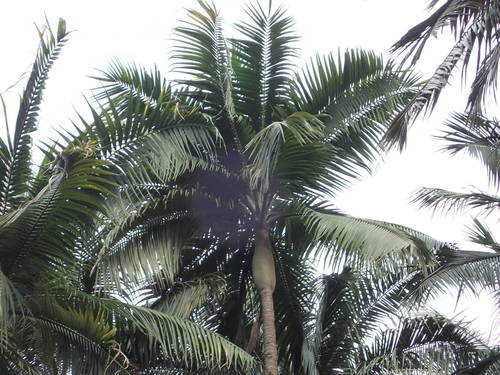
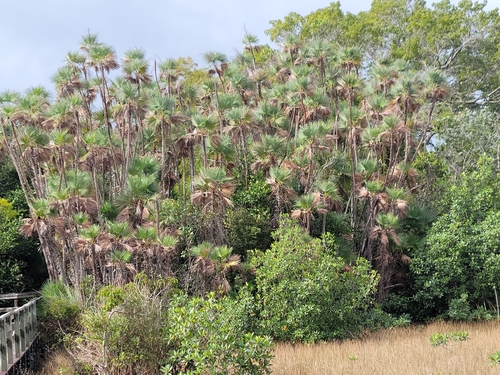
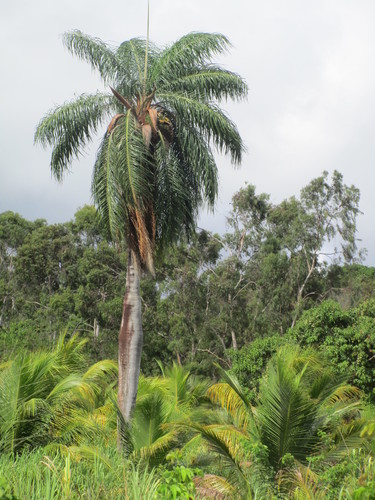
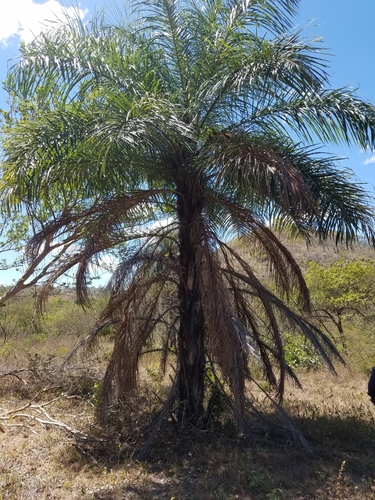
A palm with a single trunk. The trunk is usually very short. The fronds grow to 8-10 m high. There are new suckers produced at the base. The leaves are 15-18 m long. They hang over. They are feather-like and 18 m long. The male and female flowers are separate on a large branched plume like structure. This can be 3 m long and take 2-3 years to develop. The flower head starts erect and later bends over and hangs below the leaves. The fruit are oblong and 9 cm long. They have overlapping scales. They are shiny and brown and have one seed inside.
How to Grow
It spreads by suckers. Seeds are slow to germinate. The thick outer layer of the seeds needs to be removed.
Propagation: Pre-soak seed for 24 hours in warm water and sow in containers. Germination requires several months.
Medicinal Uses
None known
Other Uses
Raffia, widely used in weaving baskets, mats, and similar items, is obtained from the leaflets of this plant. The large midribs of the leaves and the leaf stalks are widely used to construct the framework of houses, as poles, and for making furniture. They can be split into strips for weaving mats, baskets, and similar items. The leaves are used for thatching and for weaving baskets, mats, and hats. Fibres from the leaves are used as tying material and for weaving mats, hoods, bags, curtains, and other items. A tough fibre known as piassava, obtained from the leaf sheaths, is used for making brooms and rope. The fibre is derived from the cuticle of leaves harvested before full expansion, which are peeled on both sides and divided into narrower strips using a comb-like tool. It appears as flat, straw-coloured strips about 12–18mm wide and 90–120cm long, and can be divided into fine threads. It is used for delicately plaited goods, hats, floor mats, and wrapping goods; loose strips are widely used by gardeners and nurserymen in place of Russian bast or tie bands. It has also been woven into superior matting used instead of tapestry for wall coverings. The preparation of raffia is one of Madagascar's most extensive industries — men cut the palm leaves in the forest and bring them home for women to complete the work, with the fibre cured the same day it is stripped. Traditional uses also include cordage and fishing nets. Raphia wax, derived from the lower surface of the leaves, is used as a polish for boats and floors, or for making candles. Oil extracted from the boiled fruit pulp and fruit kernels is used for producing soap and stearin. The fruit shells are made into snuffboxes or buttons. The wood is used for construction after the sap has been allowed to drain.
Wikipedia
Source ↗Raphia farinifera is a tropical African palm tree occurring in lowland riparian and swamp forest, also around human habitations and cultivated locations, on stream banks and other moist situations at altitudes of 50–1000 m. Found in Angola, Benin, Burkina Faso, Cameroon, Gambia, Ghana, Guinea, Ivory Coast, Kenya, Madagascar, Malawi, Mauritius, Mozambique, Nigeria, Réunion, Senegal, Seychelles, Sierra Leone, Tanzania, Togo, Uganda, Zambia and Zimbabwe, and naturalised in east lowlands of Madagascar. Its generic epithet is derived from raphis = 'needle', probably in reference to the 4 mm long yellowish spines on the margins and main veins of the leaflets. The specific name refers to a type of starchy flour obtained from the trunk pith – farina = 'flour', fera = 'bearing'. It is one of 26 species of the genus Raphia currently recognised, all native to Africa and Madagascar, with one species, R. taedigera also found in Central and South America. Their fronds, botanically a single leaf, are among the longest in the plant kingdom, those of R. regalis reaching a length of 25 m. The trunk of this species is up to 10 m tall and about 1 m in diameter – the topmost fronds reach up a further 10 m – and sheathed in persistent leaf bases. Trees occur singly or, because of suckering, in dense clumps. The pendant inflorescences are massive, up to 3.3 m (11 ft) long, and up to 35 cm (14 in) thick. | bearing unisexual flowers – male flowers at the distal end, female flowers at proximal – with first order branches of 13–32 rachillae very close-packed in almost one plane (see illustration). Raphia spp. are monocarpic or hapaxanthic, flowering and fruiting only once, followed by death. Raphia farinifera flowers when the tree is some 20–25 years old, and it takes a further 5–6 years from flowering to ripe fruit, all fruits ripening together. The fruit is oblong to ovoid, 5–10 cm in length, with imbricate, glossy, golden-brown scales. Like all Raphia species, it displays the very rare 1/4 phyllotaxy.
Production
Trees live for 25-35 years, set flowers, then wither and die.
Other Information
It is important in tropical swamp areas.
Notes
There are about 28-30 Raphia species. Most are in Africa and one is in central America. Raffia fibre is made from the leaf bases.
Names & Synonyms
Ankup, Chiwale, Kibo, Mavale, Mkalilila, Mole, Mwaale, Mwale, Rafia, Rofia, Viwale
References (31)
- Ambasta S.P. (Ed.), 2000, The Useful Plants of India. CSIR India. p 515
- Balick, M.J. and Beck, H.T., (Ed.), 1990, Useful palms of the World. A Synoptic Bibliography. Colombia p 540, 542, 655 (As Raffia ruffia),
- Brickell, C. (Ed.), 1999, The Royal Horticultural Society A-Z Encyclopedia of Garden Plants. Convent Garden Books. p 860
- Dharani, N., 2002, Field Guide to common Trees & Shrubs of East Africa. Struik. p 294
- Dransfield, J. & Beentje, H., 1995, The Palms of Madagascar. Royal Botanical Gardens, Kew and The International Palm Society. p 69
- Facciola, S., 1998, Cornucopia 2: a Source Book of Edible Plants. Kampong Publications, p 30
- Fongnzossie Fedoung, E., et al, 2020, Wild edible plants and mushrooms of the Bamenda Highlands in Cameroon: ethnobotanical assessment and potentials for enhancing food security. Journal of Ethnobiology and Ethnomedicine 16:12
- Fowler, D. G., 2007, Zambian Plants: Their Vernacular Names and Uses. Kew. p 65
- Gibbons, M., 1993, Palms. Compact study Guide and Identifier. Sandstone. p 66
- Grubben, G. J. H. and Denton, O. A. (eds), 2004, Plant Resources of Tropical Africa 2. Vegetables. PROTA, Wageningen, Netherlands. p 564
- Hedrick, U.P., 1919, (Ed.), Sturtevant's edible plants of the world. p 549 (As Raphia pedunculata)
- Hibbert, M., 2002, The Aussie Plant Finder 2002, Florilegium. p 245
- http://www.fao.org/forestry/25323-096344a3de335832e8f363c3ac5184a66.pdf
- Jardin, C., 1970, List of Foods Used In Africa, FAO Nutrition Information Document Series No 2.p 19, 36, 97, 157
- Jones, D.L., 1994, Palms throughout the World. Smithtonian Institution, Washington. p 325
- Llamas, K.A., 2003, Tropical Flowering Plants. Timber Press. p 114
- Lustgarden 31-32:88, 91. 1952
- Martin, F.W. & Ruberte, R.M., 1979, Edible Leaves of the Tropics. Antillian College Press, Mayaguez, Puerto Rico. p 188
- Menninger, E.A., 1977, Edible Nuts of the World. Horticultural Books. Florida p 141
- Otedoh, M.O., 1982, Revision of the genus Raphia Beauv. (Palmae), Journal of the Nigerian
- Purseglove, J.W., 1972, Tropical Crops. Monocotyledons. Longmans p 431
- Reitveld, S., 2013, The Animals and Plants of the Zazamalala Forest in Western Madagascar. p 49
- Riffle, R.L. & Craft, P., 2003, An Encyclopedia of Cultivated Palms. Timber Press. p 430
- Ruffo, C. K., Birnie, A. & Tengnas, B., 2002, Edible Wild Plants of Tanzania. RELMA p 558
- Russell, T.A., 1965, The Raphia palms of West Africa. Kew Bulletin 19(2):173-95
- Schatz, G.E., 2001, Generic Tree Flora of Madagascar. Royal Botanical Gardens, Kew and Missouri Botanical Garden. p 69
- Smith, A.C., 1979, Flora Vitiensis Nova, Lawaii, Kuai, Hawaii, Volume 1 p 405
- Styger, E., et al, 1999, Indigenous fruit trees of Madagascar: potential components of agroforestry systems to improve human nutrition and restore biological diversity. Agroforestry Systems 46: 289-310 (As Raphia ruffia)
- Wickens, G.E., 1995, Edible Nuts. FAO Non-wood forest products. FAO, Rome. p170
- Williamson, J., 2005, Useful Plants of Malawi. 3rd. Edition. Mdadzi Book Trust. p 213
- World Checklist of Useful Plant Species 2020. Royal Botanic Gardens, Kew