Raphia hookeri
G. Mann & H. Wendl.
Giant raffia palm
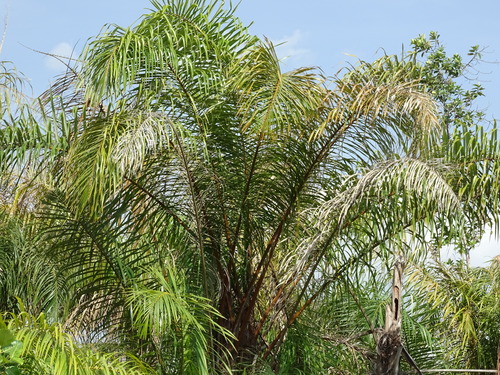
(c) IKOUKOMON Abdou-Chérifou, some rights reserved (CC BY-NC), uploaded by IKOUKOMON Abdou-Chérifou
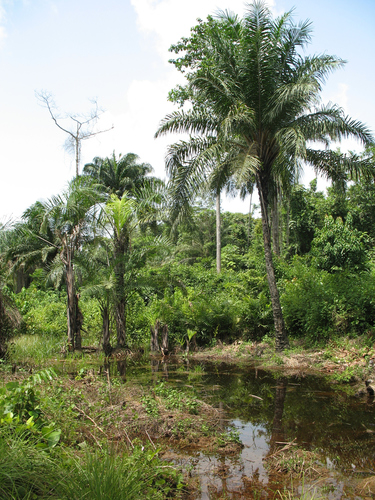
(c) Jeremy Barker, some rights reserved (CC BY-NC), uploaded by Jeremy Barker
What to Eat
Edible parts: Kernel, Sap, Nuts, Seed, Fruit, Palm heart, Cabbage, Vegetable
The sap from the trunk is fermented to make palm wine, a very popular drink in West Africa. Fresh sap tastes like ginger beer. The alcohol content rises from under 2% to about 5% during the first 8 days of tapping, then remains constant. Sap is obtained from the inflorescence and tapped from the stem as the tree approaches the flowering stage — either by felling the trunk, or by boring a hole near the apex. Tapping by piercing the base of the terminal bud eventually kills the palm. The wine can be distilled into a strong alcoholic liquor and used as baker's yeast. The fruit is boiled and eaten — it is poisonous raw. The apical bud is cooked and eaten like cabbage, though harvesting it will eventually kill the trunk as the palm cannot produce side branches. An edible starch is obtained from the stem, and an oil is obtained from the fruit.
Known Hazards
Where to Find It
A tropical plant. It grows naturally in swamps. It occurs in lowland rainforest. It suits humid locations.
Africa, Asia, Australia, Benin, Cameroon, Central Africa, Central African Republic, CAR, Congo DR, Congo R, Côte d'Ivoire, Equatorial Guinea, Gabon, Gambia, Ghana, Guinea, Guinée, India, Indonesia, Ivory Coast, Liberia, Nigeria, SE Asia, Sierra Leone, Togo, West Africa,
How to Identify
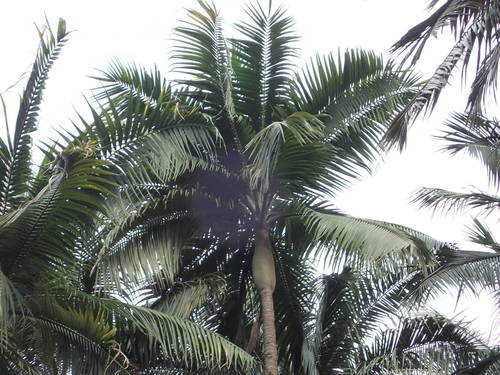
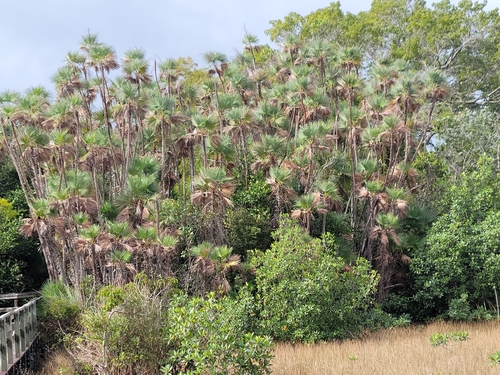
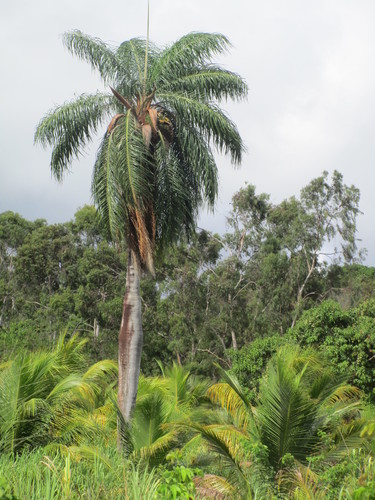
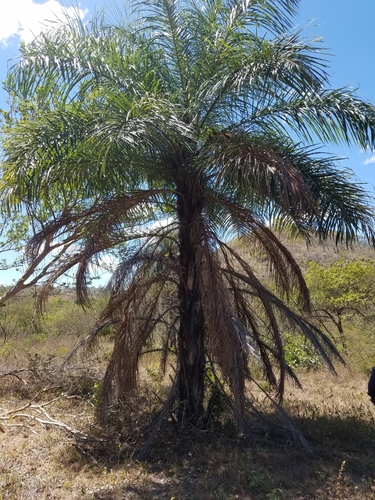
A palm. It is often a solitary palm but can also have some suckers. It grows to 10-15 m high. The trunks are 30 cm across. The upper part of the trunk is covered with leaf bases and blackish spiny fibres. The leaves are shiny dark green. They can be 12 m long. The leaves are feather like. The leaflets are rigid. The flowering stalk is 2.5 m long. They hang down. The crown dies after flowering. The flowers are brownish in colour. The fruit are brown and shaped like a top. They are 12 cm long by 5 cm wide. They have a stout beak. They are light brown, hard and shiny. They have overlapping scales.
Nutrition Score: 49/100
| Part | Moisture | kJ | kcal | Protein | Vit A | Vit C | Iron | Zinc |
|---|---|---|---|---|---|---|---|---|
| Kernel | 10.6 | 1363 | 326 | 7.8 | — | — | — | — |
How to Grow
It grows best in areas where annual daytime temperatures are within the range 24 - 30°c, but can tolerate 14 - 36°c. It prefers a mean annual rainfall in the range 3,000 - 4,000mm, but tolerates 2,000 - 5,000mm. Requires a hot, sunny position in a moist soil. Prefers a pH in the range 5 - 6, tolerating 4.5 - 6.5. Dislikes saline soils. Plants can tolerate being in flooded ground. A monocarpic plant - growing for several years without flowering, then producing a massive inflorescence and dying after setting seed. Inflorescences are produced more or less simultaneously in the axils of the most distal leaves. Tapping for wine may damage the developing inflorescence, making flowering impossible and accelerating death. The time from planting to flowering in Raphia hookeri is 3 - 7 years. Managed stands are mostly left to rejuvenate naturally by seed. In Nigeria, selected trees are left untapped for this purpose.
Propagation: Pre-soak seed for 24 hours in warm water and sow in containers. Germination requires several months, with a germination period ranging from 1–24 months and a germination rate of 30–60%. Young plants transplant easily. Although it has been suggested that seeds should be sown ventral side upwards because the embryo is located on that side, research has shown that seed orientation does not affect germination or seedling growth.
Medicinal Uses
The oily mesocarp of the fruit is used in traditional medicine for its laxative and stomachic properties and as a liniment for pains.
Other Uses
Raffia — a soft but strong fibre — is obtained by pulling ribbon-like strips from the upper surface of the leaflets of young, unfolding leaves. It is used to make mats, hats, baskets, bags, ropes, hammocks, and ceremonial costumes, and can be woven into cloth. In Europe it serves as tying material for horticulture and handicrafts. Raffia fibre has also been considered as a potential source of pulp for paper production. Piassava, a tough fibre obtained from the petioles and leaf sheaths, is used for making brooms — including the roller brushes used to sweep streets — as well as mats, bags, hammocks, ropes, and exceptionally strong paper. A very fine-textured charcoal favoured for making homemade gunpowder can be produced from this fibre. Piassava is water-resistant, hard-wearing, and has the right balance of stiffness and elasticity for effective broom action and self-cleaning. Mature leaves yield higher quality piassava than younger leaves. The large midribs and leaf stalks are widely used to construct house frameworks, poles, furniture, and ladders, and can be split into strips for screens, mats, baskets, and similar items. Leaves split lengthwise are used for thatching, though they last only one year; they are also used for mats, baskets, wickerwork, hut walls, and fences. The stem is used in house-building for framework, roof poles, furniture frames, and outer splints for heavy mat screens, partitions, and ceilings. The wood can be used after the sap has been allowed to drain. In Nigeria the plant sometimes serves as a support for yams. In Benin, tomatoes, cassava, sugar cane, red pepper, and other crops are sometimes grown on earth ridges in Raphia hookeri swamps.
Wikipedia
Source ↗Raphia hookeri is a palm species in the family Arecaceae or Palmae. It is found in Western and Central Africa, where it is locally used to make palm wine. It is best noted for its very long leaflets which in the subspecies R. h. gigantea, of Ghana and Ivory Coast, can be 11 ft 6 in (3.5 meters) in length, while only two inches (five centimeters) wide. These are the longest leaflets known from any plant.
Production
The palm flowers then dies after about 15 years.
Other Information
It is grown in swampy areas for its many useful products.
Names & Synonyms
Banh, Beunh, Dro bua, Gba'baka, Ivory Coast raphia palm, Ivory Coast raffia palm, Palem anggur, Raffia palm, Wine palm, Yor
References (26)
- Abbiw, D.K., 1990, Useful Plants of Ghana. West African uses of wild and cultivated plants. Intermediate Technology Publications and the Royal Botanic Gardens, Kew. p 41
- Ambasta S.P. (Ed.), 2000, The Useful Plants of India. CSIR India. p 515
- Balick, M.J. and Beck, H.T., (Ed.), 1990, Useful palms of the World. A Synoptic Bibliography. Colombia p 238, 298, 383,
- Blomberry, A. & Rodd, T., 1982, Palms. An informative practical guide. Angus & Robertson. p 155
- Burkill, H. M., 1985, The useful plants of west tropical Africa, Vol. 4. Kew.
- Dalziel, J. M., 1937, The Useful plants of west tropical Africa. Crown Agents for the Colonies London.
- Danforth, R.M., & Boren, P.D., 1997, Congo Native fruits. Twenty-five of the best. Privately published. p 69 (As Raphia gigantea)
- Diop, A. l., et al, 2021, Cultural importance of wild edible plants in three sympatric communities: Agni, Akyé and Gwa in the Department of Alépé (Southeast of Côte d’Ivoire). Ethnobotany Research and Applications 22:35. p 6
- Facciola, S., 1998, Cornucopia 2: a Source Book of Edible Plants. Kampong Publications, p 30
- FAO Corporate Document Repository. The Major Significance of 'Minor' Forest Products. Appendix 3
- Grubben, G. J. H. and Denton, O. A. (eds), 2004, Plant Resources of Tropical Africa 2. Vegetables. PROTA, Wageningen, Netherlands. p 564
- Hawthorne, W.& Marshall, C., 2013, Nimba Western Area Iron Ore Concentrator Mining Project Environmental and Social Impact Assessment. AcelorMittel Liberia. p 505
- Haynes, J., & McLaughlin, J., 2000, Edible palms and Their Uses. University of Florida Fact sheet MCDE-00-50-1 p 12
- Hedrick, U.P., 1919, (Ed.), Sturtevant's edible plants of the world. p 554
- Jardin, C., 1970, List of Foods Used In Africa, FAO Nutrition Information Document Series No 2.p 36
- Jones, D.L., 1994, Palms throughout the World. Smithtonian Institution, Washington. p 326
- Manvell, A., 2011, Use of Non-Timber Forest Products around Sapo National Park, Liberia (Report B) p 52
- Nkeoua, G. & Boundzanga, G. C., 1999, Donnees sur les produits forestieres non ligneux en Republique du Congo. FAO. p 35
- Ogbuagu, M. N., 2008, Vitamins, phytochemicals and toxic elements in the pulp and seed of raphia palm fruit (Raphia hookeri). Fruits, Vol. 63, p. 297-302
- Peters, C. R., O'Brien, E. M., and Drummond, R.B., 1992, Edible Wild plants of Sub-saharan Africa. Kew. p 39
- Purseglove, J.W., 1972, Tropical Crops. Monocotyledons. Longmans p 431
- Riffle, R.L. & Craft, P., 2003, An Encyclopedia of Cultivated Palms. Timber Press. p 430
- Sukarya, D. G., (Ed.) 2013, 3,500 Plant Species of the Botanic Gardens of Indonesia. LIPI p 812
- Trans. Linn. Soc. London 24:438. 1864
- Wiersema, J. H. & Leon, B., 2013, World Economic Plants. A Standard Reference CRC Press. 2nd Ed. p 580
- World Checklist of Useful Plant Species 2020. Royal Botanic Gardens, Kew