Raphia sudanica
A. Chev.
Northern Raphia palm

(c) ONG OeBenin, some rights reserved (CC BY-NC), uploaded by ONG OeBenin
(c) ong_pepiniere_d_afrique, some rights reserved (CC BY-NC)
(c) ong_pepiniere_d_afrique, some rights reserved (CC BY-NC)
What to Eat
Edible parts: Fruit, Seeds, Sap, Cabbage, Palm heart
The ripe fruits and seeds are eaten, the stem is tapped to produce wine, and the cabbage (palm heart) is edible.
Where to Find It
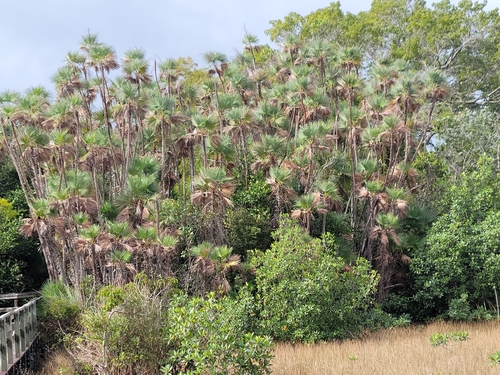
A tropical plant. It grows in swamps. It grows in drier locations than other Raphia species.
Africa, Benin, Burkina Faso, Côte d'Ivoire, Gambia, Ghana, Guinea, Guinée, Ivory Coast, Mali, Nigeria, Senegal, Sierra Leone, Sudan, West Africa,
How to Identify
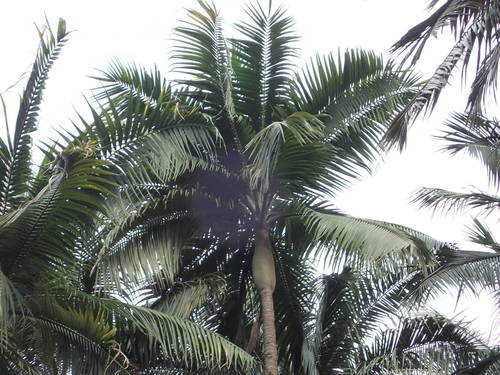
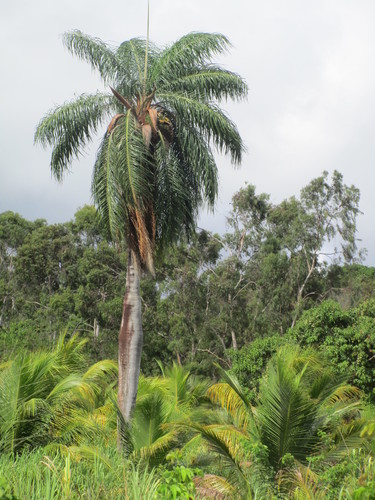
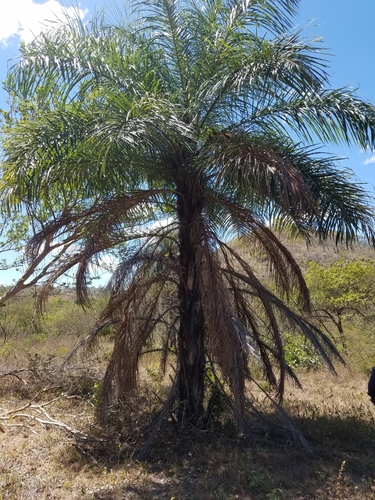
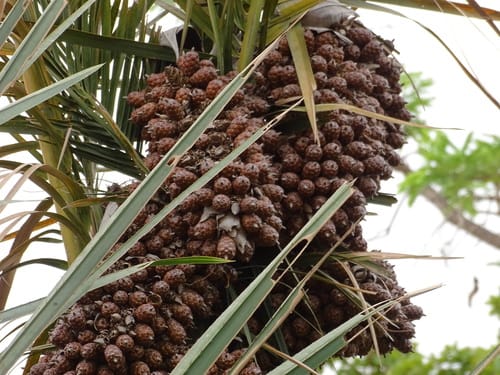
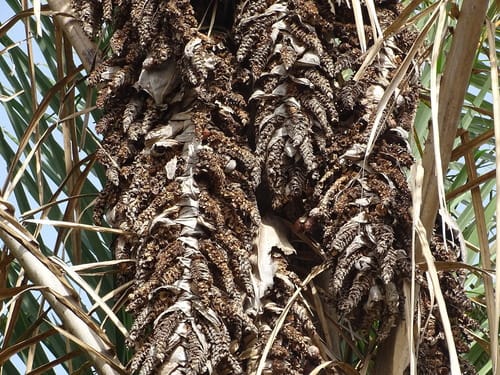
A palm. It has a stout trunk 2-3 m tall. It can be 10 m tall. The fronds are 12 m long. The young fronds have a yellow stalk. The leaflets are armed with spines on the veins and edges. The fruit are top shaped and dark red when ripe.
How to Grow
A monocarpic plant - growing for several years without flowering, then producing a massive inflorescence and dying after setting seed.
Medicinal Uses
The frond and midrib are used medicinally. This is likely to be in the treatment of blood disorders similar to the use of Raphia palma-pinus.
Other Uses
An oil obtained from the fruit pulp is used as a dressing for the hair. The mid-ribs of the leaf fronds have a wide range of uses, being employed in house construction, as canoe paddles, poles, furniture etc. Although spiny, the leaf segments are used for weaving and plaiting into mats and baskets.
Wikipedia
Source ↗Raphia sudanica is a palm species in the family Arecaceae. It is found in Western Africa, where it is locally used for construction purposes.
Other Information
It is grown in plantations in Nigeria.
Notes
It is used for a range of purposes in Nigeria.
Names & Synonyms
Ichoor, Ivory Coast wine palm
References (9)
- Bull. Soc. Bot. France 2(8):95. 1908
- Burkill, H. M., 1985, The useful plants of west tropical Africa, Vol. 4. Kew.
- Dalziel, 1937,
- Gallagher, D. E., 2010, Farming beyond the escarpment: Society, Environment, and Mobility in Precolonial Southeastern Burkina Faso. PhD University of Michigan
- Peters, C. R., O'Brien, E. M., and Drummond, R.B., 1992, Edible Wild plants of Sub-saharan Africa. Kew. p 39
- Purseglove, J.W., 1972, Tropical Crops. Monocotyledons. Longmans p 431
- Jones, D.L., 1994, Palms throughout the World. Smithtonian Institution, Washington. p 327
- Wiersema, J. H. & Leon, B., 2013, World Economic Plants. A Standard Reference CRC Press. 2nd Ed. p 580
- World Checklist of Useful Plant Species 2020. Royal Botanic Gardens, Kew