Raphia vinifera
P. Beauv.
Wine raffia palm
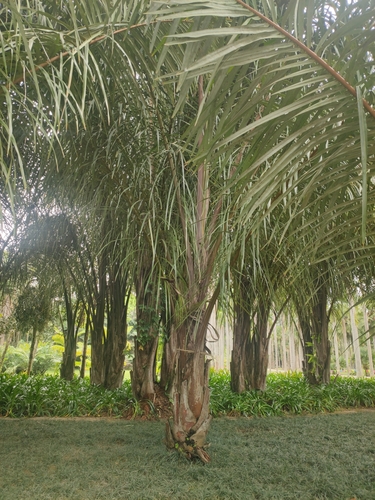
(c) 刘光裕 Liu Guangyu, some rights reserved (CC BY-NC), uploaded by 刘光裕 Liu Guangyu

Wikimedia Commons - Photo Claude TRUONG-NGOC
What to Eat
Edible parts: Nuts, Cabbage, Sap, Palm heart, Fruit
Oil extracted from the fruit mesocarp by cooking is used as food, known as raphia butter. The fruit kernels are eaten roasted. The fruit itself is edible but somewhat bitter. The terminal bud of the palm is eaten as palm cabbage. An intoxicating beverage called Bourdon is made by tapping the trunk and fermenting the sap. Sweet sap is extracted by removing the immature inflorescence and collecting the sap that runs from the cut stem. Unlike Raphia hookeri, the sap is not widely used for winemaking. The sap is also concentrated into a sweet syrup. When stems are harvested for use as poles, they are left on the ground for several days while the sap drains — the drink obtained this way is less sweet and more alcoholic than that obtained from the genuine wine palm (Elaeis spp).
Where to Find It
A tropical plant but it will grow in the subtropics. They need plenty of water. In XTBG Yunnan.
Africa, Asia, Benin, Cameroon, Central Africa, China, Congo, East Africa, Equatorial Guinea, Gambia, Guinea, Guinée, India, Madagascar, Nigeria, Sierra Leone, West Africa*, Zambia,
How to Identify
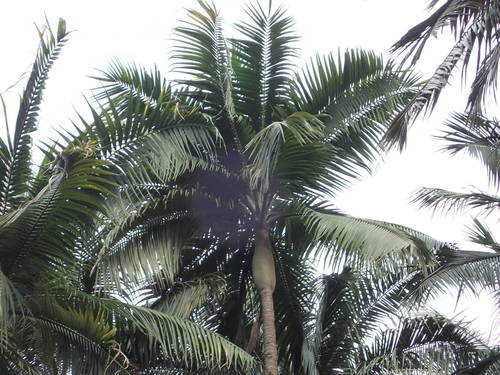
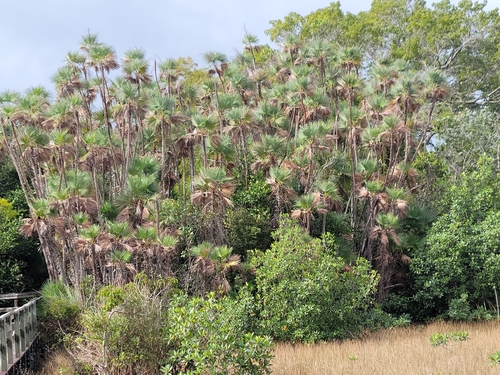
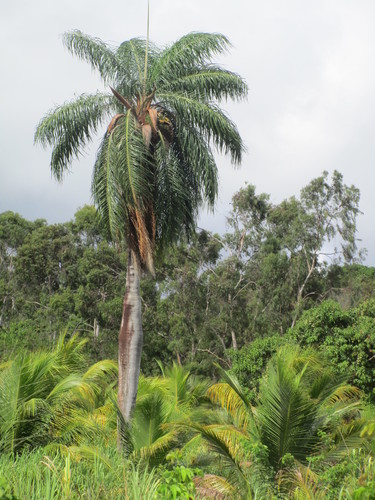
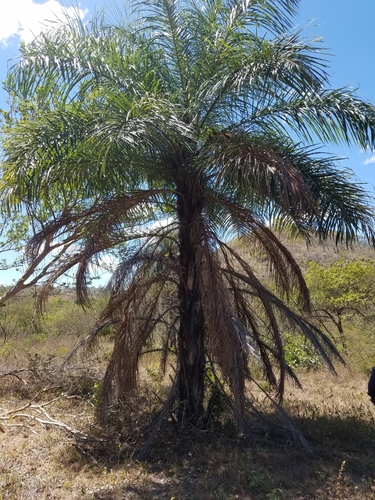
A clumping palm. The trunk is short and stout. It is 5 m tall. There are suckers near the base. The plant forms a clump. Each trunk dies after flowering. The leaves are tall and feathery. The leaflets are long. They are dark green and shiny above and waxy and have a blue-green bloom underneath. The flowering stalk is like a thick sausage like growth. It is erect to start with then hangs over. It can be 3 m long.
How to Grow
It is a weak pathogen entering fruit via wounds, sometimes killing the embryo, and leading to loss of planting material. The aphid Cerataphis palmae may cause considerable damage to Raphia vinifera, e.g. in Nigeria.
Propagation: Raphia palms are generally propagated by seed. In nurseries, a spacing of 30cm × 30cm is recommended. Seedlings may be collected from the wild and raised in a nursery before planting out. Raphia vinifera is also propagated by suckers. Propagation by tissue culture techniques may offer potential for Raphia.
Medicinal Uses
None known
Other Uses
The leaves are primarily exploited for piassava, raffia, Lagos-bast, and African bast fibres. Hats, clothes, and cordage are traditionally made from the leaves. The leaves are considered one of the best local thatching materials, being more durable than alternatives, and are bound with lines for use as thatch. Vascular bundle fibres from the leaf sheaths are made into brooms and brushes. The fibres are about 90–120cm long. Bast fibres are used for weaving mats, baskets, belts, hammocks, and fishing lines, and as tying material in horticulture. The oil extracted from the fruit mesocarp is also used as fuel oil, lubricant, or pomade. Leaf stems are about 2 metres long and are used as a building material in a manner similar to bamboo for constructing the framework of native dwellings. The mid-ribs are stout but light, with uses including poles, paddles, house-building material, and furniture; when split, they provide material for weaving floor mats. The main stems are used as house posts.
Wikipedia
Source ↗Raphia vinifera, the West African piassava palm, bamboo palm or West African bass fibre is a palm tree species in the genus Raphia. It is native to Benin, Gambia, Ghana, Nigeria, Togo, Central African Republic, Cameroon, and Democratic Republic of the Congo ( = Zaire = Congo-Kinshasa). It is particularly abundant along the creeks of Niger Delta, Cross River, Lagos and Ikorodu in Nigeria. The nut contains bitter oil, which has the property of stupefying fish. The variety or subspecies found in the Niger River delta is called the "King Raphia" (Raphia vinifera var. nigerica) is extraordinary in being the only known type of palm with opposite pairs of leaves. This variety also differs in having reddish petioles.
Names & Synonyms
African Bamboo Palm, Pharoah's palm, Wine palm
References (20)
- Ambasta S.P. (Ed.), 2000, The Useful Plants of India. CSIR India. p 516
- Balick, M.J. and Beck, H.T., (Ed.), 1990, Useful palms of the World. A Synoptic Bibliography. Colombia p 238, 511, 652,
- Burkill, H. M., 1985, The useful plants of west tropical Africa, Vol. 4. Kew.
- Burkill, I.H., 1966, A Dictionary of the Economic Products of the Malay Peninsula. Ministry of Agriculture and Cooperatives, Kuala Lumpur, Malaysia. Vol 2 (I-Z) p 1900
- Dalziel, J. M., 1937, The Useful plants of west tropical Africa. Crown Agents for the Colonies London.
- Facciola, S., 1998, Cornucopia 2: a Source Book of Edible Plants. Kampong Publications, p 30
- FAO Corporate Document Repository. The Major Significance of 'Minor' Forest Products. Appendix 3
- Fl. Oware 1:77. 1806
- Fowler, D. G., 2007, Zambian Plants: Their Vernacular Names and Uses. Kew. p 65
- Grivetti, L. E., 1980, Agricultural development: present and potential role of edible wild plants. Part 2: Sub-Saharan Africa, Report to the Department of State Agency for International Development. p 32
- Haynes, J., & McLaughlin, J., 2000, Edible palms and Their Uses. University of Florida Fact sheet MCDE-00-50-1 p 12
- Hedrick, U.P., 1919, (Ed.), Sturtevant's edible plants of the world. p 554
- Heywood, V.H., Brummitt, R.K., Culham, A., and Seberg, O., 2007, Flowering Plant Families of the World. Royal Botanical Gardens, Kew. p 348
- Jones, D.L., 1994, Palms throughout the World. Smithtonian Institution, Washington. p 52, 327
- Martin, F.W. & Ruberte, R.M., 1979, Edible Leaves of the Tropics. Antillian College Press, Mayaguez, Puerto Rico. p 210
- Peters, C. R., O'Brien, E. M., and Drummond, R.B., 1992, Edible Wild plants of Sub-saharan Africa. Kew. p 39
- Purseglove, J.W., 1972, Tropical Crops. Monocotyledons. Longmans p 431
- Riffle, R.L. & Craft, P., 2003, An Encyclopedia of Cultivated Palms. Timber Press. p 431
- Wickens, G.E., 1995, Edible Nuts. FAO Non-wood forest products. FAO, Rome. p170
- World Checklist of Useful Plant Species 2020. Royal Botanic Gardens, Kew