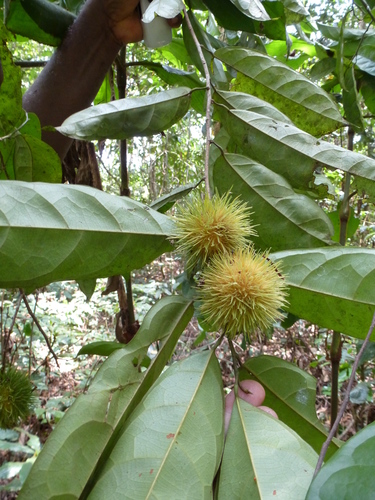
Rawsonia lucida
Harv. & Sond.
Rawsonia, Forest peach

(c) Linda Loffler, some rights reserved (CC BY-NC), uploaded by Linda Loffler

(c) Rob Palmer, some rights reserved (CC BY-NC-SA), uploaded by Rob Palmer

(c) Troos van der Merwe, some rights reserved (CC BY-NC), uploaded by Troos van der Merwe
What to Eat
Edible parts: Fruit
The fruit is eaten.
Where to Find It
A tropical plant. It occurs as an understorey tree in evergreen forest. It grows between 50-1,900 m above sea level. It grows in the lowlands but also the highlands.
Africa, Angola, Central Africa, Congo, East Africa, Eswatini, Kenya, Malawi, Mozambique, Rwanda, Somalia, South Africa, Southern Africa, Sudan, Swaziland, Tanzania, Uganda, Zambia, Zimbabwe,
How to Identify
A shrub or small tree. It grows 3-5 m high. It can grow 15 m tall. The bark is brown and smooth. The branches spread out and are inclined to droop. The leaves are alternate and simple. They are oblong. They are 7-16 cm long by 2-6 cm wide. The leaves are leathery and a glossy vivid green. They are paler and more dull underneath. The edges of the leaves have spiny teeth which point forward. The leaf stalk is 1.2 cm long. The flowers are creamy-white and 1.5-2 cm across. They occur either singly or as a few flowers together. They are 1-2 cm long. The fruit is a fleshy berry-like capsule. It is yellow to brown. It is 4 cm across. It dries out and splits open into 5 valves. There are several seeds.
Wikipedia
Source ↗Rawsonia lucida (synonym R. reticulata) is a species of plant in the Achariaceae family. It is found in eastern, central and southern Africa.
Notes
There are 2 Rawsonia species. Also put in the Flacourtiaceae family.
Names & Synonyms
Ikokodate, Inanga, Mpera mwitu, Muchekamanu, Munaba, Nyazongororo, Sehlulamanye
References (16)
- East African Herbarium records, 1981,
- Fox, F. W. & Young, M. E. N., 1982, Food from the Veld. Delta Books. p 232
- Glover et al, 1966b,
- Grivetti, L. E., 1980, Agricultural development: present and potential role of edible wild plants. Part 2: Sub-Saharan Africa, Report to the Department of State Agency for International Development. p 44
- Ichikawa, M., 1980, The Utilization of Wild Food Plants by the Suiei Dorobo in Northern Kenya. J. Anthrop. Soc. Nippon. 88(1): 25-48
- Jardin, C., 1970, List of Foods Used In Africa, FAO Nutrition Information Document Series No 2.p 157
- Long, C., 2005, Swaziland's Flora - siSwati names and Uses http://www.sntc.org.sz/flora/
- Lovett, J. C. et al, Field Guide to the Moist Forest Trees of Tanzania. p 63
- Mutie, F. M., et al, 2023, Important Medicinal and Food Taxa (Orders and Families) in Kenya, Based on Three Quantitative Approaches. Plants 2023, 12, 1145
- Palgrave, K.C., 1996, Trees of Southern Africa. Struik Publishers. p 623
- Peters, C. R., O'Brien, E. M., and Drummond, R.B., 1992, Edible Wild plants of Sub-saharan Africa. Kew. p 114
- Ruiters-Welcome, A. K., 2019, Food plants of southern Africa. Ph.D. thesis. Univ. of Johannesburg p 7
- Walsh, M., 2009, The Use of Wild and Cultivated Plants as famine Foods on Pemba Island, Zanzibar. Études océan Indien. 42-43
- White, F., Dowsett-Lemaire, F. and Chapman, J. D., 2001, Evergreen Forest Flora of Malawi. Kew. p 276
- World Checklist of Useful Plant Species 2020. Royal Botanic Gardens, Kew
- www.zimbabweflora.co.zw 2011