Roystonea oleracea
(Jacq.) O. F. Cook
Caribbean Royal Palm

(c) Magne Flåten, some rights reserved (CC BY-NC-SA), uploaded by Magne Flåten
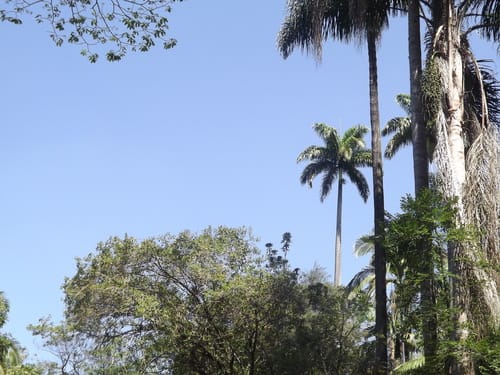
(c) Frederico Machado, some rights reserved (CC BY-NC)
What to Eat
Edible parts: Cabbage, Palm heart, Spathe or Young flower stalk, Sago, Starch, Fruit - oil
The tallest and "most majestic" royal palm, Roystonea oleracea is often used as an ornamental tree. The wood can be used for construction. The terminal bud is edible. The sap of young inflorescences can be fermented to produce alcohol. In his 1750 Natural History of Barbados Griffith Hughes reported that the immature inflorescences could be pickled and eaten as a vegetable.
Where to Find It
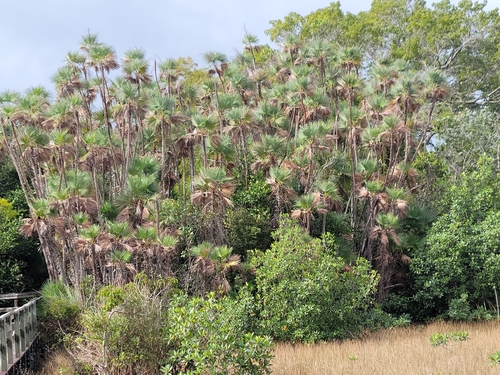
A tropical plant. It suits the tropics and subtropics. It grows in swampy areas. It also grows on the edge of the rainforest. It grows from sea level to 1760 m altitude. In Cairns Botanical Gardens. In Townsville palmetum. It grows in plant hardiness zones 11-12.
Amazon, Andamans, Asia, Australia, Barbados, Bolivia, Bazil, Central America, Colombia*, Costa Rica, Cuba, Fiji, Guatemala, Guiana, Guianas, Guyana, Hawaii, Honduras, India, Indonesia, Lesser Antilles, Mauritius, Mayotte, North America, Pacific, SE Asia, Singapore, South America, SE Asia, Sri Lanka, St. Kitts and Nevis, Suriname, Trinidad and Tobago, USA, Venezuela, West Indies,
How to Identify
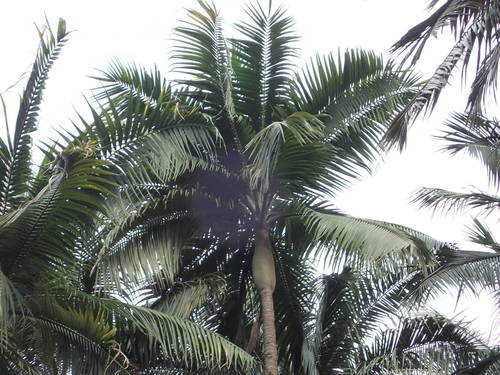
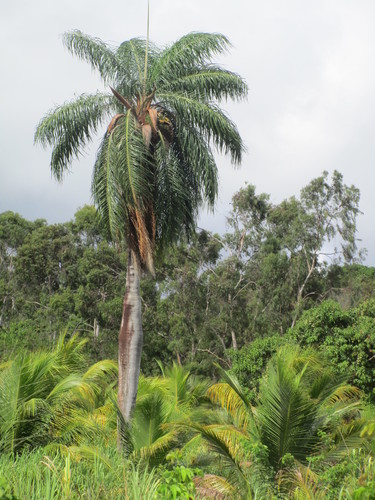
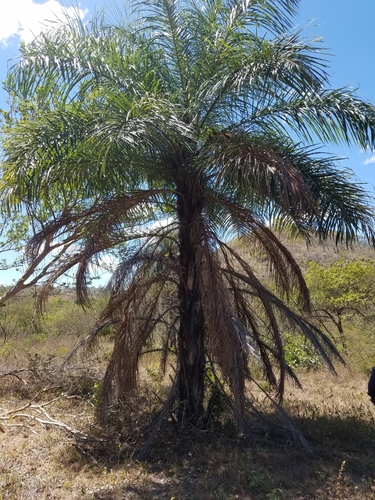
A large palm. The trunk is whitish and 30 m tall. It is 50 cm across. The trunk is the same width throughout except for a bulge at the base. The leaves are pinnate and green. The leaves are 5-7 m long. They are flat at the bottom of the crown. This is because the leaflets are placed in one plane. There is a prominent green crown-shaft. It is 2 m long. The leaflets are light green and crowded along the midrib in 2 ranks on the same plane. The flower stalk comes out below the crown-shaft. It is over 1 m long and has many branches. The flowers are white or cream. The fruit are small, round and bright red to purplish black. They are 15-20 mm long by 8-10 mm wide.
How to Grow
Plants are grown from seed. The seed are small and round and germinate easily. They take about 3 months to germinate.
Propagation: Seed - The seed takes about 2 months to germinate.
Other Uses
The hard wood has been used to make musical instruments.
Wikipedia
Source ↗Roystonea oleracea, sometimes known as the Caribbean royal palm, palmiste, imperial palm or cabbage palm, is a species of palm which is native to the Lesser Antilles, Colombia, Venezuela, and Trinidad and Tobago. It is also reportedly naturalized in Guyana and on the islands of Mauritius and Réunion in the Indian Ocean. Its specific epithet oleracea means "vegetable/herbal" in Latin and is a form of holeraceus (oleraceus). The plant's buds was eaten in the West Indies.
Production
The young seedlings grow quickly.
Notes
There are 10 Roystonea species.
Names & Synonyms
Cabbage palm, Chaguaramo, Feathery Cabbage Palm, Maparo, Palem raja karibia, Palma real, Venezuela royal palm, West Indian Royal Palm, Yagua
References (27)
- Ambasta S.P. (Ed.), 2000, The Useful Plants of India. CSIR India. p 531
- Balick, M.J. and Beck, H.T., (Ed.), 1990, Useful palms of the World. A Synoptic Bibliography. Colombia p 177, 204, 208 (As Areca oleracea), 662 (As Oreodoxa oleracea),
- Blomberry, A. & Rodd, T., 1982, Palms. An informative practical guide. Angus & Robertson. p 162
- Bodkin, F., 1991, Encyclopedia Botanica. Cornstalk publishing, p 892
- Bull. Torrey Bot. Club 28:554. 1901
- Burkill, I.H., 1966, A Dictionary of the Economic Products of the Malay Peninsula. Ministry of Agriculture and Cooperatives, Kuala Lumpur, Malaysia. Vol 2 (I-Z) p 1951
- Cundall, P., (ed.), 2004, Gardening Australia: flora: the gardener's bible. ABC Books. p 1283
- Facciola, S., 1998, Cornucopia 2: a Source Book of Edible Plants. Kampong Publications, p 31
- Gibbons, M., 2003, A pocket guide to Palms. Chartwell Books. p 188
- Grandtner, M. M., 2008, World Dictionary of Trees. Wood and Forest Science Department. Laval University, Quebec, Qc Canada. (Internet database http://www.wdt.qc.ca)
- Grandtner, M. M. & Chevrette, J., 2013, Dictionary of Trees, Volume 2: South America: Nomenclature, Taxonomy and Ecology. Academic Press p 574
- Hedrick, U.P., 1919, (Ed.), Sturtevant's edible plants of the world. p 451 (As Oreodoxa oleracea)
- Henderson, A., Galeano, G and Bernal, R., 1995, Field Guide to the Palms of the Americas. Princeton. p 135
- Hibbert, M., 2002, The Aussie Plant Finder 2002, Florilegium. p 282
- Jones, D.L., 1994, Palms throughout the World. Smithtonian Institution, Washington. p 57, 58, 343
- Kermath, B. M., et al, 2014, Food Plants in the Americas: A survey of the domesticated, cultivated and wild plants used for Human food in North, Central and South America and the Caribbean. On line draft. p 757
- Llamas, K.A., 2003, Tropical Flowering Plants. Timber Press. p 116
- Omawale, 1973, Guyana's edible plants. Guyana University, Georgetown p 86
- Purseglove, J.W., 1972, Tropical Crops. Monocotyledons. Longmans p 432
- Riffle, R.L. & Craft, P., 2003, An Encyclopedia of Cultivated Palms. Timber Press. p 442
- Smith, A.C., 1979, Flora Vitiensis Nova: A New flora of Fiji, Hawai Botanical Gardens, USA Vol 1 p 409
- Staples, G.W. and Herbst, D.R., 2005, A tropical Garden Flora. Bishop Museum Press, Honolulu, Hawaii. p 627
- Swaminathan, M.S., and Kochnar, S.L., 2007, An Atlas of major Flowering Trees in India. Macmillan. p 275
- van Roosmalen, M.G.M., 1985, Fruits of the Guianan Flora. Utrecht Univ. & Wageningen Univ. p 352
- Wong, M., 2006, Edible Plants for Hawai'i Landscapes. College of Tropical Agriculture and Human Resources. Univ. of Hawai'i
- World Checklist of Useful Plant Species 2020. Royal Botanic Gardens, Kew
- Zuchowski W., 2007, Tropical Plants of Costa Rica. A Zona Tropical Publication, Comstock Publishing. p 392