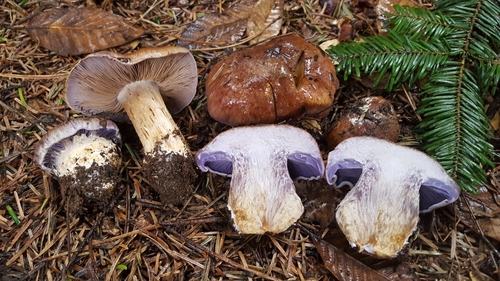
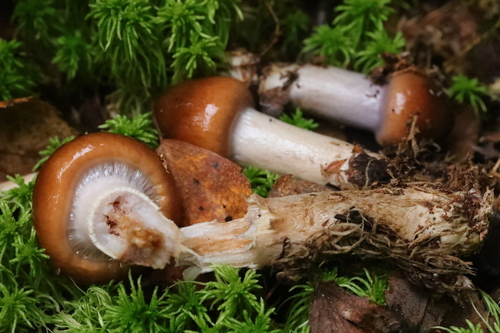
Rozites caperatus
(Pers.) P. Karst.
Gypsy mushroom, Wrinkled rozites
CortinariaceaeMushrooms

iNaturalist · cc-by
(c) Christine Young, some rights reserved (CC BY)
(c) Christine Young, some rights reserved (CC BY)

iNaturalist · cc-by
(c) Christine Young, some rights reserved (CC BY)
(c) Christine Young, some rights reserved (CC BY)

iNaturalist · cc-by
(c) Christine Young, some rights reserved (CC BY)
(c) Christine Young, some rights reserved (CC BY)
What to Eat
Edible parts: Mushroom, Fungus
The mushroom fruiting body is edible.
Where to Find It
It is a temperate plant.
Alaska, Asia, Balkans, Bulgaria, Bhutan, China, Europe, Finland, Italy, Japan, Mediterranean, Mexico, North America, Poland, Russia, Scandinavia, Sweden, USA,
Countries: Andorra, United Arab Emirates, Afghanistan, Antigua & Barbuda, Albania, Armenia, Austria, Azerbaijan, Bosnia & Herzegovina, Barbados, Bangladesh, Belgium, Bulgaria, Bahrain, Brunei, Bahamas, Bhutan, Belarus, Belize, Canada, Switzerland, China, Costa Rica, Cuba, Cyprus, Czechia, Germany, Denmark, Dominica, Dominican Republic, Algeria, Estonia, Egypt, Spain, Finland, France, United Kingdom, Grenada, Georgia, Greece, Guatemala, Honduras, Croatia, Haiti, Hungary, Indonesia, Ireland, Israel, India, Iraq, Iran, Iceland, Italy, Jamaica, Jordan, Japan, Kyrgyzstan, Cambodia, St Kitts & Nevis, North Korea, South Korea, Kuwait, Kazakhstan, Laos, Lebanon, St Lucia, Liechtenstein, Sri Lanka, Lithuania, Luxembourg, Latvia, Libya, Morocco, Monaco, Moldova, Montenegro, North Macedonia, Myanmar, Mongolia, Malta, Maldives, Mexico, Malaysia, Nicaragua, Netherlands, Norway, Nepal, Oman, Panama, Philippines, Pakistan, Poland, Puerto Rico, Portugal, Qatar, Romania, Serbia, Russia, Saudi Arabia, Sweden, Singapore, Slovenia, Slovakia, San Marino, El Salvador, Syria, Thailand, Tajikistan, Timor-Leste, Turkmenistan, Tunisia, Turkey, Trinidad & Tobago, Taiwan, Ukraine, United States, Uzbekistan, St Vincent, Vietnam, Yemen
How to Identify
A temperate mushroom in the Cortinariaceae family, commonly known as the gypsy mushroom or wrinkled rozites.
Names & Synonyms
Dhungshing shamong, Zhougai luolinsan
Pholiota
References (10)
- Boa, E. R., 2004, Wild edible fungi and their importance to people. FAO Non Wood Forest Products Booklet 17
- Cocchi, L. et al, 2006, Heavy metals in edible mushrooms in Italy. Food Chemistry 98: 277-284
- Guild, B., 1979, The Alaskan Mushroom Hunter's Guide. Alaska Northwest Publishing Company. p 158
- Hall, I. R., et al, 2003, Edible and Poisonous Mushrooms of the World. Timber Press. p 317
- Imai, S., 1938, Studies on the Agaricaceae of Hokkaido. 2. Jour. Facul. Agr., Hokkaido Imp. Univ., Sapporo, Vol. XLIII, Pt. 2, August, 1938
- Kaufmann, B. et al, 1999, The Great Encyclopedia of Mushrooms. Konemann. p 138
- Kaye, G.C., 1986, Wild and Exotic Mushroom Cultivation in North America
- Pelkonen, R., et al, 2008, Element Concentrations in Wild Edible Mushrooms in Finland. The Finnish Environment 25
- Penjor, D. et al, 2014, Wild mushrooms and their contribution to livelihoods and diet in Bhutan. in Promotion of Underutilized Indigenous Food Resources for Food Security and Nutrition in Asia and Pacific. FAO. Bangkok p 70
- Pace, G., 1998, Mushrooms of the world. Firefly books. p 62