Rumex dentatus
L.
Indian Sorrel, Toothed Dock

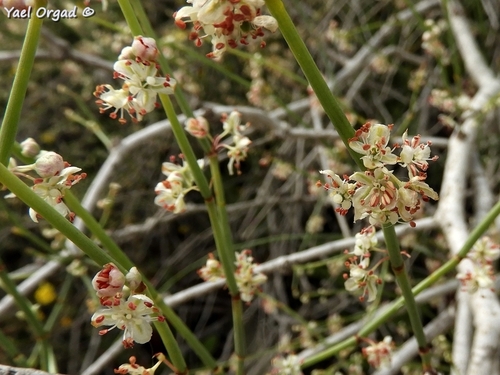
(c) 2009 Zoya Akulova, some rights reserved (CC BY-NC)
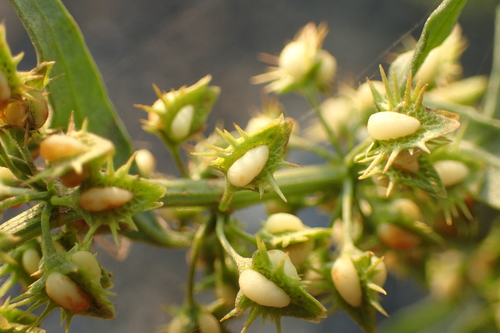
(c) 傻子, some rights reserved (CC BY-NC), uploaded by 傻子

(c) 2009 Zoya Akulova, some rights reserved (CC BY-NC)
What to Eat
Edible parts: Leaves
Tender young leaves are cooked and eaten as a vegetable.
Known Hazards
Where to Find It
It is a temperate plant. In Nepal it grows between 1200-1400 m altitude. It grows in moist, neglected ground.
Afghanistan, Africa, Asia, Bangladesh, Bhutan, Britain, Central Asia, China, Egypt, Europe, Himalayas, India, Indochina, Iraq, Kazakhstan, Korea, Kyrgyzstan, Laos, Middle East, Nepal, North Africa, Northeastern India, Pakistan, Russia, SE Asia, Tajikistan,
How to Identify
An erect annual herb. It grows to about 70 cm high. The lower leaves are stalked. They are 3-20 cm long by 0.6-5 cm wide. They are oblong and rounded or heart shaped at the base. The upper leaves are smaller. The flowers are greenish yellow. The occur in distinct leafy rings in the axils of leaves. The fruit is a nut. It is 3 sided.
Nutrition Score: 54/100
| Part | Moisture | kJ | kcal | Protein | Vit A | Vit C | Iron | Zinc |
|---|---|---|---|---|---|---|---|---|
| Leaves | 89.4 | 124 | 30 | 3.2 | 11700 | 115 | 3.4 | — |
How to Grow
Succeeds in most soils but prefers a deep fertile moderately heavy soil that is humus-rich, moisture-retentive but well-drained and a position in full-sun or part shade. Plants are usually annual, but, rarely, they can be biennial. This is an extremely variable species represented in N. Africa, Asia, and Europe by several quite distinct races, recognized taxonomically mostly as subspecies. It is closely related to R. pulcher.
Propagation: Sow seed in spring in a cold frame. Prick seedlings out into individual pots once large enough to handle, then plant out in summer.
Medicinal Uses
The root is used as an astringent application in the treatment of cutaneous disorders.
Other Uses
Although no specific mention has been made for this species, dark green to brown and dark grey dyes can be obtained from the roots of many species in this genus without the need for a mordant.
Wikipedia
Source ↗Rumex dentatus is a species of flowering plant in the knotweed family known by the common names toothed dock and Aegean dock. It is native to parts of Eurasia and North Africa, and it is widely known elsewhere as an introduced species. It grows in disturbed habitat, often in moist areas, such as lakeshores and the edges of cultivated fields. It is an annual or biennial herb producing a slender, erect stem up to 70 or 80 centimeters in maximum height. The leaves are lance-shaped to oval with slightly wavy edges, growing to a maximum length around 12 centimeters. The inflorescence is an interrupted series of clusters of flowers, with 10 to 20 flowers per cluster and each flower hanging on a pedicel. Each flower has usually six tepals, the 3 inner of which are edged with spinelike teeth and have tubercles at their centers. This plant has allelopathic activity.
Other Information
The young leaves are especially eaten by children. It is sold in local markets.
Notes
There are about 200 Rumex species.
Names & Synonyms
Ambavah, Amrule, Babal, Ban palungo, Bon palong, Holo, Hububal, Hullah, Hulow, Jangli palak, Jungli palak, Khatkal, Kukur jibwa, Lal bibi, Milu, Ola, Palki mausi, Sarkari palak, Shalkhay, Shulkhay, Tandalak, Tissa palak, Ubobal, Zamda
References (29)
- Ahmad, K., et al, 2018, Ethnobotanical investigation of wild vegetables used among local communities in northwest Pakistan. Acta Soc Bot Pol. 2019;88(1):3616.
- Ambasta S.P. (Ed.), 2000, The Useful Plants of India. CSIR India. p 534
- Amin, M., et al, 2023, Edible wild plant species used by different linguistic groups of Kohistan Upper Khyber Pakhtunkhwa (KP), Pakistan. Journal of Ethnobiology and Ethnomedicine 19:6 p 13
- Bahuguna, A. et al, 2010, Floristic Diversity and Indigenous uses of Forest Vegetation of Dabka Watershed in Indian Central Himalayas. Ethnobotanical Leaflets 14:491-510
- Bandyopadhyay, S. et al, 2009, Wild edible plants of Koch Bihar district, West Bengal. Natural Products Radiance 8(1) 64-72 (As subsp. klotzschianus)
- Barkatullah, et al, 2009, Ethnobotanical studies of plants of Charkotli Hills, Batkhela District, Malakand, Pakistan. Front. Biol. China 2009, 4(4): 539–548
- Bhatia, H., et al, 2018, Traditionally used wild edible plants of district Udhampur, J&K, India. Journal of Ethnobiology and Ethnomedicine (2018) 14:73
- Bidak, L. M., et al, 2015, Goods and services provided by native plants in desert ecosystems: Examples from the northwestern coastal desert of Egypt. Global Ecology and Conservation 3 (2015) 433–447
- Chowdhury, A. & Das, A. P., 2014, Conservation through sustainable utilization of wetland leafy vegetables of Terai and Duars, West Bengal, India. International Journal of Advanced Life Sciences (IJALS), 7(4) p 657
- Dangol, D. R. et al, 2017, Wild Edible Plants in Nepal. Proceedings of 2nd National Workshop on CUAOGR, 2017.
- Ethnobotanical Study of Tehsil Kabal, Swat District, KPK, Pakistan, Table 1
- FAO, 1988, Traditional Food Plants, FAO Food and Nutrition Paper 42. FAO Rome p 430
- Flora of China @ efloras.org Volume 5
- Food Composition Tables for the Near East. http://www/fao.org/docrep No. 314
- Hanif, U., et al, 2013, Ethnobotanical studies on some wild plants of head Qadirabad and adjoining areas, Pakistan. International Journal of Phytomedicine 5:373-377
- Hossain, U. & Rahman, A., 2018, Study and quantitative analysis of wild vegetable floral diversity available in Barisal district, Bangladesh. Asian J. Med. Biol. Res. 2018, 4 (4), 362-371
- Joshi, N., et al, 2007, Traditional neglected vegetables of Nepal: Their sustainable utilization for meeting human needs. Tropentag 2007. Conference on International Agricultural Research for Development.
- Kamal, M., et al, 2009, Ethnobotanically Important Plants of District Bannu, Pakistan. Pak. J. Pl. Sci., 15 (2): 87-93
- Khan, A. H., et al, 2023, Traditional foraging for ecological transition? Wild food ethnobotany among three ethnic groups in the highlands of the eastern Hindukush, North Pakistan. Journal of Ethnobiology and Ethnomedicine 19:9
- Majeed, M., et al, 2021, Gathered Wild Food Plants among Diverse Religious Groups in Jhelum District, Punjab, Pakistan. Foods 2021, 10, 594.
- Manandhar, N.P., 2002, Plants and People of Nepal. Timber Press. Portland, Oregon. p 406 (subsp. klotzschianus)
- Mant. pl. 2:226. 1771
- Marandi, R. R. & Britto, S. J., 2015, Medicinal Properties of Edible Weeds of Crop Fields and Wild plants Eaten by Oraon Tribals of Latehar District, Jharkhand. International Journal of Life Science and Pharma Research. Vo. 5. (2) April 2015
- Martin, F.W. & Ruberte, R.M., 1979, Edible Leaves of the Tropics. Antillian College Press, Mayaguez, Puerto Rico. p 214
- Plants for a Future database, The Field, Penpol, Lostwithiel, Cornwall, PL22 0NG, UK. http://www.scs.leeds.ac.uk/pfaf/
- Sher, H. et al, 2011, Ethnobotanical and Economic Observations of Some Plant Resources from the Northern Parts of Pakistan. Ethnobotany research & Applications 9:027-041
- Sher, Z., Hussain, F., & Ibrar, M., 2014, Traditional knowledge on plant resources of Ashezai and Salarzai Valleys, District Buner, Pakistan. African Journal of Plant Science. Vol. 8(1), pp. 42-53, January 2014
- Terra, G.J.A., 1973, Tropical Vegetables. Communication 54e Royal Tropical Institute, Amsterdam, p 70
- Thakur, D., et al, 2017, Why they eat, what they eat: patterns of wild edible plants consumption in a tribal area of Western Himalaya. Journal of Ethnobiology and Ethnomedicine (2017) 13:70