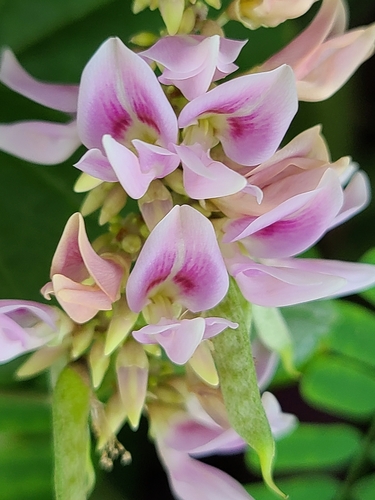
Arachis hypogea
L.
Peanut, Groundnut

(c) pallantebp, some rights reserved (CC BY-NC)

(c) pallantebp, some rights reserved (CC BY-NC)

(c) pallantebp, some rights reserved (CC BY-NC)
What to Eat
Edible parts: Seeds, Leaves, Flavouring, Spice, Pods, Vegetable, Oil, Caution
The seeds are eaten raw or cooked by boiling, steaming, roasting, or salting, and are made into peanut butter or flour. Young leaves are cooked as a vegetable. Unripe pods are cooked and eaten. Sprouted seeds are also eaten. Oil extracted from seeds is used for stir-frying, and the remaining meal is eaten.
Where to Find It
A tropical and subtropical plant. Peanuts grow well from sea level up to about 1650 metres altitude in the equatorial tropics. They need a temperature of about 28°C and between 24°C and 33°C. The plants get killed by frost. They need a well drained soil and cannot stand water-logging. Therefore they are often grown on raised garden beds. They do better in drier areas but need 300 to 500 mm of rain during the growing season. Near harvest dry weather is needed. It is grown between 40° N and 40°S. Short season cultivars are used in semi arid regions. It suits hardiness zones 8-12. In Sichuan and Yunnan.
Africa, Amazon, Angola, Antigua-Barbuda, Antilles, Argentina*, Asia, Australia, Balkans, Bangladesh, Barbados, Belize, Benin, Bolivia, Botswana, Bougainville, Brazil*, Burkina Faso, Burundi, Cambodia, Cameroon, Canada, Cape Verde, Central Africa, Central African Republic, CAR, Central America, Central Asia, Chad, Chile, China, Colombia, Comoros, Congo DR, Congo R, Cook Islands, Costa Rica, Côte d'Ivoire, Cuba, Djibouti, Dominican Republic, East Africa, East Timor, Ecuador, El Salvador, Equatorial-Guinea, Eswatini, Ethiopia, Europe, Fiji, France, French Guiana, Gabon, Gambia, Ghana, Grenada, Guadeloupe, Guam, Guatemala, Guianas, Guinea, Guinée, Guinea-Bissau, Guyana, Haiti, Hawaii, Himalayas, Hispaniola, Honduras, India, Indochina, Indonesia, Iraq, Ivory Coast, Jamaica, Japan, Kenya, Korea, Laos, Liberia, Macedonia, Madagascar, Malawi, Malaysia, Mali, Marianas, Martinique, Mauritius, Mexico, Middle East, Mongolia, Montserrat, Mozambique, Myanmar, Namibia, Nepal, New Zealand, Nicaragua, Niger, Nigeria, Niue, North America, Pacific, Pakistan, Papua New Guinea, PNG, Peru, Philippines, Puerto Rico, Reunion, Rotuma, Rwanda, Sahel, Samoa, Sao Tome and Principe, SE Asia, Senegal, Serbia, Sierra Leone, Slovenia, Solomon Islands, South Africa, Southern Africa, South America, South Sudan, Spain, Sri Lanka, St. Kitts and Nevis, Sudan, Suriname, Swaziland, Taiwan, Tajikistan, Thailand, Timor-Leste, Togo, Tonga, Turkey, Türkiye, Uganda, USA, Uzbekistan, Vanuatu, Vietnam, West Africa, West Indies, West Papua, West Timor, Zambia, Zimbabwe,
How to Identify
A spreading bushy plant up to about 40 cm high. Leaves are made up of 2 pairs of leaflets arranged opposite each other. Flowers are produced in the axils of leaves. Two main kinds occur. They are often called runner and bunch types. The runner kind has a vegetative or leafy branch between each fruiting branch and therefore produces a more spreading type of plant. This is called "Virginia" peanut. The pods have 2 dark brown seeds. The other kind produces fruiting branches in a sequence one after the other along the branches. These are called "Spanish-Valencia" types. They grow as a more upright plant and grow more quickly. They have lighter coloured leaves and the pods have 2 to 6 seeds which are often white. Virginia types have the flowers in alternate pairs. Spanish and Valencia types have several flower branches one after another along the stem. Pods are produced on long stalks which extend under the ground. The stalk or peg from the flower grows down into the soil and then produces the pod and seed under the ground. The flower needs to be no more than 18 cm from the soil for the seed pod to develop under ground.
Nutrition Score: 68/100
| Part | Moisture | kJ | kcal | Protein | Vit A | Vit C | Iron | Zinc |
|---|---|---|---|---|---|---|---|---|
| Seed dried | 4.5 | 2364 | 566 | 24.3 | 0 | — | 2 | 3 |
| Seed fresh | 45 | 1394 | 333 | 15 | — | 10 | 1.5 | — |
| Leaves | 78.5 | 228 | 69 | 4.4 | — | — | 4.2 | — |
| Pods | — | — | — | — | — | — | — | — |
| Sprouts | — | — | — | — | — | — | — | — |
How to Grow
Peanuts require soil with good levels of calcium or they produce empty pods. Adding gypsum will improve this. If the nutrient boron is short then flowers won't flower and fruit properly. Because peanuts are legumes, they have root nodule bacteria which can fix their own nitrogen and this means they can still give good yields in grassland soils where nitrogen is at a lower level. The seeds or nuts are normally removed from the shell before planting and are sown 2 to 3 cm deep. The alternately branched or Virginia-type of peanuts have a dormancy period so that they must be stored before replanting. A suitable spacing is 10 cm between plants and 60 to 80 cm between rows. Often plants are grown in mixed cultures with other plants but where a pure stand is used up to 250,000 plants per hectare are used. The soil needs to be weeded and loose by the time the flowers are produced to allow the peg for the seed pods to penetrate the soil. Normally when the whole plant dies off the plant are ready to pull. They are left to dry in the sun for 3 or 4 days.
Medicinal Uses
Rich in protein (42.5 g per 100 g), fat (9.9 g per 100 g), and B vitamins including niacin (30.7 mg per 100 g), with notable iron (9.0 mg per 100 g) and calcium (60 mg per 100 g) content.
Production
Flowering may commence in 30 days. It takes from 3.5 to 5 months till maturity. They are harvested when the top of the plants die. The whole plant is pulled out. Virginia peanuts have a longer growing season and the seeds need to be stored for a while before they will start to re-grow. (30 days.)
Other Information
It is a commercially cultivated vegetable. A very popular snack food in all areas where it can be grown. Seeds are also sold.
Notes
There are about 75 Arachis species. After oil is extracted, the residual meal is eaten. Chemical composition (per 100g): Protein = 42.5g. Fat = 9.9g. Calcium = 60 mg. Iron = 9.0 mg. Vitamin B1 = .54 mg. Vitamin B2 = .54 mg. Niacin = 30.7 mg. Kcal = 387.
Names & Synonyms
Akate, Amendoim, Arer, Azi, Badam, Bhui mug, Bombole, Cacahuate, Chinabadam pata, Chini-badam, Damsi, Dauphong, Dikomaanti, Dindongo, Drop flower born, Dua phong, Ekpa, Endim-boanjo, Epa, Epa gidi, Fa-sang, Fore-rai, Geda, Goober, Granat, Guerte, Gugia, Gyada, Inchi, Kacang tana, Kaju-kadala, Kalanga, Katekokoo, Kofomboanjo, Kirikaju, Lubalala, Luphuasheng, Ma-kantr, Makate, Mani, Man-kand, Muafumo, Mungafali, Mung-phali, Myay-pe, Nchuku, Nduhu, Nela-gadale, Nelakadala, Neyerem, Nguba, Niki, Nikili, Nikli, Nilakkadalai, Nkate, Nkatie, onyrem, Ntongamane, Nuse, Nzungu, Nzyngu, Okba, Okpa, Pinati, Pinda, Pindar, Pitasy, Rakkasei, Rata caju, Ratakaju, Saandaek dei, Thonga, Thua lisong, Tiga, Tikomaanti, Torali, Ttangkong, Umbaz, Verkadalai, Verusenagalu, Yurak inchi
References (109)
- Abbiw, D.K., 1990, Useful Plants of Ghana. West African uses of wild and cultivated plants. Intermediate Technology Publications and the Royal Botanic Gardens, Kew. p 31
- Ali, A. M. S., 2005, Homegardens in Smallholder Farming Systems: Examples from Bangladesh. Human Ecology, Vol. 33, No. 2 pp. 245-270
- Ambasta S.P. (Ed.), 2000, The Useful Plants of India. CSIR India. p 48
- Anderson, E. F., 1993, Plants and people of the Golden Triangle. Dioscorides Press. p 202
- Ara, R. I. T., 2015, Leafy Vegetables in Bangladesh. Photon eBooks. p 117
- Baa-Poku, F. & Asante, I. K., 2020, Use of Neglected and Underutilized Crop Species (NUCS) in some farming communities in the Upper Afram and Upper Dayi River Basins in Ghana. International Journal of Technology and Management Research 5 (2): 48-63
- Bernholt, H. et al, 2009, Plant species richness and diversity in urban and peri-urban gardens of Niamey, Niger. Agroforestry Systems 77:159-179
- BERRY- KOCH
- Bianchini, F., Corbetta, F., and Pistoia, M., 1975, Fruits of the Earth. Cassell. p 234
- Bircher, A. G. & Bircher, W. H., 2000, Encyclopedia of Fruit Trees and Edible Flowering Plants in Egypt and the Subtropics. AUC Press. p 36
- Bodkin, F., 1991, Encyclopedia Botanica. Cornstalk publishing, p 93
- Bodner, C. C. and Gereau, R. E., 1988, A Contribution to Bontoc Ethnobotany. Economic Botany, 43(2): 307-369
- Bortolotto, I. M., et al, 2018, Lista preliminar das plantas alimenticias nativas de Mato Grosso do Sul, Brasil. Iheringia, Serie Botanica, Porto Alegre, 73 (supl.):101-116
- Brouk, B., 1975, Plants Consumed by Man. Academic Press, London. p 219, 238
- Burkill, H. M., 1985, The useful plants of west tropical Africa, Vol. 2. Kew.
- Caballero-Serrano, V., et al, 2019, Traditional ecological knowledge and medicinal plant diversity in Ecuadorian Amazon home gardens. Global Ecology and Conservation 17 (2019) e00524 p 9
- Chin, H. F., 1999, Malaysian Vegetables in Colour. Tropical Press. p 104
- Cobley, L.S. (rev. Steele, W.M.) 2nd Ed., 1976, An Introduction to the Botany of Tropical Crops. Longmans. p 80
- Coe, F. G. & Anderson, G. J., 1997, Ethnobotany of the Miskitu of Eastern Nicaragua. Journal of Ethnobiology 17(2): 171-214
- Coe, F. G. and Anderson, G. J., 1999, Ethnobotany of the Sumu (Ulwa) of Southeastern Nicaragua and Comparisons with Miskitu Plant Lore. Economic Botany Vol. 53. No. 4. pp. 363-386
- Cundall, P., (ed.), 2004, Gardening Australia: flora: the gardener's bible. ABC Books. p 169
- Diouf, M., et al, Leafy Vegetables in Senegal. Bioversity webite
- Duarte, M. C., et al, 2022, Diversity of Useful Plants in Cabo Verde Islands: A Biogeographic and Conservation Perspective. Plants 2022, 11, 1313 p 10
- Facciola, S., 1998, Cornucopia 2: a Source Book of Edible Plants. Kampong Publications, p 102
- Flora of Pakistan. www.eFloras.org
- Flowerdew, B., 2000, Complete Fruit Book. Kyle Cathie Ltd., London. p 208
- Fowler, D. G., 2007, Zambian Plants: Their Vernacular Names and Uses. Kew. p 36
- Fox, F. W. & Young, M. E. N., 1982, Food from the Veld. Delta Books. p 201
- French, B., 1986, Food Plants of Papua New Guinea, Asia Pacific Science Foundation p 33
- French, B.R., 2010, Food Plants of Solomon Islands. A Compendium. Food Plants International Inc. p 42
- Furusawa, T., et al, 2014, Interaction between forest biodiversity and people's used of forest resources in Roviana, Solomon Islands: implications for biocultural conservation under socioeconomic changes. Journal of Ethnobiology and Ethnomedicine, 10:10
- Gregory, W.C. & Gregory, M.P., 1979, Groundnut, in Simmonds N.W.,(ed), Crop Plant Evolution. Longmans. London. p 151
- Hedrick, U.P., 1919, (Ed.), Sturtevant's edible plants of the world. p 65
- Hermandez Bermejo, J.E., and Leon, J. (Eds.), 1994, Neglected Crops. 1492 from a different perspective. FAO Plant Production and Protection Series No 26. FAO, Rome. p15
- Hu, Shiu-ying, 2005, Food Plants of China. The Chinese University Press. p 465
- Hunter, D., et al, 2019, The potential of neglected and underutilized species for improving diets and nutrition. Planta (2019) 250:709-729
- ILDIS Legumes of the World http:www;ildis.org/Legume/Web
- Jacquat, C., 1990, Plants from the Markets of Thailand. D.K. Book House p 46
- Jardin, C., 1970, List of Foods Used In Africa, FAO Nutrition Information Document Series No 2.p 24, 56
- Kays, S. J., and Dias, J. C. S., 1995, Common Names of Commercially Cultivated Vegetables of the World in 15 languages. Economic Botany, Vol. 49, No. 2, pp. 115-152
- Khan, D. & Shaukat, S.S., 2006, The Fruits of Pakistan: Diversity, Distribution, Trends of Production and Use. Int. J. Biol. Biotech., 3(3):463-499
- Kiple, K.F. & Ornelas, K.C., (eds), 2000, The Cambridge World History of Food. CUP p 433, 1830
- Kohila, A. & Kensa, V. M., 2019, Survey of Wild Edible Plants of Dhanakarkulam Panchayath, Tirunelveli District, Tamil Nadu, India. Kong. Res. J. 6(2): 20-27, 2019
- Larson, T. J., 1970, Hambukushu Ethno-botany. Botswana Notes and Records. Vol 13.
- Latham, P., 2004, Useful Plants of Bas-Congo province. Latham & DFID p 39
- Latham, P. & Mbuta, A. K., 2014, Useful Plants of Bas-Congo Province, Democratic Republic of Congo. Volume 1. p 58
- Latham, P. & Mbuta, A. K., 2017, Plants of Kongo Central Province, Democratic Republic of Congo. Volume 1. 3rd ed p 63
- Lazarides, M. & Hince, B., 1993, Handbook of Economic Plants of Australia, CSIRO. p 23
- Lyle, S., 2006, Discovering fruit and nuts. Land Links. p 69
- Macmillan, H.F. (Revised Barlow, H.S., et al) 1991, Tropical Planting and Gardening. Sixth edition. Malayan Nature Society. Kuala Lumpur. p 343
- Magwede, K., van Wyk, B.-E., & van Wyk, A. E., 2019, An inventory of Vhavenḓa useful plants. South African Journal of Botany 122 (2019) 57–89
- Malaisse, F., 2010, How to live and survive in Zambezian open forest (Miombo Ecoregion). Les Presses Agronomiques de Gembloux.
- Manandhar, N.P., 2002, Plants and People of Nepal. Timber Press. Portland, Oregon. p 92
- Martin, F.W. & Ruberte, R.M., 1979, Edible Leaves of the Tropics. Antillian College Press, Mayaguez, Puerto Rico. p 48, 197
- Maundu, P. et al, 1999, Traditional Food Plants of Kenya. National Museum of Kenya. 288p
- Menninger, E.A., 1977, Edible Nuts of the World. Horticultural Books. Florida p 87
- Milliken, W., 2,000, Ethnobotany of the Yali of West Papua. Royal Botanic Garden, Edinburgh (near Baliem)
- Molares, S. & Ladio, A., 2012, The Usefulness of Edible and Medicinal Fabaceae in Argentine and Chilean Patagonia: Environmental Availability and Other Sources of Supply. Evidence-Based Complementary and Alternative Medicine. Volume 2012, Article ID 901918, 12 pages, Hindawi Publishing Corporation.
- Mulherin, J., 1994, Spices and natural flavourings. Tiger Books, London. p 110
- Nascimento, V. T. D., et al, 2013, Knowledge and Use of Wild Food Plants in Areas of Dry Seasonal Forests in Brazil. Ecology of Food and Nutrition, 52:317–343
- Norrington, L., & Campbell, C., 2001, Tropical Food Gardens. Bloomings Books. p 33
- Ochse, J.J. et al, 1931, Vegetables of the Dutch East Indies. Asher reprint. p 363
- Omawale, 1973, Guyana's edible plants. Guyana University, Georgetown p 59
- Owen, S., 1993, Indonesian Food and Cookery, INDIRA reprints. p 66
- Parham, B. E. V., 1972, Plants of Samoa. New Zealand Department of Scientific and Industrial Research. Information Series. No. 85 p 101
- Peekel, P.G., 1984, (Translation E.E.Henty), Flora of the Bismarck Archipelago for Naturalists, Division of Botany, Lae, PNG. p 233, 232
- Pham-Hoang Ho, 1999, An Illustrated Flora of Vietnam. Nha Xuat Ban Tre. p 975
- Plants for a Future database, The Field, Penpol, Lostwithiel, Cornwall, PL22 0NG, UK. http://www.scs.leeds.ac.uk/pfaf/
- Plants of Haiti Smithsonian Institute http://botany.si.edu/antilles/West Indies
- Purseglove, J.W., 1968, Tropical Crops Dicotyledons, Longmans. p 224
- Rajapaksha, U., 1998, Traditional Food Plants in Sri Lanka. HARTI, Sri Lanka. p 216
- Rashid, H. E., 1977, Geography of Bangladesh. Westview. p 286
- Recher, P, 2001, Fruit Spirit Botanical Gardens Plant Index. www.nrg.com.au/~recher/ seedlist.html p 1
- Roa, J. A. G. & Boada, D. S. G., 2018, Fundación para el Fortalecimiento de la Fruticultura y Plantas Alimenticias no Convencionales en Colombia.
- Ruiters-Welcome, A. K., 2019, Food plants of southern Africa. Ph.D. thesis. Univ. of Johannesburg p 55
- Salako, V. K. et al, 2013, Home gardens: an assessment of their biodiversity and potential contribution to conservation of threatened species and crop wild relatives in Benin. Genet Resour Crop Evol
- Segnon, A. C. & Achigan-Dako, E. G., 2014, Comparative analysis of diversity and utilization of edible plants in arid and semi-arid areas in Benin. Journal of Ethnobiology and Ethnomedicine 2014, 10:80
- Shava, S., et al, 2009, Traditional food crops as a source of community resilience in Zimbabwe. International Journal of the African Renaissance 4(1)
- Sillitoe, P. 1995, An Ethnobotanical Account of the Plant Resources of the Wola Region, Southern Highlands Province, Papua New Guinea. J. Ethnobiol. 15(2): 201-235
- Small, E., 2009, Top 100 Food Plants. The world's most important culinary crops. NRC Research Press. p 409
- Solomon, C., 2001, Encyclopedia of Asian Food. New Holland. p 275
- Song, M., et al, 2013, Traditional knowledge of wild edible plants in Jeju Island, Korea. Indian Journal of Traditional Knowledge. 12(2) pp 177-194
- Sp. pl. 2:741. 1753
- Sukenti, K., et al, 2016, Ethnobotanical study on local cuisine of the Sasak tribe in Lombok Island, Indonesia. Journal of Ethnic Foods. 3 (2016) 189-200 p 198
- Sutjaritjai, N., et al, 2019, Traditional Uses of Leguminosae among the Karen in Thailand. Plants 2019, 8, 600 p 5
- Termote, C., et al, 2014, Assessing the potential of wild foods to reduce the cost of a nutritionally adequate diet: An example from eastern Baringo District, Kenya. Food and Nutrition Bulletin, vol. 35, no. 4
- Terra, G.J.A., 1973, Tropical Vegetables. Communication 54e Royal Tropical Institute, Amsterdam, p 25
- Thaman, R.R., 1976, The Tongan Agricultural System, University of the South Pacific, Suva, Fiji. p 381
- Tindall, H.D., & Williams, J.T., 1977, Tropical Vegetables and their Genetic Resources, International Board for Plant Genetic Resources, Rome, p 77
- Tindall, H.D., 1983, Vegetables in the Tropics, Macmillan p 250
- Torre, de la, L., et al, 2008, Enciclopedia de las Plantas Útiles del Ecuador. Herbario QCA. Pontificia Universidad Católica del Ecuador. p 331
- Tredgold, M.H., 1986, Food Plants of Zimbabwe. Mambo Press. p 35
- Urgamal, M., Oyuntsetseg, B., Nyambayar, D. & Dulamsuren, Ch. 2014. Conspectus of the vascular plants of Mongolia. (Editors: Sanchir, Ch. & Jamsran, Ts.). Ulaanbaatar, Mongolia. “Admon“ Press. 334pp. (p. 121-143).
- Valder, P., 1999, The Garden Plants of China. Florilegium. p 351
- van Wyk, B., 2005, Food Plants of the World. An illustrated guide. Timber press. p 66
- van Wyk, Be, & Gericke, N., 2007, People's plants. A Guide to Useful Plants of Southern Africa. Briza. p 20
- van Wyk, Ben-Erik, 2019, The diversity and multiple uses of southern African legumes. Australian Systematic Botany, 2019, 32, 519–546
- Vasquez, R. and Gentry, A. H., 1989, Use and Misuse of Forest-harvested Fruits in the Iquitos Area. Conservation Biology 3(4): 350f
- Verdcourt, B., 1979, Manual of New Guinea Legumes. Botany Bulletin No 11, Division of Botany, Lae, Papua New Guinea. p 381
- Vickery, M.L. and Vickery, B., 1979, Plant Products of Tropical Africa, Macmillan. p 24, 29
- Walter, A. & Lebot, V., 2007, Gardens of Oceania. ACIAR Monograph No. 122. p 232
- Welcome, A. K. & Van Wyk, B.-E., 2019, An inventory and analysis of the food plants of southern Africa. South African Journal of Botany 122 (2019) 136–179
- Wickens, G.E., 1995, Edible Nuts. FAO Non-wood forest products. FAO, Rome. p 33
- Wiersema, J. H. & Leon, B., 2013, World Economic Plants. A Standard Reference CRC Press. 2nd Ed. p 62
- Williams, C.N., Chew, W.Y., and Rajaratnam, J.A., 1989, Tree and Field Crops of the Wetter Regions of the Tropics. Longman, p 202
- Williamson, J., 2005, Useful Plants of Malawi. 3rd. Edition. Mdadzi Book Trust. p 28
- Wiriadinata, H., Ethnobotany of Economic Plants in the Baliem Valley, Jayawijaya, Irian Jaya, Indonesian Institute of Science, Bogor, Indonesia
- World Checklist of Useful Plant Species 2020. Royal Botanic Gardens, Kew
- Yuncker, T. G., 1943, The Flora of Niue Island. Bernice P. Bishop Museum Bulletin 178 p 52