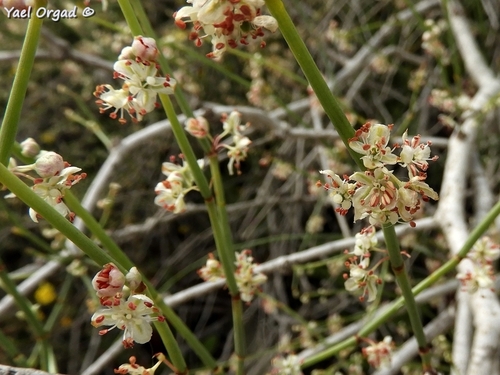
Rumex sagittatus
Thunb.
Rambling Dock, Climbing dock, Scrambling dock

(c) papillon79, some rights reserved (CC BY-NC)
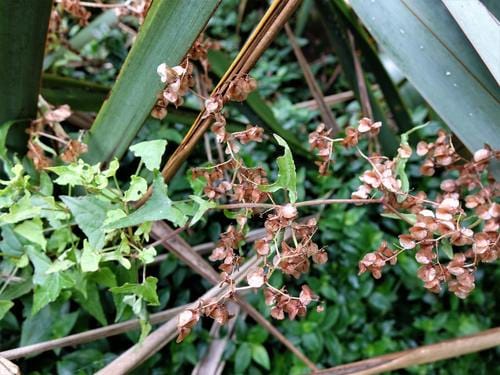
(c) Jacqui Geux, some rights reserved (CC BY)
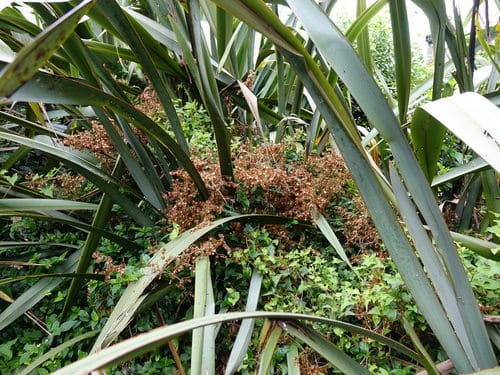
(c) Jacqui Geux, some rights reserved (CC BY)
What to Eat
Edible parts: Leaves
The leaves and young stems can be cooked and eaten and are sometimes cultivated as a vegetable in Java.
Where to Find It
It is a temperate plant. It grows in coastal districts. It will grow in most soils and positions. It is resistant to drought but sensitive to frost. In Zimbabwe it grows between 1,160-1,900 m above sea level.
Africa, Australia, Botswana, East Africa, Eswatini, Indonesia, Lesotho, Malawi, Mozambique, Namibia, New Zealand, SE Asia, South Africa*, Southern Africa, Swaziland, Tasmania, Zambia, Zimbabwe,
How to Identify
A creeper. It keeps growing from year to year. It grows 2 m high. The leaves are smooth and arrow-shaped. They are 3-7 cm long. They are pale green and soft. The flowers develop clusters of papery capsules. These are about 1 cm wide. They change from pale green to reddish-brown.
How to Grow
Plants can be grown from seed.
Wikipedia
Source ↗Rumex sagittatus, synonym Acetosa sagittata, commonly known as turkey rhubarb or rambling dock or potato vine, is a herbaceous perennial plant native to southern Africa, which has become a weed in Australia and New Zealand.
Notes
There are about 200 Rumex species.
Names & Synonyms
Potato vine, Simunyane, Soorengan, Surengan, Turkey Rhubarb
References (20)
- Bodkin, F., 1991, Encyclopedia Botanica. Cornstalk publishing, p 895
- Facciola, S., 1998, Cornucopia 2: a Source Book of Edible Plants. Kampong Publications, p 187
- Fox, F. W. & Young, M. E. N., 1982, Food from the Veld. Delta Books. p 308
- Guillarmod, J., 1966, 1971,
- Lazarides, M. & Hince, B., 1993, Handbook of Economic Plants of Australia, CSIRO. p 208
- Long, C., 2005, Swaziland's Flora - siSwati names and Uses http://www.sntc.org.sz/flora/
- Low, T., 1991, Wild Herbs of Australia and New Zealand. Angus & Robertson. p 107 (Drawing)
- Low, T., 1992, Bush Tucker. Australia’s Wild Food Harvest. Angus & Robertson. p 154
- Ochse, J. J. et al, 1931, Vegetables of the Dutch East Indies. Asher reprint. p 595
- Ogle & Grivetti, 1985,
- Peters, C. R., O'Brien, E. M., and Drummond, R.B., 1992, Edible Wild plants of Sub-saharan Africa. Kew. p 163
- Prodr. pl. cap. 67. 1794
- Romanowski, N., 2007, Edible Water Gardens. Hyland House. p 114
- Ruiters-Welcome, A. K., 2019, Food plants of southern Africa. Ph.D. thesis. Univ. of Johannesburg p 91
- Swaziland's Flora Database http://www.sntc.org.sz/flora
- Terra, G.J.A., 1973, Tropical Vegetables. Communication 54e Royal Tropical Institute, Amsterdam, p 70
- Tasmanian Herbarium Vascular Plants list p 45 (As Acetosa sagittata)
- van Wyk, Be., & Gericke, N., 2007, People's plants. A Guide to Useful Plants of Southern Africa. Briza. p 74
- Welcome, A. K. & Van Wyk, B.-E., 2019, An inventory and analysis of the food plants of southern Africa. South African Journal of Botany 122 (2019) 136–179
- World Checklist of Useful Plant Species 2020. Royal Botanic Gardens, Kew