Rumex sanguineus
L.
Red-veined dock, Bloodwort

(c) emmahanlon, some rights reserved (CC BY-NC)

(c) Zo Clark, some rights reserved (CC BY)
What to Eat
Edible parts: Leaves
Young leaves can be eaten raw or cooked as a spinach substitute. When young, the flavour is mild enough to use on their own as a cooked green or added in moderation to mixed salads. The leaves become bitter as they age.
Known Hazards
Where to Find It
It is a temperate plant. It is best in a sunny location. It suits hardiness zones 6-10. In Hobart Botanical gardens.
Africa, Asia, Australia, Britain, Canada, Europe, France, Ireland, Netherlands, North Africa, North America, Slovenia, Spain, Tasmania, USA,
How to Identify
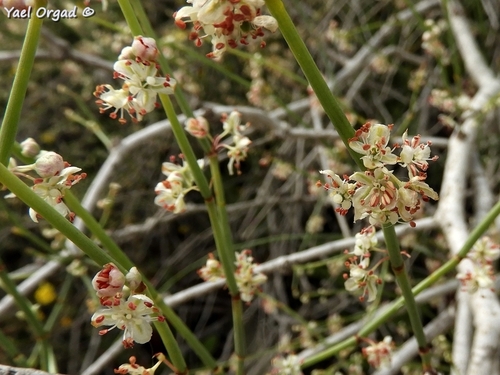
A clumping herb. It grows 50-100 cm high and spreads 30-90 cm wide. The stems are dark. The leaves are lance shaped. They are 15 cm long. The veins are red. The flowers are small and green on long stalks.
How to Grow
A very easily grown plant, succeeding in most soils and preferring a moist moderately fertile well-drained soil in a sunny position. Plants usually self-sow freely in the garden. Of some value in the flower border or kitchen garden for its ornamental edible leaves.
Propagation: Sow seed in spring directly in situ. Plants can also be propagated by division in spring.
Medicinal Uses
The root is astringent and an infusion is useful for treating bleeding. The root is harvested in early spring and dried for later use. A decoction made from the leaves is used to treat several skin diseases.
Other Uses
Dark green to brown and dark grey dyes can be obtained from the roots of plants in this genus without the need for a mordant.
Wikipedia
Source ↗Rumex sanguineus, commonly known as wood dock, bloody dock or red-veined dock, is a perennial flowering plant species in the family Polygonaceae. Rumex sanguineus is a dicot and can be observed in Europe with at least two varieties.
Notes
There are about 200 Rumex species.
Names & Synonyms
Krvava kislica
References (10)
- Cundall, P., (ed.), 2004, Gardening Australia: flora: the gardener's bible. ABC Books. p 1288
- Facciola, S., 1998, Cornucopia 2: a Source Book of Edible Plants. Kampong Publications, p 187
- Hedrick, U.P., 1919, (Ed.), Sturtevant's edible plants of the world. p 584
- Hibbert, M., 2002, The Aussie Plant Finder 2002, Florilegium. p 282
- http://www.botanic-gardens-ljubljana.com/en/plants
- Irving, M., 2009, The Forager Handbook, A Guide to the Edible Plants of Britain. Ebury Press p 180
- Plants for a Future database, The Field, Penpol, Lostwithiel, Cornwall, PL22 0NG, UK. http://www.scs.leeds.ac.uk/pfaf/
- Romanowski, N., 2007, Edible Water Gardens. Hyland House. p 113
- Ryan, S., 2008, Dicksonia. Rare Plants Manual. Hyland House. p 110
- Sp. pl. 1:334. 1753