Rumex vesicarius
L.
Ruby dock, Bladder Dock
(c) overlander (Gerald Krygsman), some rights reserved (CC BY-NC), uploaded by overlander (Gerald Krygsman)

(c) zebedeugalinha, some rights reserved (CC BY)

(c) zebedeugalinha, some rights reserved (CC BY)
What to Eat
Edible parts: Leaves, Vegetable, Fruit
The leaves can be eaten raw or cooked. They have an acid flavour and are used like sorrel — as a flavouring in salads or cooked as a spinach substitute.
Known Hazards
Where to Find It
It is a tropical and Mediterranean plant. It grows in arid regions. It occurs in Central Australia. It is cultivated in Java. In West Africa it grows in the Sahara. It grows in the Sahel. It suits hardiness zones 6-10.
Afghanistan, Africa, Algeria, Asia, Asia Minor, Australia, Bangladesh, East Africa, Egypt, Ethiopia, Europe, Greece, Himalayas, India, Indonesia, Iraq, Jordan, Kuwait, Libya, Malaysia, Mali, Mauritania, Mediterranean, Middle East, Morocco, Myanmar, Nepal, North Africa, Northeastern India, Pakistan, Qatar, Sahara, Sahel, Saudi Arabia, SE Asia, Somalia, Sudan, Tanzania, Tunisia, Turkey, Türkiye, United Arab Emirates, UAE, West Africa, Yemen,
How to Identify
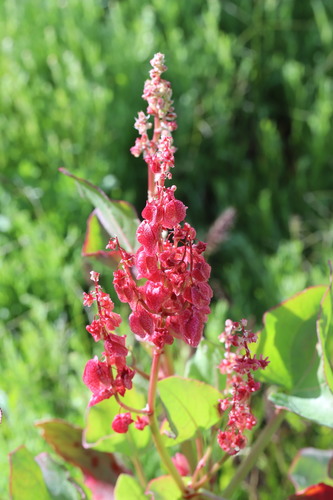
A shrub like plant. It is an annual plant. The stems are hollow up to about 75 cm high. The stems only occasionally branch. The leaves are broad and thick. They are like blunt arrowheads. The leaf stalks are about as long as the leaves. There are papery stipules at the base of the leaf stalk. The seed capsules occur on tall spikes and are papery red. The seed capsules have dark veins. The capsules are 1.5-2.5 cm long.
How to Grow
Succeeds in most soils, preferring a moist moderately fertile well-drained soil in a sunny position. Cultivated for its edible leaves in Indonesia and occasionally sold in local markets there.
Propagation: Sow seed in spring in a cold frame. Once seedlings are large enough to handle, prick them out into individual pots and plant them out during summer.
Medicinal Uses
The leaves are aperient, astringent, diuretic, and cooling. The seed is also cooling; it is roasted and used in the treatment of dysentery. The juice of the plant is cooling and useful for settling heat of the stomach, alleviating toothache pain, and checking nausea through its astringent properties.
Other Uses
No specific dye use has been recorded for this species, but roots of many plants in this genus are known to yield dark green to brown and dark grey dyes without the need for a mordant.
Wikipedia
Source ↗Rumex vesicarius, also known as ruby dock, rosy dock or bladder dock, is a species of perennial flowering plant in the family Polygonaceae. According to Plants of the World Online, Rumex vesicarius is native to tropical and temperate Asia, Africa, and Western Australia. However, the Council of Heads of Australasian Herbaria asserts that within Australia it is naturalised in Western Australia, the Northern Territory, South Australia, Queensland and New South Wales.
Other Information
The leaves are sold in markets. It is a cultivated food plant. It is useful in dry areas when other vegetables are scarce.
Notes
There are about 200 Rumex species.
Names & Synonyms
Aambadchuka, Ambari, Ambongteh, Anbongteh, Bhote palunge, Chooka, Chuka, Chukani bhaji, Chukka kura, Hamaimesah, Hambad, Hammad, Hommidha, Hummed, Jussi soppu, Kala-chin-baung-gyi, Katta mitha, Katta palak, Khatti tan, Palak, Palang sag, Pink dock, Rosy dock, Saluni, Shakkan kirai, Suka kora, Suka sak, Sukha sak, Sukki soppu, Takpalang, Tarweekai, Turkey rhubarb, Tershoka, Wild hops
References (48)
- Al-Qura'n, S. A., 2010, Ethnobotanical and Ecological Studies of Wild Edible Plants in Jordan. Libyan Agriculture Research Center Journal International 1(4):231-243
- Al-Sodany, Y. M., et al, 2013, Medicinal Plants in Saudi Arabia: I. Sarrwat Mountains at Taif, KSA. Academic Journal of Plant Sciences 6 (4): 134-145
- Ambasta S.P. (Ed.), 2000, The Useful Plants of India. CSIR India. p 535
- Arora, R. K., 2014, Diversity in Underutilized Plant Species - An Asia-Pacific Perspective. Bioversity International. p 45
- BARC, 2016, State of Biodiversity for Food and Agriculture in Bangladesh. Bangladesh Agricultural Research Council.
- Ben Ismail, H., 2013, Edible Wild Vegetables Used in North West of Tunisia. PARIPEX - Indian Journal of Reearch 2(9) :219-221
- Bidak, L. M., et al, 2015, Goods and services provided by native plants in desert ecosystems: Examples from the northwestern coastal desert of Egypt. Global Ecology and Conservation 3 (2015) 433–447
- Burkill, H. M., 1985, The useful plants of west tropical Africa, Vol. 4. Kew.
- Burkill, I.H., 1966, A Dictionary of the Economic Products of the Malay Peninsula. Ministry of Agriculture and Cooperatives, Kuala Lumpur, Malaysia. Vol 2 (I-Z) p 1954
- Cundall, P., (ed.), 2004, Gardening Australia: flora: the gardener's bible. ABC Books. p 1288
- Facciola, S., 1998, Cornucopia 2: a Source Book of Edible Plants. Kampong Publications, p 187
- FAO, 1988, Traditional Food Plants, FAO Food and Nutrition Paper 42. FAO Rome p 431
- Flora of Pakistan. www.eFloras.org
- Gangte, H. E., et al, 2013, Wild Edible Plants used by the Zou Tribe in Manipur, India. International Journal of Scientific and Research Publications, Volume 3, Issue 5
- Grubben, G. J. H. and Denton, O. A. (eds), 2004, Plant Resources of Tropical Africa 2. Vegetables. PROTA, Wageningen, Netherlands. p 452
- Guite, C., 2016, Study of wild edible plants associated with the Paite Tribe of Manipur, India. International Journal of Current Research. Vol. 8, Issue 11, pp. 40927-40932
- Hedrick, U.P., 1919, (Ed.), Sturtevant's edible plants of the world. p 585
- HOOPER,
- Hussey, B.M.J., Keighery, G.J., Cousens, R.D., Dodd, J., Lloyd, S.G., 1997, Western Weeds. A guide to the weeds of Western Australia. Plant Protection Society of Western Australia. p 202
- Jardin, C., 1970, List of Foods Used In Africa, FAO Nutrition Information Document Series No 2.p 98
- Joshi, N., et al, 2007, Traditional neglected vegetables of Nepal: Their sustainable utilization for meeting human needs. Tropentag 2007. Conference on International Agricultural Research for Development.
- Khalid, N., et al, 2023, Wild food plants gathered by four cultural groups in North Waziristan, Pakistan. Genet Resour Crop Evol. 70:1243–1276
- Kiran, K. C., et al, 2019, Diversity and Seasonal Availability of Potential Wild Edible Plants from Vidarbha Region of Maharashtra State, India. Int.J.Curr.Microbiol.App.Sci (2019) 8(2): 1434-1446
- Kuhnlein, H. V., et al, 2009, Indigenous Peoples' food systems. FAO Rome p 193
- Lamp, C & Collet F., 1989, Field Guide to Weeds in Australia. Inkata Press. p 249
- Lazarides, M. & Hince, B., 1993, Handbook of Economic Plants of Australia, CSIRO. p 208
- Low, T., 1991, Wild Herbs of Australia and New Zealand. Angus & Robertson. p 42 (Drawing)
- Low, T., 1992, Bush Tucker. Australia’s Wild Food Harvest. Angus & Robertson. p 152
- Mahklouf, M. H., 2019, Ethnobotanical Study of Edible Wild Plants in Libya. European Journal of Ecology. 5(2): 30-40
- Mandaville, J. P., 2004, Bedouin ethnobotany: Plant concepts and plant use in a desert pastoral world. PhD thesis University of Arizona. p 155
- Martin, F.W. & Ruberte, R.M., 1979, Edible Leaves of the Tropics. Antillian College Press, Mayaguez, Puerto Rico. p 214
- Medhi, P. & Borthakur, S. K., 2012, Phytoresources from North Cachur Hills of Assam -3: Edible plants sold at Hflong market. Indian Journal or Natural Products and Resources. 3(1) pp 84-109
- Morley, B.D., & Toelken, H.R., (Eds), 1983, Flowering Plants in Australia. Rigby. p 85
- Nassif, F., & Tanji, A., 2013, Gathered food plants in Morocco: The long forgotten species in Ethnobotanical Research. Life Science Leaflets 3:17-54
- Ochse, J. J. et al, 1931, Vegetables of the Dutch East Indies. Asher reprint. p 595
- Plants for a Future database, The Field, Penpol, Lostwithiel, Cornwall, PL22 0NG, UK. http://www.scs.leeds.ac.uk/pfaf/
- Rivera, D. et al, 2006, Gathered Mediterranean Food Plants - Ethnobotanical Investigations and Historical Development, in Heinrich M, Müller WE, Galli C (eds): Local Mediterranean Food Plants and Nutraceuticals. Forum Nutr. Basel, Karger, 2006, vol 59, pp 18–74
- Shah, G.L., 1984, Some economically important plant of Salsette Island near Bombay. J. Econ. Tax. Bot. Vol. 5 No. 4 pp 753-765
- Shaheen, N., et al, 2013, Food Composition Table for Bangladesh. University of Daka. p 33
- Sharma, B.B., 2005, Growing fruits and vegetables. Publications Division. Ministry of Information and broadcasting. India. p 198
- Sp. pl. 1:336. 1753
- Steenbeeke, Greg as part of the Plants Directory project. List of plant species from northern NSW that may be used as food plants p 2 (As Acetosa vesicaria)
- Tareen, N. M., et al, 2016, Ethnomedicinal Utilization of Wild Edible Vegetables in District Harnai of Balochistan Province - Pakistan. Pakistan Journal of Botany 48(3): 1159-1171
- Terra, G.J.A., 1973, Tropical Vegetables. Communication 54e Royal Tropical Institute, Amsterdam, p 70
- USDA, ARS, National Genetic Resources Program. Germplasm Resources Information Network - (GRIN). [Online Database] National Germplasm Resources Laboratory, Beltsville, Maryland. Available: www.ars-grin.gov/cgi-bin/npgs/html/econ.pl (10 April 2000)
- Wiersema, J. H. & Leon, B., 2013, World Economic Plants. A Standard Reference CRC Press. 2nd Ed. p 602
- World Checklist of Useful Plant Species 2020. Royal Botanic Gardens, Kew
- Zeven, A. C. & de West, J. M. J., 1982, Dictionary of cultivated plants and their regions of diversity. Wageningen. p 78