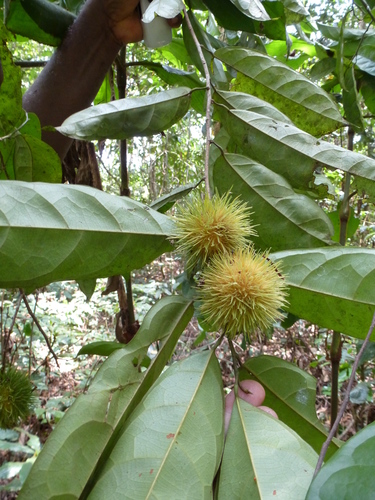
Ryparosa multinervosa
Sloot.
AchariaceaeFruit

gbif · cc-by
Royal Botanic Gardens, Kew
Royal Botanic Gardens, Kew
What to Eat
Edible parts: Fruit
The fruit is sour but edible.
Where to Find It
A tropical plant.
Asia, Malaysia, SE Asia,
Countries: United Arab Emirates, Afghanistan, Armenia, Azerbaijan, Bangladesh, Bahrain, Brunei, Bhutan, China, Georgia, Indonesia, Israel, India, Iraq, Iran, Jordan, Japan, Kyrgyzstan, Cambodia, North Korea, South Korea, Kuwait, Kazakhstan, Laos, Lebanon, Sri Lanka, Myanmar, Mongolia, Maldives, Malaysia, Nepal, Oman, Philippines, Pakistan, Qatar, Saudi Arabia, Singapore, Syria, Thailand, Tajikistan, Timor-Leste, Turkmenistan, Turkey, Taiwan, Uzbekistan, Vietnam, Yemen
How to Identify
A tree. It grows 10-23 m high. Sometimes it has buttresses. The bark is smooth. Young growth is finely hairy but this disappears quickly. The leaves are oblong and can taper towards the tip. They can be rounded at the base. They are shiny and green-brown on top but dull and pale underneath. There are hairs underneath especially near the midrib. The leaves are 20-32 cm long by 9-14 cm wide. The leaf stalk has rusty hairs which fall off. The male flower stalks can be 20-30 cm long. The fruit is round and flattened. It can have brown hairs which come off.
Notes
Also put in the Flacourtiaceae family.
Names & Synonyms
Pehapan ruai
References (3)
- Milow, P., et al, 2013, Malaysian species of plants with edible fruits or seeds and their evaluation. International Journal of Fruit Science. 14:1, 1-27
- Sleumer, H., 1954, Flacourtiaceae in Flora Malesiana, Ser 1 Vol 5(1) p 44
- World Checklist of Useful Plant Species 2020. Royal Botanic Gardens, Kew