Sabal minor
(Jacq.) Persoon
Dwarf Palmetto, Scrub Palmetto

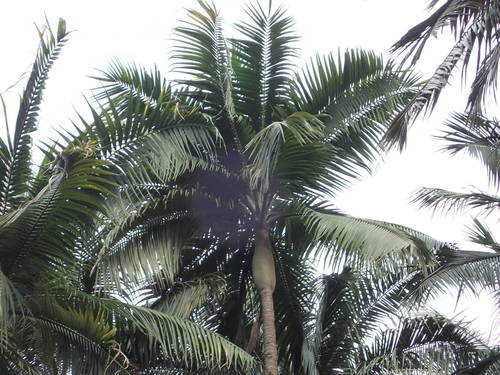
(c) Larry D. Moore, some rights reserved (CC BY)
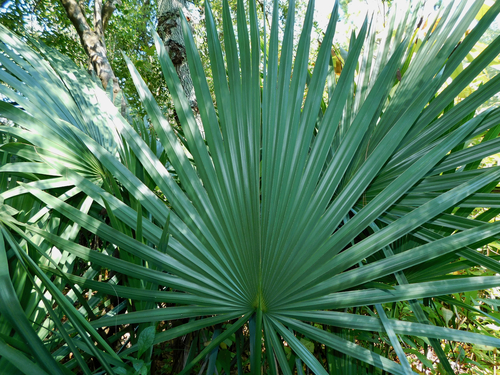
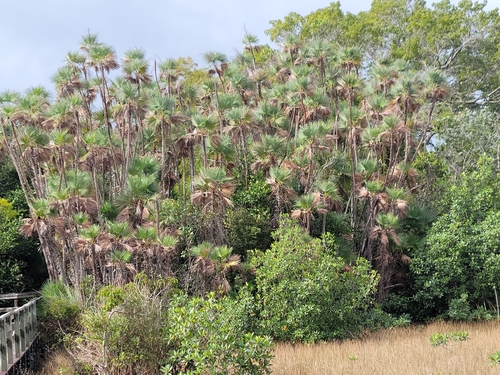
(c) Michael J. Papay, some rights reserved (CC BY), uploaded by Michael J. Papay
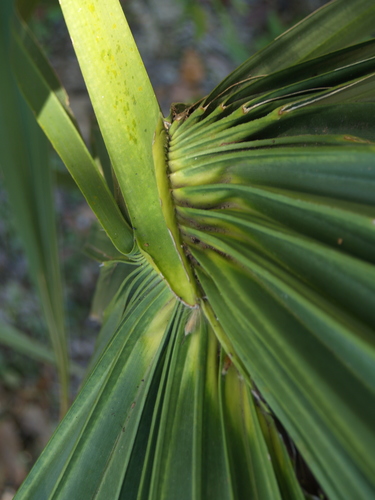
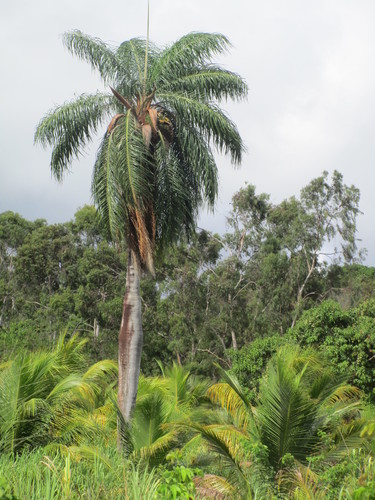
(c) Carlos G Velazco-Macias, some rights reserved (CC BY-NC), uploaded by Carlos G Velazco-Macias
What to Eat
Edible parts: Fruit, Leaves, Root, Sap, Palm hearts, Starch
Fresh root slices have been baked and eaten as bread. The fruit is a small dry berry up to 10mm in diameter with a thin sweet flesh. The following uses recorded for the related S. palmetto very probably apply here as well. Fruit can be eaten raw or cooked — sweet and pleasant, it is described as a nourishing food though said to be an acquired taste; S. palmetto fruit is up to 12mm in diameter with a thin sweet flesh. Young leaves can be eaten raw or cooked and are considered an excellent food. The large succulent leaf buds are cooked and eaten as a vegetable. The sap is sweet.
Where to Find It
It will grow from the tropics to the temperate zones. It can stand very low temperatures. It grows in swamps in the Southern USA. It grows in undergrowth in evergreen and deciduous forests at low elevations. It suits hardiness zones 8-11.
Africa, Asia, Australia, East Africa, Guam, India, Indonesia, North America, Pakistan, SE Asia, Singapore, USA*, Zimbabwe,
How to Identify
A small palm. The trunk is underground. Some plants can have a trunk 1-2 m high. The trunk can be 25-30 cm across. The leaf stalk extends into the blade. The leaf stalk is strong and the leaves are held upright. The leaf blade may be split into 2 halves. The leaves are blue green. The flowering bunch is also upright but arches over and extends beyond the leaves. The flowers are small and white and have a scent. The fruit are about 1 cm across. They are black when ripe.
How to Grow
Plants can be grown from seeds.
Propagation: Sow seed as soon as ripe in a warm greenhouse at no less than 24°C — stored seed is very slow to germinate. Pre-soaking seed for 24 hours in warm water before sowing may reduce germination time. Plants form a long tap-root before producing a shoot. Fresh seed typically germinates in 3–4 months at 25°C. Prick seedlings out into individual pots once large enough to handle and grow on in the greenhouse for at least their first two winters. Plant out in late spring or early summer after the last expected frosts, and consider providing cold protection through at least the first winter outdoors.
Medicinal Uses
The juice of the crushed small root has been rubbed into sore eyes as a counterirritant. A decoction of the dried root has been taken to treat high blood pressure and kidney problems.
Other Uses
The dried leaves are used occasionally to thatch the roofs of huts. The following uses are recorded for S. palmetto and very probably apply here as well. An excellent fibre is obtained from the leaf stalks — the finest quality from young leaf stalks still in the bud, with coarser material from older leaves or the bases of old leaf stalks surrounding the bud. Fibres are up to 50cm long and are harvested commercially to make brushes, especially those required to remain stiff in hot water or caustics. Pieces of the spongy bark of the stem are used as a substitute for scrubbing brushes. The leaves are woven into coarse hats, mats, and baskets. The roots contain about 10% tannin, which has been commercially harvested in the past, though the yield is not considered sufficient for profitable extraction. The wood is light and soft; trunks are used for wharf piles, polished cross-sections have been used as small table tops, and the wood is also largely manufactured into canes.
Wikipedia
Source ↗Sabal minor, commonly known as the dwarf palmetto, is a small species of palm. It is native to the deep southeastern and south-central United States and northeastern Mexico. It is naturally found in a diversity of habitats, including maritime forests, swamps, floodplains, and occasionally on drier sites. It is often found growing in calcareous marl soil. Sabal minor is one of the most frost and cold tolerant among North American palms.
Production
It grows very slowly in temperate countries. Plants usually flower while quite young.
Notes
There are 16 Sabal species. They can hybridise with each other.
Names & Synonyms
Blue Palmetto, Bush palmetto, Lanatier, Palem sabal mini, Swamp Palmetto
References (21)
- Ambasta S.P. (Ed.), 2000, The Useful Plants of India. CSIR India. p 536
- Balick, M.J. and Beck, H.T., (Ed.), 1990, Useful palms of the World. A Synoptic Bibliography. Colombia p 583,
- Blomberry, A. & Rodd, T., 1982, Palms. An informative practical guide. Angus & Robertson. p 164
- Brickell, C. (Ed.), 1999, The Royal Horticultural Society A-Z Encyclopedia of Garden Plants. Convent Garden Books. p 920
- Bull. Sci. Soc. Philom. Paris 3(87):205-206, t. 25. 1804 (As Sabal adansonii)
- Cundall, P., (ed.), 2004, Gardening Australia: flora: the gardener's bible. ABC Books. p 1292
- Facciola, S., 1998, Cornucopia 2: a Source Book of Edible Plants. Kampong Publications, p 31
- Flora of Pakistan. www.eFloras.org
- Gibbons, M., 1993, Palms. Compact study Guide and Identifier. Sandstone. p 71
- Gibbons, M., 2003, A pocket guide to Palms. Chartwell Books. p 193
- Hedrick, U.P., 1919, (Ed.), Sturtevant's edible plants of the world. p 585 (As Sabal adansonii)
- Henderson, A., Galeano, G and Bernal, R., 1995, Field Guide to the Palms of the Americas. Princeton. p 66
- Hibbert, M., 2002, The Aussie Plant Finder 2002, Florilegium. p 282
- Jones, D.L., 1994, Palms throughout the World. Smithtonian Institution, Washington. p 51, 348
- Kermath, B. M., et al, 2014, Food Plants in the Americas: A survey of the domesticated, cultivated and wild plants used for Human food in North, Central and South America and the Caribbean. On line draft. p 771
- Moerman, D. F., 2010, Native American Ethnobotany. Timber Press. p 499
- Plants for a Future database, The Field, Penpol, Lostwithiel, Cornwall, PL22 0NG, UK. http://www.scs.leeds.ac.uk/pfaf/
- Recher, P, 2001, Fruit Spirit Botanical Gardens Plant Index. www.nrg.com.au/~recher/ seedlist.html p 7
- Riffle, R.L. & Craft, P., 2003, An Encyclopedia of Cultivated Palms. Timber Press. p 447
- Sukarya, D. G., (Ed.) 2013, 3,500 Plant Species of the Botanic Gardens of Indonesia. LIPI p 816
- Syn. pl. 1:399. 1805