Salacca affinis
Griff.
Linsum palm, Snake palm, Red salak

(c) hutan90, some rights reserved (CC BY-NC), uploaded by hutan90

Wikimedia Commons - Naturalis Biodiversity Center
What to Eat
Edible parts: Fruit, Cabbage
Salacca affinis is rarely cultivated outside of its native range. Since its spines discourage its cultivation in parks and gardens, it is rarely found in cultivation outside of botanical gardens. Cultivation for fruit is limited as those of Salacca zalacca are superior, although it is sometimes gathered locally and sold in markets.
Where to Find It
A tropical plant. It grows in shady forests. It grows in lowland and monsoonal rainforests and swamps.
Asia, Australia, Brunei, Indonesia*, Malaysia, SE Asia, Singapore,
How to Identify
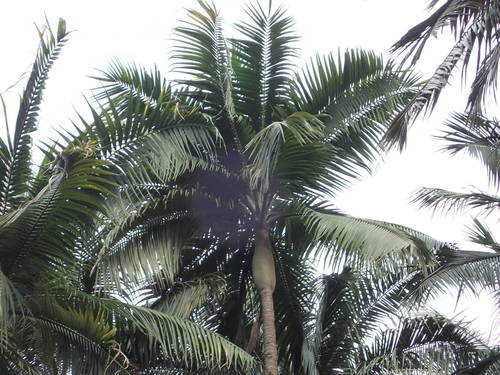
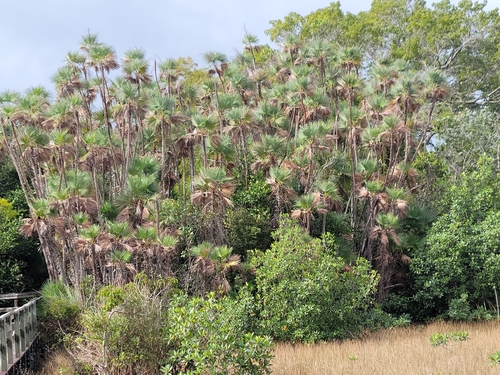
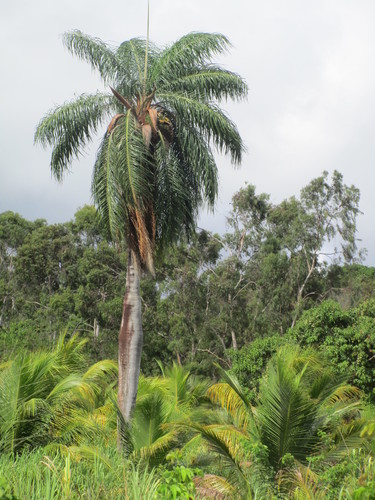
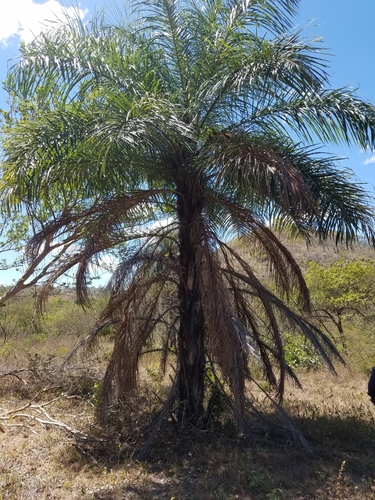
A prickly clumping palm. Most parts have spines. These are 3-6 cm long. The stems are underground. Leaves are about 2.5-4 m long. They are held erect. They grow in rings from short trunks which lie along the ground. The leaflets are smooth and broad. They are 45 cm long by 10 cm wide. They occur in clusters of 2-4 on each side of the stalk. They are held in one plane. The fruit are 4 cm long and scaly. They have a sweet edible pulp. They have a short nipple like tip.
How to Grow
Plants can be grown from seeds.
Wikipedia
Source ↗Salacca affinis, also known as red salak, red snakefruit salak, red snakefruit, buah ridan salak, buah ridan, linsum, salak hutan, buah manau, kelubi, buah rotan, and ridan, is a flowering shrub in the family Arecaceae. The specific epithet (affinis) comes from Latin "ad finis", meaning "at the boundary", and refers to its resemblance with the congener species Salacca zalacca.
Production
Male and female plants are essential for fertile seed production.
Notes
There are about 18-24 Salacca species. They occur in SE Asia.
Names & Synonyms
Ridan, Salak hutan, Salak linsum, Salak merah
References (13)
- Burkill, I.H., 1966, A Dictionary of the Economic Products of the Malay Peninsula. Ministry of Agriculture and Cooperatives, Kuala Lumpur, Malaysia. Vol 2 (I-Z) p 2324 (As Salacca affinis)
- Chai, P. P. K. (Ed), et al, 2000, A checklist of Flora, Fauna, Food and Medicinal Plants. Lanjak Entimau Wildlife Sanctuary, Sarawak. Forestry Malaysia & ITTO. p 164, 169
- Haynes, J., & McLaughlin, J., 2000, Edible palms and Their Uses. University of Florida Fact sheet MCDE-00-50-1 p 12
- Hedrick, U.P., 1919, (Ed.), Sturtevant's edible plants of the world. p 691 (As Zalacca affinis)
- Johnson, D.V., 1998, Tropical palms. Non-wood Forest products 10. FAO Rome. p 19, 48
- Jones, D.L., 1994, Palms throughout the World. Smithtonian Institution, Washington. p 54, 351
- Milow, P., et al, 2013, Malaysian species of plants with edible fruits or seeds and their evaluation. International Journal of Fruit Science. 14:1, 1-27
- PROSEA No. 2
- Riffle, R.L. & Craft, P., 2003, An Encyclopedia of Cultivated Palms. Timber Press. p 449
- Shaffiq, A. M., A., et al, 2013, Marketable wild fruits of Sarawak, Borneo: Their mode of consumption, uses and sugar profiles. Indian Journal of Traditional Knowledge. Vol 12(2): 195-201
- Soepadmo, E., 1998, Plants. The Encyclopedia of Malaysia. Archipelago press. p 54
- Sukarya, D. G., (Ed.) 2013, 3,500 Plant Species of the Botanic Gardens of Indonesia. LIPI p 817
- World Checklist of Useful Plant Species 2020. Royal Botanic Gardens, Kew