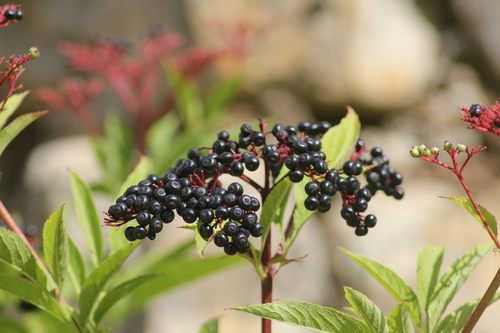
Sambucus callicarpa
Greene
Red coast elder, Pacific Red Elder

Wikimedia Commons

Wikimedia Commons - Douglas Goldman
What to Eat
Edible parts: Flowers, Fruit
The flowers and fruit are edible, used for jellies, pies, and wine.
Known Hazards
Dangerous Lookalikes
This plant can be confused with the following toxic species. Always verify identification carefully before consuming any wild plant.


Pokeweed: Thick red/purple herbaceous stems (no bark), berries in a line (raceme), simple large leaves, large white taproot.
Red coast elder: Woody bark, berries in broad flat clusters (cymes), compound leaves with 5-7 leaflets.
Where to Find It
It is a temperate plant. They occur in low lying damp areas.
Britain, Canada, Europe, North America, USA,
How to Identify
A shrub or small tree. They grow to 1.5-4 m high. The leaves have 5-7 leaflets. Each leaflet is 6-16 cm long. They are sword shaped and with sharp teeth. They are hairy along the veins. The flowers are yellowish-white. The flowers are star shaped and fragrant. They are in rounded clusters which are 10 cm across. The berries are purple black or red and 4-6 mm across.
Notes
There are about 25 Sambucus species. Also put in the family Sambucaceae.
References (3)
- Farrar, J.L., 1995, Trees of the Northern United States and Canada. Iowa State University press/Ames p 175
- Fl. Franciscana 3:342. 1892
- Plants for a Future database, The Field, Penpol, Lostwithiel, Cornwall, PL22 0NG, UK. http://www.scs.leeds.ac.uk/pfaf/